Why Native Trees Outperform in North Florida
A native tree in a North Florida yard has spent thousands of years adapting to exactly the conditions you're asking it to grow in: acidic, well-draining sandy soils (in most of Leon County), high summer rainfall with a dry spring, humidity, and the local insect and disease pressures specific to this region.
Non-native ornamental trees can work, but they often require more inputs (irrigation, fertilization, disease management) to perform well. Natives generally need less once established.
There's also the wildlife angle: native trees support far more insects, birds, and other wildlife than exotic species. A water oak or live oak supports hundreds of species of insects and birds. An ornamental cherry supports almost none. For most Tallahassee homeowners, this matters.
Here are the best performers.
Live Oak (Quercus virginiana)
The signature tree of North Florida. Live oaks are evergreen, long-lived (200+ years in the right location), and among the most wind-resistant trees in the region. A mature live oak with a broad, spreading canopy is one of the most aesthetically impressive trees you can have on a property.
What you need to know:
- Slow to moderate growth; fast-growing to 40–60 feet with a spread that can exceed 100 feet at maturity
- Protected by Tallahassee's tree ordinance once established, factor this into placement decisions
- Needs space; not appropriate for small lots or close to structures
- Requires maintenance pruning as it matures, deadwood removal, clearance pruning
Best for: Large yards, rural properties, streetside planting with enough clearance.
Southern Red Oak (Quercus falcata)
Faster-growing than live oak with a more conventional deciduous growth habit. Southern red oak provides excellent shade and has excellent fall color (uncommon in Tallahassee's mild climate). Better suited to large lots with room for the spreading canopy.
Unlike water oak, southern red oak tends to be longer-lived and structurally more sound in residential settings. Worth considering as a "big shade tree" option where you want deciduous character and significant canopy.
Longleaf Pine (Pinus palustris)
Longleaf pine is North Florida's ecological keystone species, historically the dominant tree over millions of acres of the region that have been converted to other land uses. For property owners with drier, sandier soils, longleaf is one of the best choices for a large native tree.
What you need to know:
- Slow early growth (the "grass stage" for the first few years while root system develops), then accelerates
- Long-lived, drought-tolerant once established
- Provides critical habitat for red-cockaded woodpeckers and many other native species
- Can reach 80+ feet; appropriate spacing from structures is important
Not appropriate for: Wet soils or poor-draining areas.
Sweetbay Magnolia (Magnolia virginiana)
The native magnolia for wetter sites. Sweetbay is semi-evergreen (holds leaves through mild winters), has fragrant white flowers, and tolerates (actually prefers) moist to wet soil conditions where many trees struggle.
Much better behaved than its cousin, southern magnolia (Magnolia grandiflora), which drops thick, decomposition-resistant leaves that smother understory plants. Sweetbay grows 10–35 feet and is appropriate as a medium-sized tree in yards with moist areas or near water features.
Southern Magnolia (Magnolia grandiflora)
Yes, the leaf litter is a maintenance issue. Yes, the trees are stunning, large, glossy evergreen leaves, enormous fragrant white flowers, and a presence that no other tree quite matches.
Southern magnolia is native to North Florida and genuinely worth planting if you're willing to deal with the leaf drop. Don't plant it where leaves will fall into gutters or pool filters. In an open lawn area with room for the full canopy to develop, it's one of the best trees in North Florida.
Size: 60–80 feet tall, 30–50 feet wide at maturity. This is a large tree, plan accordingly.
Florida Maple (Acer saccharum subsp. floridanum)
North Florida's native maple, more heat-tolerant than sugar maple and adapted to the region's conditions. Florida maple provides shade and the best fall color of any common North Florida tree, reds and oranges that don't look like what you'd expect in a warm climate. Grows 40–60 feet.
Note: Florida maple prefers well-drained to moderately moist soils and doesn't tolerate standing water. It also tends to be slower-growing than oaks.
American Beautyberry (Callicarpa americana). Large Shrub/Small Tree
Technically more shrub than tree, but beautyberry deserves mention for any landscape discussion in North Florida. It's native, low-maintenance, drought-tolerant once established, and produces spectacular clusters of vivid purple-magenta berries in fall that are among the showiest features any North Florida yard can have. Grows 4–8 feet; can be pruned to a small multi-stem tree form.
Bald Cypress (Taxodium distichum)
One of the most striking trees in North Florida and perfectly suited to wet or poorly drained sites. Bald cypress tolerates flooding (it grows in standing water along Florida's swamps and rivers), but also grows well in normal yard conditions. Fall color is coppery-brown. Long-lived.
What you need to know:
- "Knees" (woody root projections) can emerge in very wet sites and are difficult to mow around
- Grows 60–100+ feet; this is a large tree
- Drought-tolerant once established despite the swamp association
What to Avoid
A few common choices that create long-term problems in Tallahassee yards:
Bradford/Callery pear: Invasive, structurally weak (major limb failures are nearly universal), short-lived. The street trees are coming down across the Southeast. Don't plant one.
Mimosa (Albizia julibrissin): Invasive, seeds prolifically, short-lived. Pretty flowers, but the cons outweigh the pros.
Chinese tallow: Invasive and prohibited in Florida. Don't plant it.
Water oak: Native but genuinely problematic close to structures, fast-growing, relatively brittle, shorter-lived than other oaks. Fine in a large yard with space; poor choice planted 15 feet from the house.
We Do Tree Planting
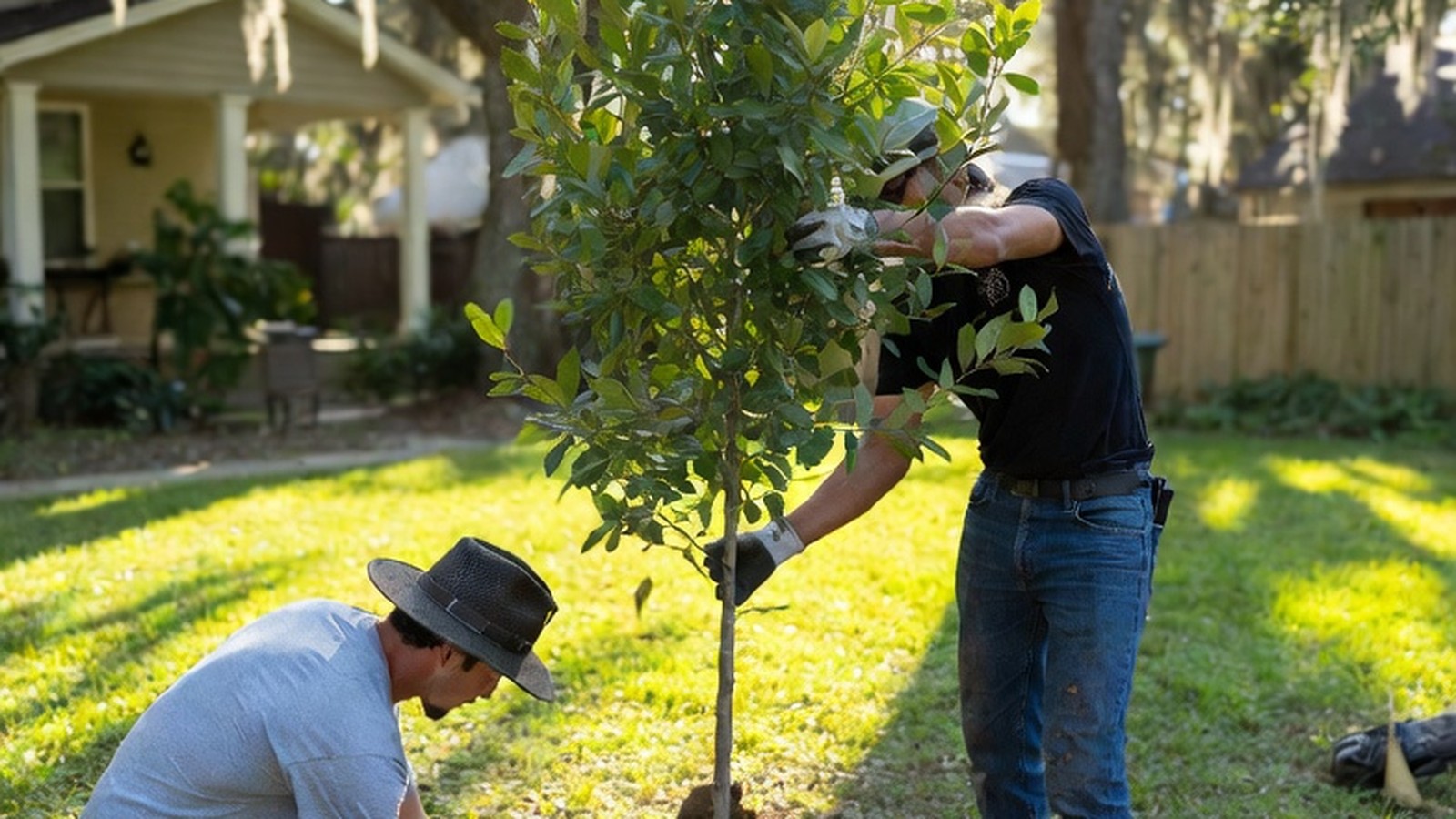
We plant trees throughout Tallahassee and North Florida as part of our service offerings. If you're replacing a removed tree or starting fresh on a new property, we can advise on species selection and get the tree properly planted with the right depth and root ball treatment.
Call (850) 570-4074 or request an estimate online for tree planting, assessment, or advice on species selection for your North Florida property.