What Are Co-Dominant Stems?
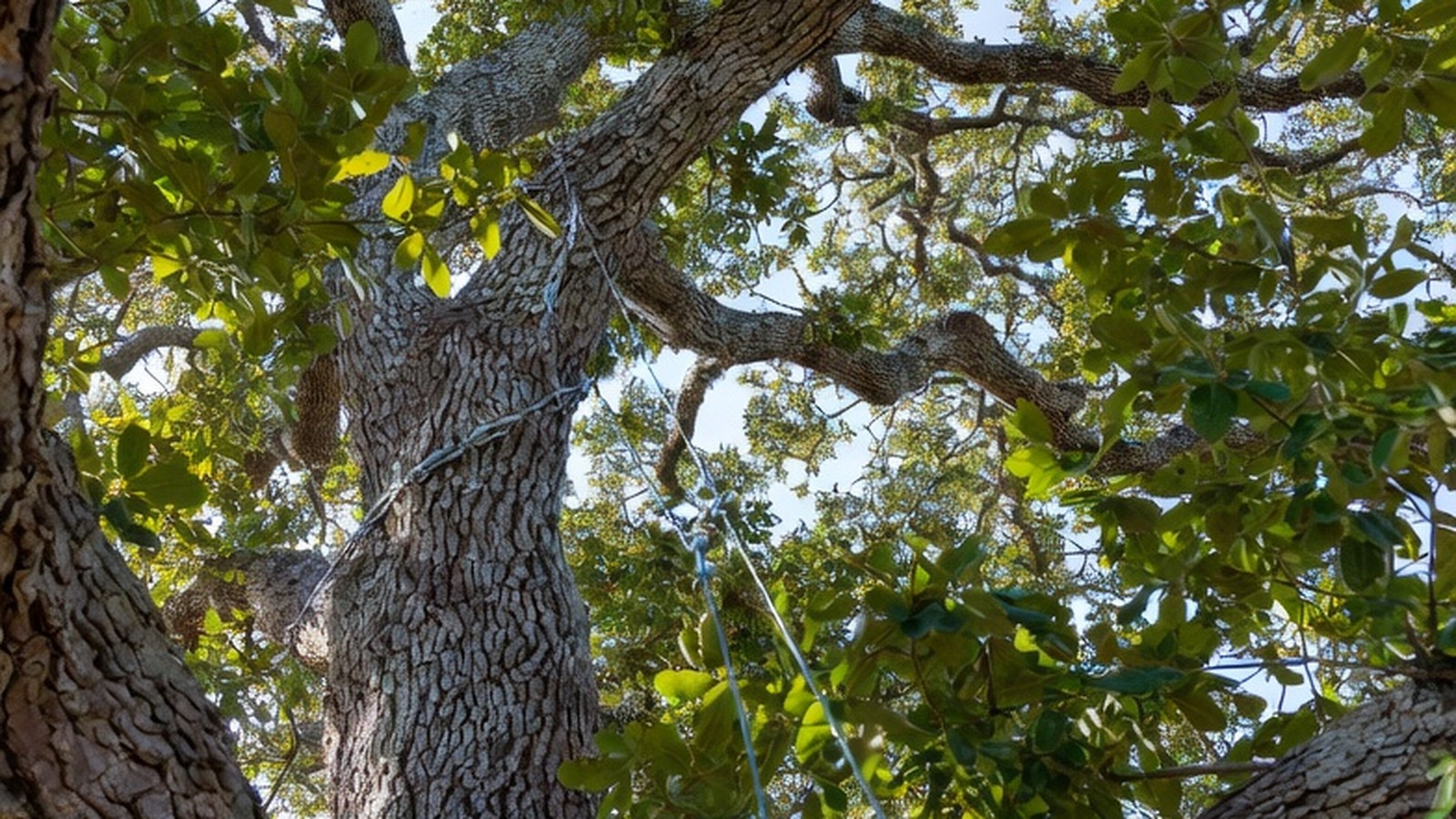
A co-dominant stem is what forms when a tree develops two (or more) stems of roughly equal size from a common point. Instead of one dominant central leader with subordinate branches, the tree forks into two competing trunks that grow side by side.
This is common. Many trees develop co-dominant structure naturally, oaks, maples, and water oaks in particular. The problem isn't the fork itself, but what forms in the crevice between the stems over time.
The Included Bark Problem
Where two co-dominant stems meet, bark can become trapped between them. As both stems grow larger, they press inward against each other instead of forming a strong wood-to-wood union. The bark can't fuse, it just gets compressed between the two expanding trunks.
This creates included bark: a wedge of bark embedded in the crotch between the stems. Included bark dramatically weakens the attachment point because:
- Wood doesn't bond across included bark: the union is bark against bark, not wood against wood
- The wedge shape means the stems are being forced outward as they grow
- The included bark can trap moisture and accelerate decay
- Under load (wind, ice, wet leaves), the attachment is far weaker than it appears from the outside
The joint can look solid while hiding significant structural weakness. Trees with included bark often fail at the co-dominant crotch with no advance warning.
How to Identify Co-Dominant Stems and Included Bark
Look at the crotch angle: Narrow, tight V-shaped crotches between two large stems are more likely to have included bark than wider U-shaped crotches. A U-shaped union typically indicates a strong wood-to-wood collar formed properly; a V-shape is a warning sign.
Look for bark running into the crotch: In a good union, bark at the crotch turns and forms a ridge above the meeting point (a "branch bark ridge"). In included bark, bark runs straight down into the crevice.
Check for cracking: Existing cracks or splits starting at the crotch and running down one or both stems indicate the joint is already failing under load.
Look for dieback in one stem: If one of the co-dominant stems is declining or dead while the other is healthy, the attachment has often been compromised.
What Can Be Done
Cabling: For co-dominant stems you want to keep, installing high-strength cable between the stems limits how far apart they can spread in high winds. Cabling doesn't fix the weak union, it manages the risk. This is a job for a trained arborist; cables must be correctly placed and sized.
Crown weight reduction: Reducing the weight of canopy on one or both co-dominant stems reduces the load on the weak attachment point.
Removal of one stem: If one stem is significantly more hazardous or the tree is positioned to threaten a structure, removing the problematic stem may be the most practical option.
Full tree removal: If the tree is large, positioned to cause serious damage, and the co-dominant union is severely compromised, removal may be the right call.
North Florida Context
Live oaks and water oaks in North Florida commonly develop co-dominant structure. A mature live oak with a tight V-crotch and a 24-inch stem on each side, positioned over a house or driveway, deserves professional evaluation. These trees look healthy and are often healthy, but the structural attachment at the fork can be the weak point that fails in a storm.
If you have trees with this structure and they're positioned over targets you care about, professional assessment is worth scheduling before storm season.
Questions about co-dominant stems or tree structural risk? Call (850) 570-4074 or request a consultation online.