Most tree removals don't require a crane. A crew with a climber, a bucket truck, and a chipper can handle the majority of jobs you'll encounter in a typical Tallahassee neighborhood. But some trees can't come down the standard way, and when that's the case, a crane is the difference between a controlled removal and a serious mistake.
Crane removals cost more. Understanding why, and what you're paying for, makes the price easier to evaluate when you get a quote.
What Crane Tree Removal Costs in Tallahassee
Crane removal in Tallahassee and North Florida runs $1,500 to $6,000 or more for a single tree. The wide range reflects real variation in job complexity.
Get a free crane removal estimate: Call or text (850) 570-4074.
A straightforward crane job, meaning a large but accessible tree with a clear drop zone and no structure risk, will typically fall in the $1,500 to $3,000 range. A large live oak over a roofline in a tight Tallahassee neighborhood, where every section has to be lifted and swung to a landing zone 40 feet away, can push $4,000 to $6,000 or beyond depending on the tree's size and the site conditions.
The crane itself is expensive to mobilize. The operator is a separate specialist. The rigging crew is larger than a standard removal crew. And the job takes longer because every section has to be rigged, lifted, swung, and set down rather than dropped. That combination drives the cost higher than standard removals, which typically run $600 to $2,000 for similar-sized trees in accessible locations.
| Removal Type | Typical Cost Range | When Used |
|---|---|---|
| Standard climbing crew | $400–$2,000 | Open yard, safe drop zone available |
| Crane-assisted removal | $1,500–$6,000+ | Over structures, no drop zone, tight access |
| Emergency crane removal | Add $500–$1,500 | Same-day response, after hours |
When a Crane Is Actually Required
Not every large tree needs a crane. The decision comes down to the site, not just the size.
The tree is over or directly adjacent to a structure. This is the most common reason for crane work in Tallahassee. A live oak with branches spreading over a roof, a large pine leaning toward an HVAC unit, a water oak that can't be sectioned from above without dropping wood onto a screened enclosure. When the normal drop zones are occupied by something that can't be damaged, a crane holds the section while it's cut, then swings it clear.
No ground access for equipment. Standard aerial equipment (bucket trucks, aerial lifts) needs a path to get near the tree. A fenced backyard with a 4-foot gate, saturated or soft ground that won't support a heavy truck, a hillside that makes positioning unsafe: in any of these situations, a crane set up on a street or driveway can reach over obstacles to get where ground equipment can't go.
The tree is severely storm-damaged. A split or partially uprooted tree can shift unpredictably when sections are cut. Rigging the crane to hold the load before the cut gives the crew control over where the wood goes when it breaks free. This matters especially for storm-damaged trees over or near structures.
Very large trees in any situation. Above a certain mass, individual sections are too heavy to manage safely without lifting equipment. The crane doesn't just provide reach, it provides weight-handling capacity that climbers and ropes alone can't match.
Dead or brittle trees. Dead wood doesn't behave predictably under a climber's weight or saw cuts. For large dead trees near structures, a crane is often the safer choice even when access is otherwise fine.
What the Job Actually Looks Like
If you've never watched a crane removal, the process is faster and more precise than most homeowners expect.
Before the job: We walk the site and plan the cut sequence. We identify where the crane will be set up, where sections will be set down (the landing zone), and how each piece will be rigged and swung. For tight jobs, we coordinate with neighboring properties if the crane's reach crosses a property line. We confirm the crane can handle the estimated weight of the sections we'll be lifting.
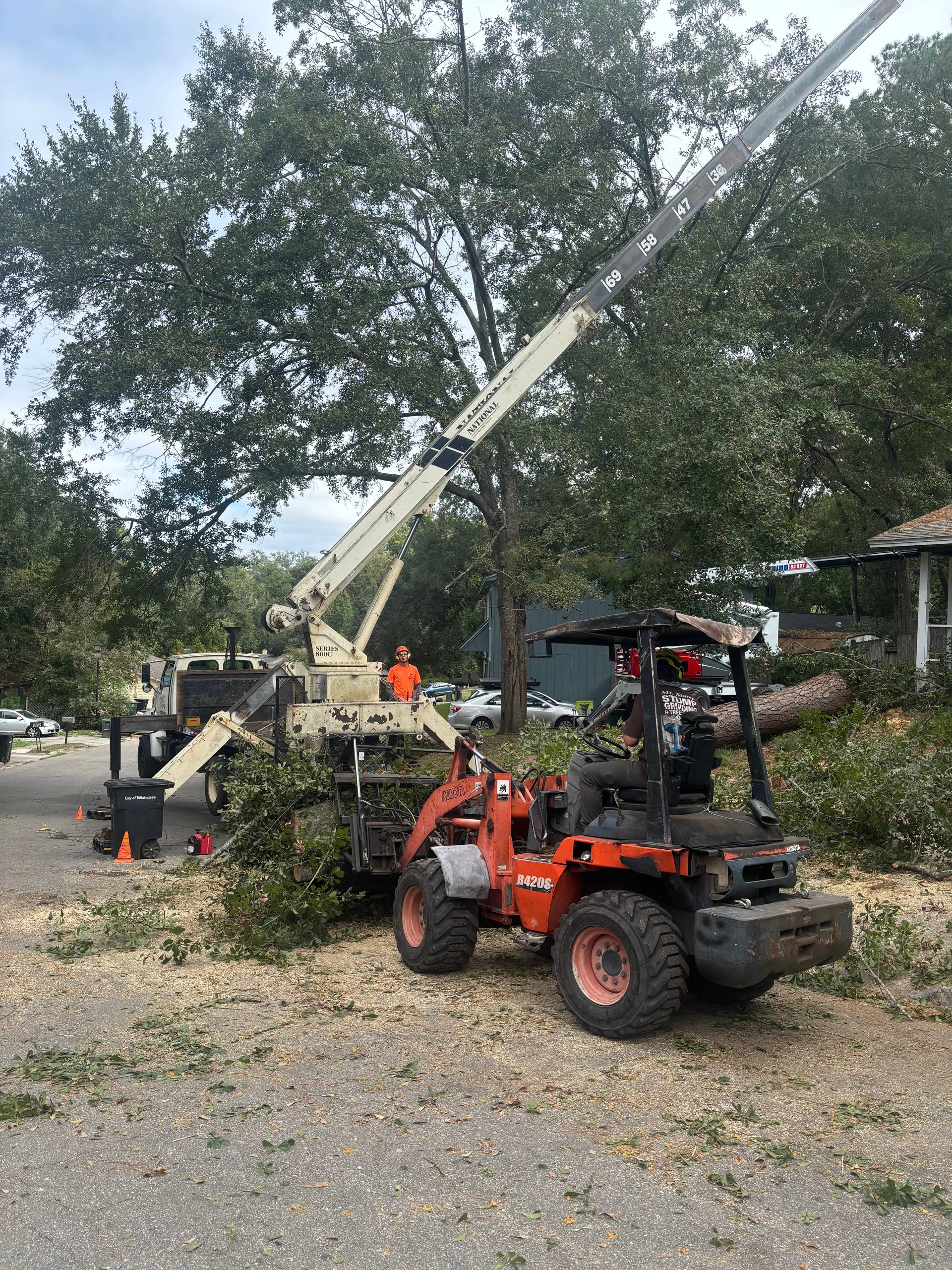
Setup on the day: The crane arrives and is positioned on outriggers, the stabilizing arms that spread the load across a wider footprint to prevent tipping. A crane can look unstable when it's walking into position; on outriggers it is extremely stable.
The removal: Our climber goes up with a rigging system and attaches a large section of the tree to the crane's load line. The crane holds the section under tension while the climber makes the cut. Once the cut is complete, the crane operator lifts the section clear and swings it to the landing zone, where the ground crew processes it into manageable pieces. The process repeats from the top down until the trunk is low enough to fell safely or is also craned out.
After the wood is down: The ground crew handles chipping, hauling, or leaving wood for firewood depending on what was arranged. Stump grinding can be done the same day or scheduled as a separate visit. We leave the site clean.
Depending on tree size and site complexity, a crane removal takes two hours to a full day. Large multi-tree jobs or very complex access situations may take longer.
Why Reed Tree Service Has Its Own Crane
Most tree service companies in Tallahassee don't own a crane. When they take a job that needs one, they subcontract: they hire a crane operator from a separate company, coordinate schedules between two crews, and pass that coordination cost along. The result is slower scheduling, more moving parts, and split accountability when something doesn't go as planned.
Reed Tree Service owns our crane. That means one call, one quote, one crew, one point of contact. We control the schedule, we control the rigging plan, and we're accountable for the whole job from the first cut to the last chip hauled away.
For homeowners dealing with a time-sensitive job (a tree damaged in a storm, a hazard that needs to come down before the next rain event), the scheduling difference matters. We're not waiting on a third-party crane company to have an opening in their calendar.
Cost Variables: What Changes the Number
Within the $1,500 to $6,000+ range, several specific factors move the price.
Tree size. A 60-foot tree and a 100-foot tree are different jobs in every dimension: time, number of sections, rigging complexity, crane capacity required.
Access. A crane set up on a wide street with clear sightlines to the tree is efficient. A crane picking over a fence line into a narrow backyard adds time and difficulty.
Structure risk. The more precise the placement has to be (landing zones measured in feet, not yards), the slower and more careful the work. That time shows up in the price.
Stump grinding. Stump removal is almost always quoted separately. Ask upfront whether it's included or add-on.
Debris haul-away. Some quotes include full debris removal. Others leave the wood and chips on-site. Be explicit about which you want.
Number of trees. Multiple crane jobs on the same property share the mobilization cost. Per-tree cost usually drops when there are two or three trees to do in one visit.
Live Oaks Over Homes: The Most Common Crane Job in Tallahassee
If you live in Betton Hills, Myers Park, Midtown, Waverly Hills, or any of Tallahassee's older neighborhoods, you know what the landscape looks like: large, old live oaks with canopies that spread over houses, driveways, and everything in between. These trees are among Tallahassee's greatest assets. They're also the most common reason we bring the crane.
Live oaks that have reached end of life, sustained significant storm damage, or developed structural defects that can't be corrected through cabling or pruning need to come down. When the canopy is spread over a roofline, there's no version of that job that doesn't involve a crane.
Leon County and the City of Tallahassee require permits for the removal of oaks above certain size thresholds. We pull the permits as part of the job. If your live oak needs to come down and a permit is required, we handle the application and any required inspection. This isn't a separate service; it's part of how we do the work.
Insurance and Crane Removal
Homeowners insurance sometimes covers crane tree removal if the tree caused damage or poses an imminent threat to a covered structure. The specifics depend heavily on your policy, the cause of the damage, and your insurer's documentation requirements.
We're not insurance adjusters, and we can't tell you what your policy covers. What we can do is provide the documentation most insurers want: written scope of work, photos, a detailed invoice. If you're working through a claim, let us know upfront so we can make sure our documentation matches what your adjuster needs.
One note on timing: don't wait to call us if there's a tree actively threatening your structure. Emergency response matters more than coordinating perfectly with your insurance company. Document everything before and after, but get the hazard dealt with.
Getting an Accurate Quote
The cost ranges in this article are starting points. An accurate number requires seeing the job: the tree's height and condition, what's in the drop zone, how the crane can access the property, and what you want done with the debris.
Call or text us at (850) 570-4074, or request a free estimate online and include photos of the tree and the surrounding area. Photos of the access situation (gate, driveway, adjacent structures) are particularly useful for us to assess whether and how the crane will position.
If you're not sure whether your job actually needs a crane, we'll tell you honestly. We don't recommend crane work on jobs that don't need it. Our crane services page covers our equipment and service area in more detail.
Frequently Asked Questions About Crane Tree Removal Cost
How much does crane tree removal cost in Tallahassee? Crane tree removal in Tallahassee typically runs $1,500 to $6,000 for a single tree. A large but accessible tree with a clear drop zone falls toward the lower end; a massive live oak over a roofline in a tight neighborhood can exceed $5,000 depending on size and site conditions.
Is crane removal worth the extra cost? When a crane is actually required, yes — it's the difference between a controlled removal and real risk to your property or someone's safety. When it's not required, a standard climbing crew costs significantly less. We won't recommend crane work if a standard removal can do the job safely.
Do you own your crane or subcontract it? We own and operate our crane equipment. Most tree companies in Tallahassee either rent equipment or subcontract these jobs, which adds delays and markups. Because we own it, we can mobilize faster and price the job more competitively.
Frequently Asked Questions
Does homeowner's insurance cover crane tree removal?
Sometimes. Most policies cover removal of a tree that has damaged a covered structure, but coverage for a tree that poses a threat without having already fallen varies significantly by insurer and policy. If a live oak limb came through your roof, your insurer is more likely to cover it than if you're proactively removing a healthy tree you're concerned about. Call your insurer before the job if possible, or document the situation thoroughly if you need to act immediately. We can provide whatever documentation your adjuster requests.
How long does crane removal take?
A single medium-to-large tree in a typical Tallahassee backyard usually takes two to four hours from crane setup to final cleanup. Very large trees or complex access situations take longer. Multi-tree jobs can extend to a full day. We'll give you a realistic time estimate when we quote the job.
Do I need to be home during the removal?
Not necessarily, though many homeowners prefer to be present, especially for a first-time crane job. We need access to the property and a clear understanding of the plan before we start. If you can't be there, make sure the access situation is sorted in advance (gates unlocked, cars moved, neighboring homeowners notified if needed) and that you have a way to reach us if questions come up during the job.
Can you remove a tree in one day?
Usually yes, for a single-tree job. Very large trees in complex situations may require a two-day approach: rigging and major lifts on day one, stump grinding and final cleanup on day two. We'll tell you the realistic timeline when we quote the job and confirm it before we show up.