Some Trees Can't Come Down the Standard Way
Most tree removals follow a standard process: a climber goes up, cuts the tree into manageable sections from the top down, and the crew below handles the pieces. It works well, for most trees.
Then there are the trees that can't come down that way.
A 90-foot water oak that split in a storm and is leaning toward the house. A live oak so close to the roof that any piece dropped from above will hit something. A large pine in a backyard with no access path wide enough for equipment. A massive tree over a swimming pool, a deck, or a vehicle that can't be moved.
In these situations, a crane isn't a premium option, it's the safe option. Trying to piece-cut a tree in these conditions creates unacceptable risk of dropping wood onto structures or injuring crew. Crane work eliminates that risk.
When Is a Crane Required?
We assess every removal before quoting. Crane is generally the right answer when:
The tree is over or adjacent to a structure. If any section of the tree falls in a likely piece-cut trajectory would hit a roof, HVAC unit, pool, vehicle, or fence, a crane takes over. The crane holds the section as it's cut, swings it clear of the structure, and sets it down in a safe zone.
Limited access makes equipment impossible. Bucket trucks and other aerial equipment need a path to get near the tree. If there's no way in (fenced yard, soft ground, narrow gate) a crane positioned on the street or driveway can often reach where trucks can't.
The tree is severely storm-damaged. A split or partially uprooted tree can shift unpredictably when sections are cut. Craning the whole piece (or large sections) while it's still partly attached gives the crew control of where it goes when it breaks free.
The tree is very large. Above a certain size, the mass of individual sections makes them unsafe to drop. A crane handles weight that can't be managed any other way.
The tree is dead and brittle. Dead wood doesn't behave predictably under a climber's weight or chainsaw cuts. Craning a dead tree is often safer than climbing it.
What a Crane Removal Looks Like
For homeowners who haven't seen one, crane work is impressive to watch and goes faster than most people expect.
Before the job: We survey the site, identify the crane setup position, and plan the cut sequence. We measure access, confirm the crane can bear the estimated tree weight, and identify a landing zone where sections will be set down. In tight situations, we coordinate with neighboring property owners if the crane will reach across property lines.
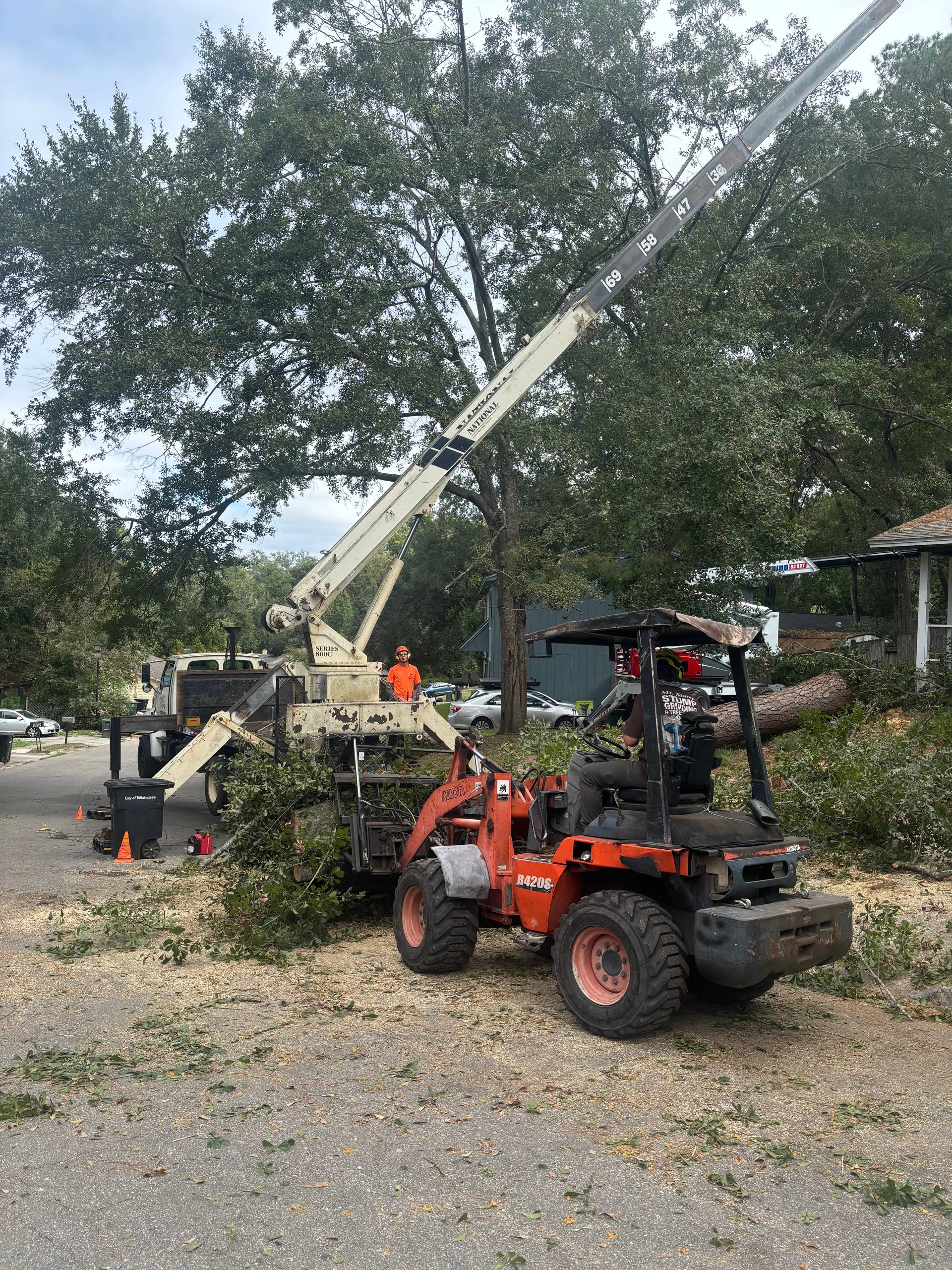
The day of the job: The crane arrives and is set up on outriggers, stabilizing feet that spread the load and prevent tipping. Our climber goes up with a rigging system and connects a large section of the tree to the crane's load line. The crane holds the section while the climber cuts it, then the operator swings it clear and sets it in the landing zone where the ground crew processes it.
Depending on tree size, a crane removal can take anywhere from two hours to a full day. Large, complex jobs (multiple trees, tight access, significant structure risk) may take longer.
After: The crane lifts out the debris or the ground crew processes it on-site. We can haul everything away, leave the wood for firewood (our crew splits some if requested), or handle it per your preference. Stump grinding is a separate step and can be done the same day or scheduled as a follow-up.
Crane Work and Live Oaks
Many of Tallahassee's most significant crane removals involve live oaks, heritage-size trees near or over homes that have reached the end of their life or present unmanageable structural risk.
Live oak removals with cranes add a complication: permits. Leon County and the City of Tallahassee require permits for removal of oaks above a certain size. The permit process adds time but isn't impossible. We pull the permits. If your live oak requires crane removal, we handle everything, the permit application, the city or county inspection, and the removal itself.
We've pulled dozens of permits in Leon County and know what documentation is required. Don't let permit complexity talk you out of getting the job done right.
Cost of Crane Tree Removal
Crane work costs more than a standard removal. The crane itself is a significant piece of equipment to mobilize, and the labor involved is intensive. For a large tree over a structure, the cost difference between crane and non-crane approaches can be several thousand dollars.
That said, the comparison isn't really between crane cost and standard removal cost, it's between crane cost and what happens if a section of tree drops onto your roof. A bad cut on a large tree over a structure can produce a six-figure insurance claim (or more). The crane is cheap by comparison.
For an accurate estimate on crane work, we need to see the job. Call us or send photos through our estimate form and we'll tell you honestly what's needed and what it will cost. We don't recommend crane work unless it's genuinely necessary.
South Georgia Crane Service
Our crane capability covers the same territory as all our other services. Tallahassee, Leon County, and the surrounding region including Gadsden, Jefferson, and Wakulla counties in Florida, and Thomas, Grady, Brooks, and Lowndes counties in South Georgia.
Large trees exist throughout our service area, and access and structure challenges don't stop at the state line. If you're in South Georgia with a large tree over a building, call us, we can get there.
Call us to discuss crane tree removal: (850) 570-4074. We'll assess your situation, tell you whether a crane is needed, and provide a firm quote. Request an estimate online, include photos for faster turnaround.