
If you've lived in Tallahassee for more than one summer, you know crape myrtles. They're the tree that blooms in July when everything else has given up in the heat. They line driveways, anchor front yards, and put on a show of white, pink, coral, red, and lavender from June through September. Tallahassee probably has more crape myrtles per square mile than any city in Florida.
They're also among the most mis-pruned trees in the South.
Knowing when and how to prune your crape myrtle (and, critically, what not to do) makes the difference between a gorgeous 25-year specimen and a lumpy, stressed-out stub that never reaches its potential. Here's what you need to know.
When to Prune Crape Myrtles in Tallahassee, FL
Timing matters more than most homeowners realize. Crape myrtles bloom on new growth produced each season, so pruning at the wrong time can delay or reduce your summer display.
The correct window for Tallahassee and North Florida: late February through mid-March.
This timing takes advantage of a few things specific to our climate. Crape myrtles are one of the last trees to leaf out in spring, and they hold dormancy well into February here. Pruning before new buds push gives you clean cuts that heal quickly once growth starts, and it lets you see the tree's structure clearly before the canopy fills in.
Avoid pruning in fall. Cutting in September or October can stimulate tender new growth that gets hit by our occasional cold snaps in November and December. That frost damage weakens the tree and wastes energy it was storing for spring.
The one exception: removing dead or storm-damaged wood can be done any time of year. If a branch cracks in a summer storm, don't wait until February to deal with it.
How to Prune a Crape Myrtle Correctly
The honest answer is that most crape myrtles in good health, planted in the right spot, need very little pruning. The goal isn't to cut a lot, it's to make the right cuts.
What to remove:
- Suckers at the base. These are thin sprouts that come up from the root crown around the trunk. Remove them flush with the base. Left alone, they compete with the main trunks and make the tree look scraggly.
- Crossing or rubbing branches. Where two branches cross and rub against each other, one will eventually wound the other. Remove the weaker one back to its origin point.
- Interior clutter. Twiggy, weak growth in the interior of the crown can be thinned to improve air circulation, this is particularly useful in Tallahassee's humid summers, where good airflow reduces fungal pressure.
- Dead wood. Any branch that didn't leaf out last season, or that feels hollow and brittle, comes out.
What to leave alone:
The main trunks and major structural limbs. The natural multi-trunk, vase-shaped form of a crape myrtle is its best form. Cuts into that structure should be made only with a clear reason, at branch junctions, never at arbitrary points along a stem.
Tools: Sharp bypass pruners for anything under 3/4 inch diameter. A sharp pruning saw for larger cuts. Clean tools reduce disease transmission. There's no need for wound sealant, research consistently shows it does more harm than good on most species.
What Is "Crape Murder" and Why Should You Avoid It?
Drive through any Tallahassee neighborhood in January or February and you'll see it: crape myrtles cut back to thick stubs. Trunks the diameter of a coffee can chopped off three feet from the ground. Major scaffold branches reduced to knuckled stumps.
This is crape murder, and it's everywhere.
It usually happens because a homeowner or landscaping crew assumes that cutting the tree back hard each year "controls" the size or "helps it bloom." Neither is true. Crape myrtles bloom on new growth regardless of whether you top them or not. An untouched crape myrtle will flower just as prolifically, and look far better doing it.
What topping actually does:
- Creates large wounds that the tree struggles to compartmentalize, leaving entry points for decay and disease
- Forces out clusters of fast-growing water sprouts from each cut point, weak, poorly attached growth that makes the tree denser and more cluttered, not more manageable
- Produces permanent knuckle growths at cut points that enlarge over years and become part of the tree's silhouette permanently
- Shortens the tree's lifespan and weakens its structure
- Destroys the natural vase shape that makes crape myrtles beautiful in the first place
If you've noticed ugly swollen knobs at the tops of trunks on crape myrtles in your area, that's the result of years of repeated topping. The knobs don't go away.
How to tell if your tree was topped: Look for abrupt, flat cut points on the main trunks or large limbs, surrounded by a cluster of thin, fast-growing shoots. The shoots may look vigorous, but the growth is structurally weak and attached to wood that was already cut.
When to Call a Professional for Crape Myrtle Pruning
Most homeowners can handle sucker removal and light interior thinning on dwarf and medium crape myrtles with a good pair of bypass pruners. But there are situations where professional help is the right call.
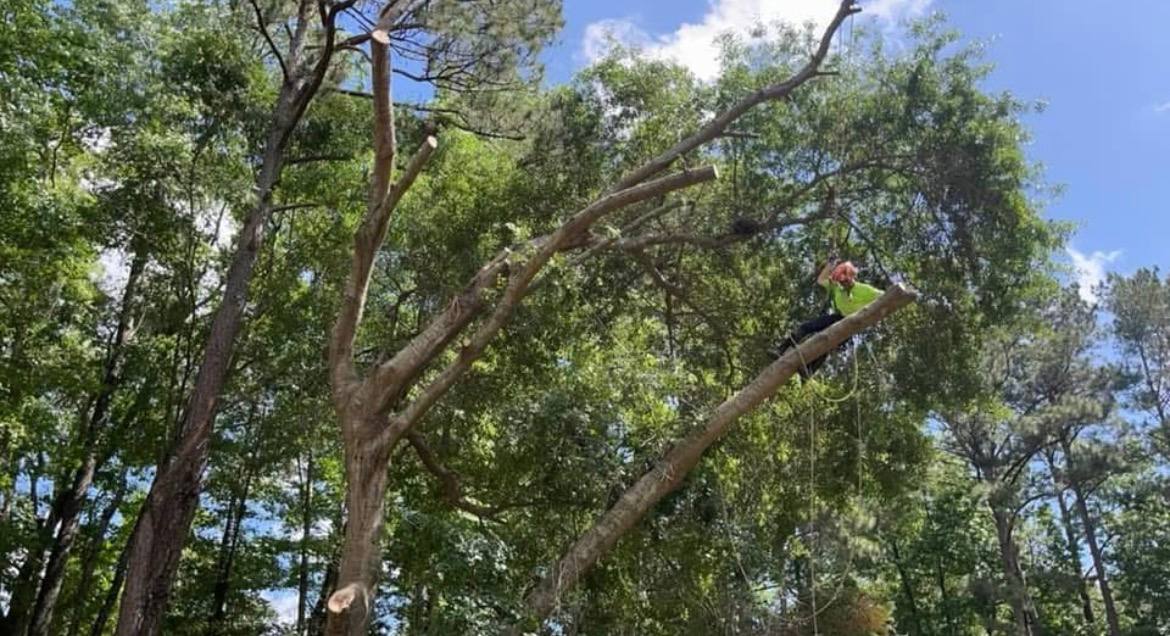
Large tree-form varieties. Natchez, Tuscarora, and Muskogee crape myrtles are among the most common in Tallahassee, and they grow 20 to 30 feet tall at maturity. Work in the upper canopy of a tree that size requires climbing equipment, proper rigging to direct branch falls, and experience reading a tree's structure from height.
Multiple trees on a property. If you have six crape myrtles along a driveway that all need attention, the time and logistics of doing it right add up fast.
Trees near structures. Removing larger branches near a house, fence, or vehicle requires controlling where wood falls. A branch that slips the wrong direction from 18 feet up can do real damage.
If you're not sure what to cut. Crape myrtles are forgiving trees, but a confident bad cut is worse than calling someone who knows what they're looking at. If you're standing under the tree and second-guessing yourself, that uncertainty is worth resolving before you make a cut you can't undo.
If your tree was previously topped. Restructuring a heavily topped crape myrtle is a different task than routine maintenance. An experienced eye can identify which of the many water sprouts are worth keeping to rebuild the crown versus which ones should come out.
Crape Myrtle Pruning in Tallahassee: What Reed Tree Service Does
We've pruned crape myrtles all over Tallahassee and across North Florida. We know the varieties common to this area, we know the timing that works for our climate, and we know how to work on large specimens without damaging the surrounding landscape.
Our recommendation is always toward preserving the natural form. We'll remove what needs to come out, leave the structure intact, and give you a crape myrtle that looks better in three years than it does today. If you're dealing with a tree that's been topped repeatedly and you want to know your options, we'll give you a straight read on what's realistic.
We also understand that sometimes a homeowner has a specific reason for wanting something done differently. We work with you on what's best for your property and your situation. If you're not sure what's right for your crape myrtle, we're happy to take a look.
Request a free estimate or call us directly at (850) 570-4074. We serve Tallahassee and the surrounding North Florida area.
For more on our tree pruning services or general tree care, explore the rest of our site.