"Can I Wait on This?"
It's a reasonable question. Tree removal costs money, and a dead tree that hasn't fallen yet seems like something that can be handled next month, or next season, or when it becomes an obvious problem.
Sometimes that's true. Sometimes it's not. The difference matters.
How Dead Trees Deteriorate
A tree that has died doesn't immediately become a hazard. The wood is still structurally sound for a period (sometimes years) after the tree loses its leaves and stops growing. But it deteriorates in a predictable sequence:
Year 1-2: Wood is generally still sound. Bark begins separating. Fine branches and twigs start falling. Woodpeckers begin investigating for insects.
Year 2-4: Internal decay from fungi and wood-boring insects begins. The rate depends heavily on species, climate, and whether the root system is compromised. In North Florida's humidity, this phase can advance faster than in drier climates.
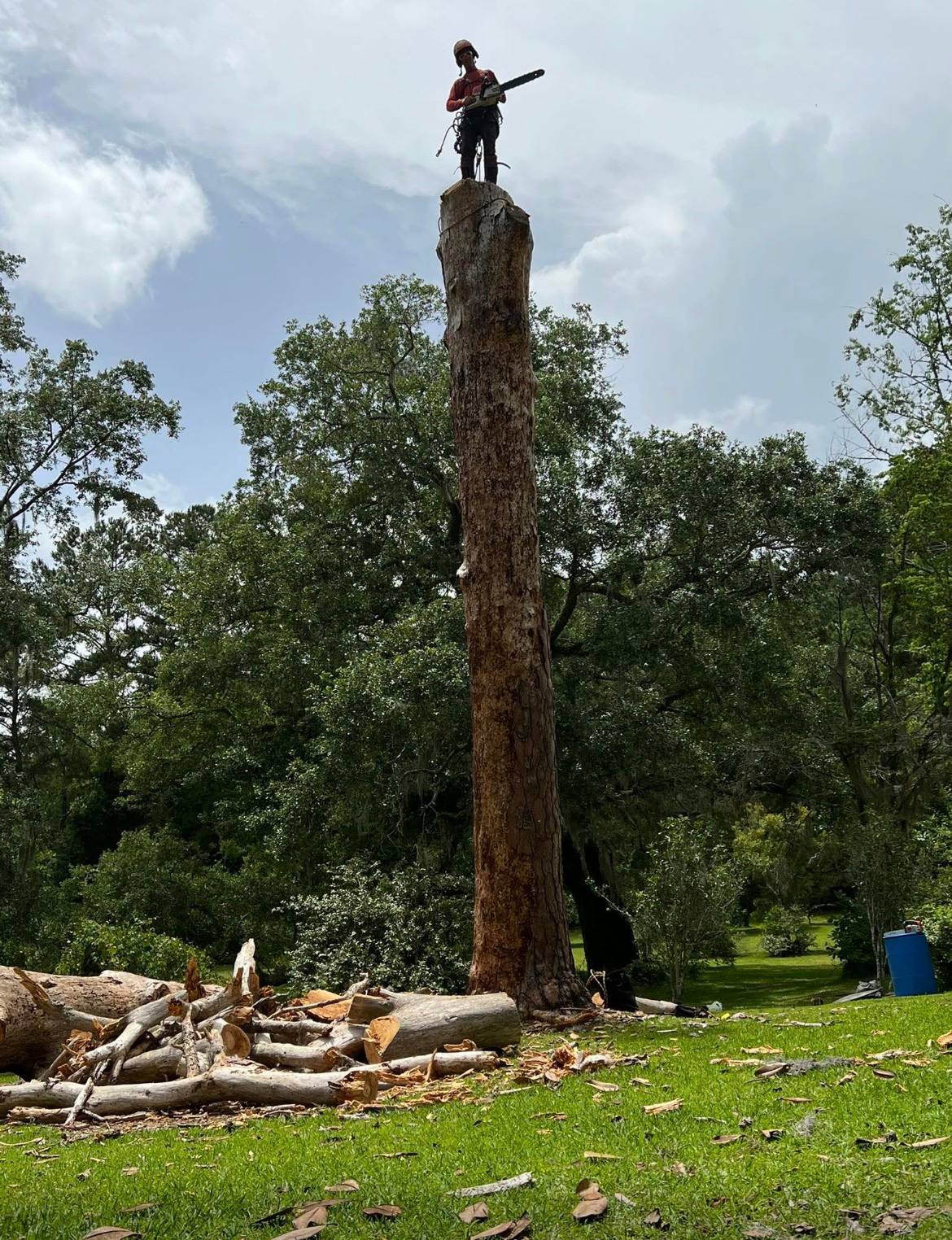
Year 4-7: Structural integrity degrades meaningfully. Large branches become unpredictable. The trunk may be hollow or soft at the base. At this stage, even moderate wind events can cause failure.
Year 7+: Complete structural failure is increasingly likely with any significant wind or storm event. The wood may look solid from a distance while being hollow or punky inside.
These timelines are rough. A large pine often deteriorates faster than a hardwood. A water oak that was already in decline may be structurally compromised within a year. A well-rooted live oak in dry conditions may take longer.
When You Need to Act Quickly
The urgency increases significantly when any of these are true:
Target below the tree: A dead tree directly over a structure, vehicle, power lines, or a path people use regularly is a priority removal. The potential for harm from delay is high enough that waiting isn't a good option.
Evidence of advanced decay: If the base of the trunk sounds hollow when tapped, has visible fungal conks or shelf fungi, or feels soft, the internal structure is compromised. A tree in this condition can fail in a routine thunderstorm.
Bark is falling off in large sheets: Heavy bark loss is a sign of advanced deterioration in the outer wood layers.
The tree is leaning and recently dead: A dead tree that has developed a lean (especially toward a structure) is higher risk than a plumb dead tree. Roots that were supporting the lean while the tree was alive are losing strength.
Storm season approach: Dead trees are significantly more likely to fail in high winds. If you're heading into June-November in North Florida with a dead tree over your property, that's the window to get it handled before it becomes an emergency.
When You Have More Time
You have more time when:
- The dead tree is small (under 20 feet)
- It's in an open area with no target below it, if it falls, it falls into open yard or woods
- It died recently and you can see the wood is still solid
- You're outside of active storm season
Even in these cases, "more time" doesn't mean indefinitely. A dead tree with no target in an open area is a different risk profile than one over your house, but it still deteriorates on the same timeline.
Snag Value
One consideration worth noting: dead standing trees ("snags") have genuine ecological value. They provide nesting habitat for cavity-nesting birds (woodpeckers, owls, bluebirds), foraging sites for insectivorous birds, and habitat for numerous invertebrates.
If a dead tree poses no hazard to people or property, leaving it as a snag is a legitimate choice, and increasingly encouraged by wildlife-minded property owners. This is only a viable option when the tree is well away from structures and paths. A dead tree over your house is a hazard, not a habitat feature.
Getting the Timing Right
If you're unsure whether a dead tree needs to come down now or can wait, the honest answer comes from looking at it closely:
- Is there anything below it that could be harmed?
- Does the wood appear sound or is there evidence of decay?
- How long has it been dead?
If the answers push toward urgency, don't delay. If the answers suggest low immediate risk, you have some flexibility, but schedule the work before storm season rather than after.
We do assessments of dead trees to give you an honest read on what you're dealing with. Call (850) 570-4074 or request an estimate online.