The Honest Assessment
We're a tree service. We'd prefer you call us for all tree removal. But we're also going to be straight with you: there are situations where a homeowner with a decent chainsaw and good judgment can safely handle a small tree removal themselves.
What we want to do is help you accurately assess whether your situation is one of them.
Trees That Are Generally Within DIY Range
A small tree that meets ALL of these criteria is potentially a DIY job:
- Under 20 feet tall (roughly two stories)
- Clear fall zone: you have open lawn or open space in the direction you intend to drop it, with no structures, fences, utility lines, or other trees in the fall path
- Straight trunk, no significant lean in an unintended direction
- Healthy wood: not dead, not diseased, not hollow
- Not near any utility lines: even secondary lines (cable, phone) are a complication
- You've used a chainsaw before and are comfortable with it
If you check all six boxes, a small tree in the open may be within your capabilities. If you miss on any one of them, you're in different territory.
Where DIY Goes Wrong
The tree removal injuries and deaths we're aware of almost universally involve one of these scenarios:
Miscalculating lean. A tree that appears straight often has a significant lean in one direction, held up by branch tension and root system. When the saw cuts through the trunk, the tree goes where the lean and tension take it, not necessarily where you planned. Experienced operators read lean and tension before the first cut. Inexperienced ones don't.
Kickback. A chainsaw kickback event happens in a fraction of a second. If the nose of the bar contacts a branch or the cut begins to close and pinch the bar, the saw kicks up and back toward the operator. Without proper chainsaw safety equipment (chaps, face shield, gloves, helmet), a kickback is potentially fatal. Most homeowners operating a chainsaw don't have this equipment.
The tree doesn't fall where planned. Undercuts and back cuts done incorrectly leave no margin for error. A tree that goes the wrong direction hits what's in its path, the house, the fence, you.
Falling sections during limbing. Cutting limbs off a tree can result in unexpected dropping or springing. A large limb under tension can move faster and further than expected when released.
The tree is dead inside. A tree can look structurally sound from the outside and be hollow or severely decayed inside. A hollow tree doesn't respond to cutting the way a sound tree does, it fails unpredictably.
The Size Factor
Here's the hardest truth: most people dramatically underestimate how big a 30-foot tree is when it's on the ground.
A 30-foot water oak in a North Florida yard looks manageable. Standing next to it, it doesn't seem that big. But a 30-foot tree has a trunk diameter that's harder to work around than expected, branch weight that's much heavier than it looks, and a fall zone that needs to be clear to a radius larger than most residential lots can accommodate.
At 30+ feet, you're in professional territory. At 40+ feet, there's essentially no scenario where DIY is the right call.
When the Call Is Clear
Call us, don't DIY:
- Any tree over 20–25 feet
- Any tree leaning toward a structure, fence, or utility line
- Any tree with visible decay, hollow sections, or disease
- Any tree over a pool, driveway, or paved surface
- Any dead tree: dead trees fail unpredictably
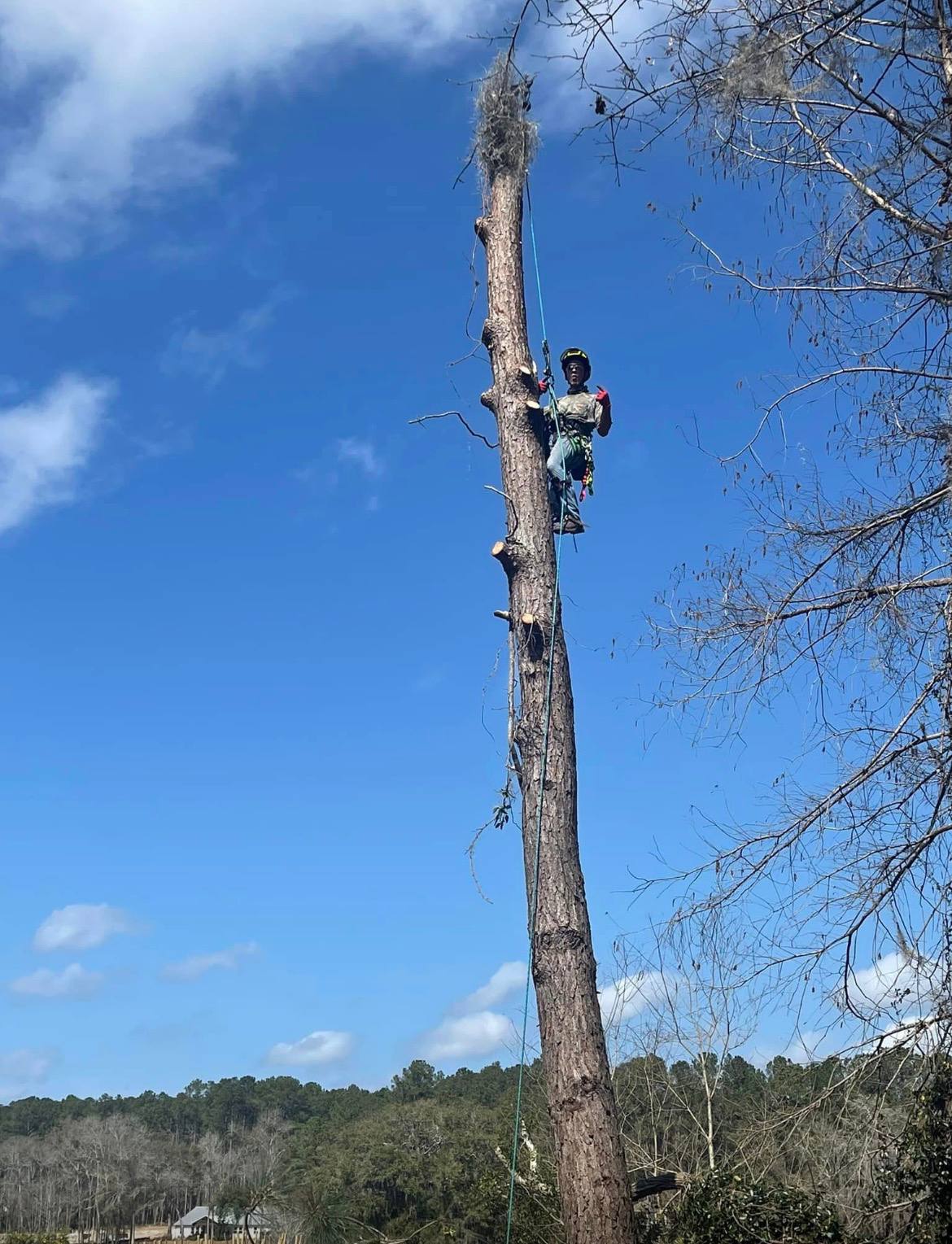
- Any tree that requires climbing to complete removal
- Any tree near utility lines of any kind
- Any situation where the fall zone is not completely clear to a distance equal to the tree's height
If you're on this list and you're still thinking about DIYing it: the ER visit, property damage, or both will cost more than we would have charged.
What About Stump Removal?
After you cut a small tree down, you have a stump. Stump grinding requires specialized equipment, a stump grinder. You can rent them, but they're heavy equipment with significant kickback potential for inexperienced operators. For most homeowners, grinding is the one part of tree work where the rental cost plus time plus risk doesn't beat just hiring someone with a grinder.
The Middle Ground: Debris Cleanup After DIY
Some homeowners cut a small tree down themselves and then call us for debris pickup, the wood, branches, and cleanup. We do debris-only jobs. If you handled the cutting but have a yard full of material you need hauled, that's a standard service call.
What We Charge
We're not going to make tree removal quotes on our website because every job is different. What we will tell you: for small residential trees in accessible locations, professional removal typically costs less than people expect. The quote is free. Call or submit a photo.
Call (850) 570-4074 or request an estimate online before you decide whether to DIY. We'll give you an honest quote, and you can decide from there.