Call Us First: (850) 570-4074
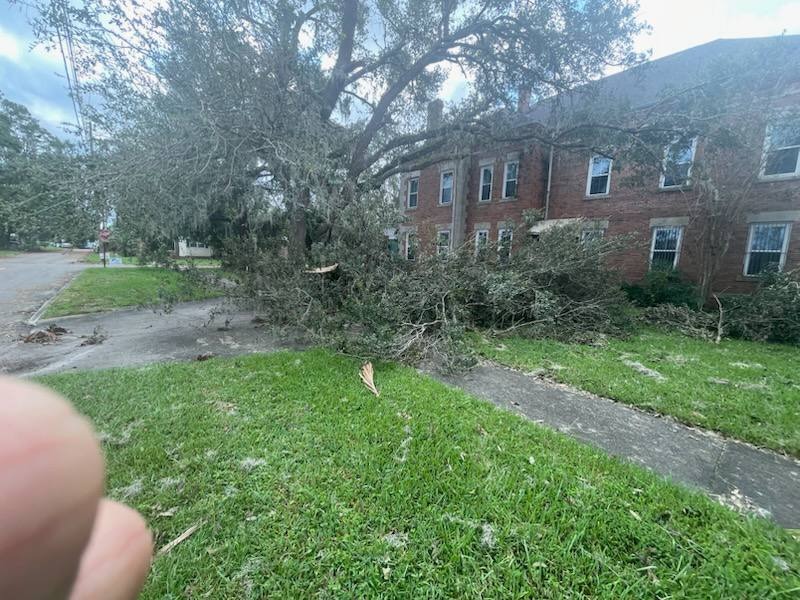
If you're in the middle of an emergency right now (a tree is on your house, blocking your car, or creating an immediate danger) call us at (850) 570-4074. We respond 24 hours a day, 7 days a week, including holidays.
If you have a moment to read this first, here's what to do.
Step 1: Get Everyone Safe
Before anything else, make sure everyone in the household is away from the fallen tree and any structures it may have compromised. Trees can settle, shift, or drop additional limbs for hours after initial failure.
Do not go back inside a structure the tree has penetrated until a professional has assessed the damage. A tree on a roof can destabilize ceiling joists and trusses that look intact but aren't.
If a tree has come down on a power line, call your utility company first (Gulf Power / Florida Power & Light for North Florida, Georgia Power for South Georgia) and stay well clear. Do not touch any downed lines or any fence, vehicle, or other object in contact with them.
Step 2: Call Reed Tree Service
(850) 570-4074: we answer emergency calls day and night.
When you call, tell us:
- Your address
- Whether anyone is injured (if yes, call 911 first)
- Whether the tree is on a structure
- Whether there are downed power lines involved
- How large the tree looks (rough estimate is fine)
We prioritize calls where trees are on structures or creating immediate safety hazards. We'll give you an estimated arrival time on the call.
Step 3: Document the Damage for Insurance
While you wait for our crew, use your phone to photograph and video the damage from safe vantage points. Document:
- The full extent of where the tree landed
- Any structural damage to the roof, walls, or foundation
- Damage to vehicles, fences, or outbuildings
- The root ball if the tree pulled out of the ground (shows the root system was the failure point)
Don't touch or move anything unless it's creating an immediate safety hazard. Insurance adjusters need to see the damage as-it-was. Document before you start cleanup.
Also note the approximate time the tree fell, this matters for insurance claims.
Step 4: Contact Your Insurance Company
Most homeowner's insurance policies cover tree damage to structures. Call your insurance company as soon as possible, many have 24/7 claims lines. Ask specifically about:
- Emergency tree removal coverage
- Structural repair coverage
- Temporary housing if the structure is uninhabitable
- Whether you need pre-approval before cleanup begins
Keep your receipt from our work. You'll need it for the claim.
Important: If the tree fell on your neighbor's property, it's generally their insurance that covers the damage to their structure, not yours. This is true even if the tree was on your property when it was standing. Exceptions exist for cases where negligence can be proven (e.g., a tree that was clearly dead or rotting that you failed to remove despite being notified).
Step 5: Stabilize and Secure (After We Assess)
Once our crew arrives and removes the fallen tree, the exposed structure needs to be secured against weather while permanent repairs are arranged. We work with local roofing contractors and can recommend tarp-and-secure options to protect the structure overnight until your insurance adjuster visits.
What Happens During Emergency Tree Removal
When our crew arrives at an emergency call, here's what the process looks like:
Hazard assessment: We evaluate the scene before any equipment moves. This includes checking for hidden damage, secondary failure risks in the crown, and any structural concerns with the building the tree has contacted.
Section-by-section removal: Emergency removals usually work from the top down, cutting the tree into manageable sections that can be lowered safely without additional damage to the structure. This is slower than a standard removal but protects the property.
Debris clearing: We clear the immediate area and any debris that's on the structure. Full cleanup and stump grinding can be done immediately or scheduled as a separate job depending on the situation.
Documentation for your claim: Our crew can provide you with a written statement of what was found and what was done, which helps with insurance documentation.
After the Emergency
Once the immediate situation is handled, you'll likely need to address:
- Root cause: Why did the tree fall? Rot, root damage, structural failure? If there are other similar trees on the property, they may pose the same risk. We'll tell you what we found.
- Stump grinding: The stump left after an emergency removal is a trip hazard and should be addressed within a few weeks.
- Other at-risk trees: After any major storm, it's worth having an experienced eye look at the other trees on your property. We offer free assessments and can tell you which trees are stable and which need attention.
We serve Tallahassee and all of North Florida and South Georgia, 24/7.
If you're dealing with a tree emergency right now, call (850) 570-4074. For non-emergency estimates, use our online form.