The Quiet Problem in North Florida's Tree Canopy
Tallahassee has a genuinely impressive urban tree canopy. But mixed into that canopy (and spreading outward into rural North Florida and South Georgia) are a number of invasive tree species that crowd out natives, offer minimal wildlife value, and in some cases are actively regulated by the State of Florida.
Homeowners often discover they have an invasive tree when they ask us about removal and we tell them they're actually required to remove it. Or, more commonly, they're maintaining a tree for years without knowing it's invasive and slowly expanding onto their neighbors' properties and into surrounding woodlands.
Here are the most common invasive trees we deal with in North Florida.
Chinese Tallow (Triadica sebifera)
What it looks like: Deciduous (loses its leaves in winter), heart-shaped leaves that turn bright red, orange, and yellow in fall. White waxy berries in fall and winter. Fast-growing, often 30–40 feet tall at maturity. Sometimes confused for native trees due to attractive fall color.
Why it's a problem: Chinese tallow is one of Florida's most problematic invasive species. A single tree can produce tens of thousands of seeds annually, and birds spread them widely. It invades wetlands, disturbed areas, roadsides, and residential yards, outcompeting native species. Florida's Noxious Weed list includes Chinese tallow, the Florida Department of Agriculture classifies it as a prohibited invasive species.
Removal: Standard removal, but stump grinding is critical. Chinese tallow will resprout aggressively from stumps, without grinding, you're looking at multiple resprout trunks within a season. Chemical treatment of the cut stump is sometimes used in conjunction with removal for large trees.
Camphor Tree (Cinnamomum camphora)
What it looks like: Evergreen, dense rounded canopy. New growth is often reddish. Leaves have a strong camphor smell when crushed. Small black berries. Can reach 60+ feet at maturity and develop very significant trunk girth over decades.
Why it's a problem: Camphor is widespread in older Tallahassee neighborhoods, it was commonly planted as an ornamental decades before its invasive potential was understood. Florida lists it as a Category I invasive, meaning it's altering native plant communities and causing measurable ecological damage. It doesn't spread as aggressively as tallow, but established specimens seed prolifically and the species is well-established across Leon County.
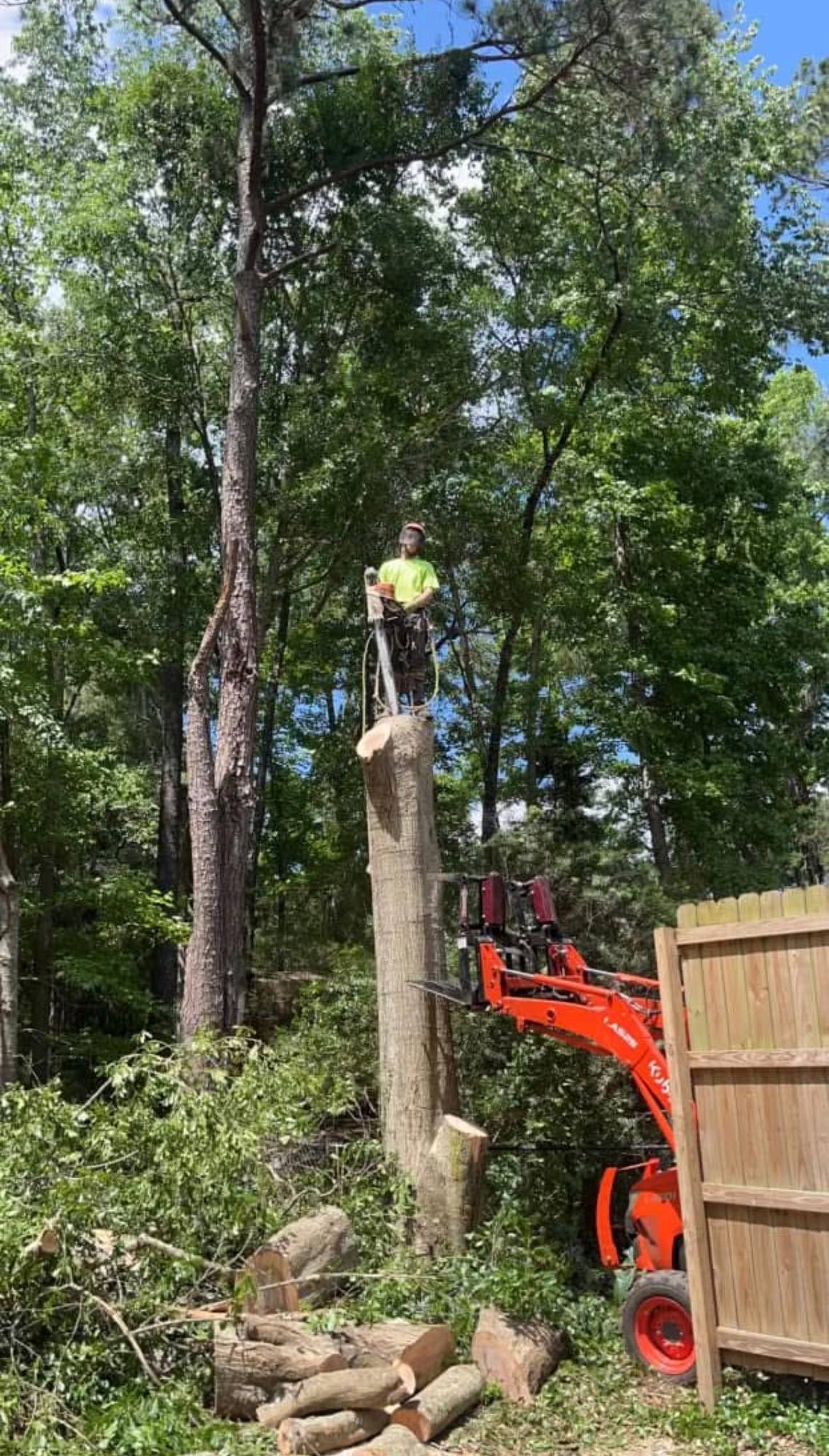
Removal note: Camphor trees planted close to structures (a very common situation given how often they were placed near homes) frequently require crane or bucket truck work due to size and proximity. These are not small trees.
Chinaberry (Melia azedarach)
What it looks like: Deciduous, compound leaves (multiple leaflets on each stem), fragrant purple flowers in spring, clusters of yellow berries that persist through winter. Fast-growing. Common along roadsides, fence lines, and disturbed areas throughout North Florida.
Why it's a problem: Berries are toxic to humans and animals. The tree spreads aggressively along disturbed edges, fence lines, road shoulders, woodland edges. Florida Category I invasive.
Chinese Privet (Ligustrum sinense) and Japanese Privet (Ligustrum japonicum)
What they look like: Privets range from large shrubs to small trees. Dense, semi-evergreen foliage. Small white flowers in spring. Dark berries. Often used as hedging material. Japanese privet in particular is widely sold and planted.
Why it's a problem: Chinese privet is one of the most invasive shrubs/small trees in the Southeast. It spreads relentlessly from bird-dispersed seed and invades understory areas of native forest. Japanese privet is less aggressive but still a Florida Category I invasive. If you've been maintaining a privet hedge for years, you may have noticed it escaping into surrounding areas, that's not an accident.
Ear-Leaf Acacia (Acacia auriculiformis)
What it looks like: Evergreen, with curved, sickle-shaped phyllodes (modified leaves) rather than true leaves. Yellow flowers. Fast-growing. Common in central and north Florida, less common than tallow but increasingly problematic.
Why it's a problem: Florida Category I invasive. Spreads rapidly in disturbed areas and pinelands.
What Removal Involves
Invasive tree removal follows the same process as any other tree removal, the species doesn't change the basic mechanics of felling, sectioning, chipping, and hauling. What it changes:
Stump treatment. For species that resprout aggressively (especially Chinese tallow), stump grinding alone may not be sufficient. We can treat cut stumps with herbicide to prevent regrowth, if you're clearing tallow from a property, this step saves a significant amount of follow-up work.
Volume. Invasive species often come in clusters, a fence line full of chinaberry, a stand of tallow in the back corner of a lot. The price for invasive clearing is volume-based, and we can usually quote based on photos and a rough count.
Disposal. Invasive woody material is chipped and hauled the same as any other, the wood doesn't require special disposal. What matters is not leaving viable seed material piled on-site.
South Georgia Context
Chinese tallow has spread significantly into South Georgia. Thomas, Grady, Colquitt, and adjacent counties all have established populations. Landowners in our South Georgia service area encounter tallow along creek banks, pond edges, fence lines, and in fields returning to brush. It's worth addressing when it's small rather than waiting until the stand has seeded out.
Should You Report Invasive Species?
Florida IFAS (Institute of Food and Agricultural Sciences) maintains reporting tools for invasive species if you encounter new infestations, particularly in natural areas. This is separate from removal on private property, which you can proceed with at any time.
For invasive tree removal throughout Tallahassee, North Florida, and South Georgia, call (850) 570-4074 or request an estimate online. Photos of the trees and an approximate count help us quote quickly.