Live Oak Pruning and Trimming in Tallahassee: What You Need to Know
If there's one tree that defines Tallahassee, it's the Southern live oak (Quercus virginiana). The sprawling giants along Miccosukee Road, the tunnel of branches on the canopy roads, the century-old specimens anchoring neighborhoods like Killearn and Betton Hills, live oaks are as much a part of this city as the Capitol building.
They're also the tree we get the most questions about.
Live oaks are long-lived, structurally complex, and protected by local ordinance in ways that most trees are not. Here's what Tallahassee homeowners need to know before touching one.
Are Tallahassee Live Oaks Protected?
Yes, to varying degrees. Both the City of Tallahassee and Leon County have tree protection ordinances that regulate the removal and significant trimming of live oaks.
The key thresholds:
- Trees with a trunk diameter (DBH: measured at breast height, 4.5 feet above grade) of 8 inches or larger typically require a permit before removal
- "Heritage trees" (those with a DBH of 24 inches or larger) have additional protections and higher permit fees
- Even on private property, you generally cannot remove a significant live oak without city or county approval
The permit process isn't impossible, but it takes time and requires justification. Common approved reasons include:
- The tree is dead or presents an imminent hazard
- The tree is causing documented structural damage to a building
- Development or site work that cannot reasonably accommodate the tree
We handle permitting. We know the Leon County and City of Tallahassee ordinances, we've pulled dozens of permits, and we can tell you upfront whether your tree will qualify and what the process will look like.
When Do You NOT Need a Permit?
Generally, you don't need a permit for:
- Routine pruning that removes less than 25% of the live crown in a year
- Dead wood removal: dead branches can be removed without a permit in most cases
- Hazard limb removal: a branch that presents an imminent safety hazard can typically be removed under emergency provisions
When in doubt, call us before you cut. Unpermitted removal of a protected live oak can result in significant fines and replacement requirements.
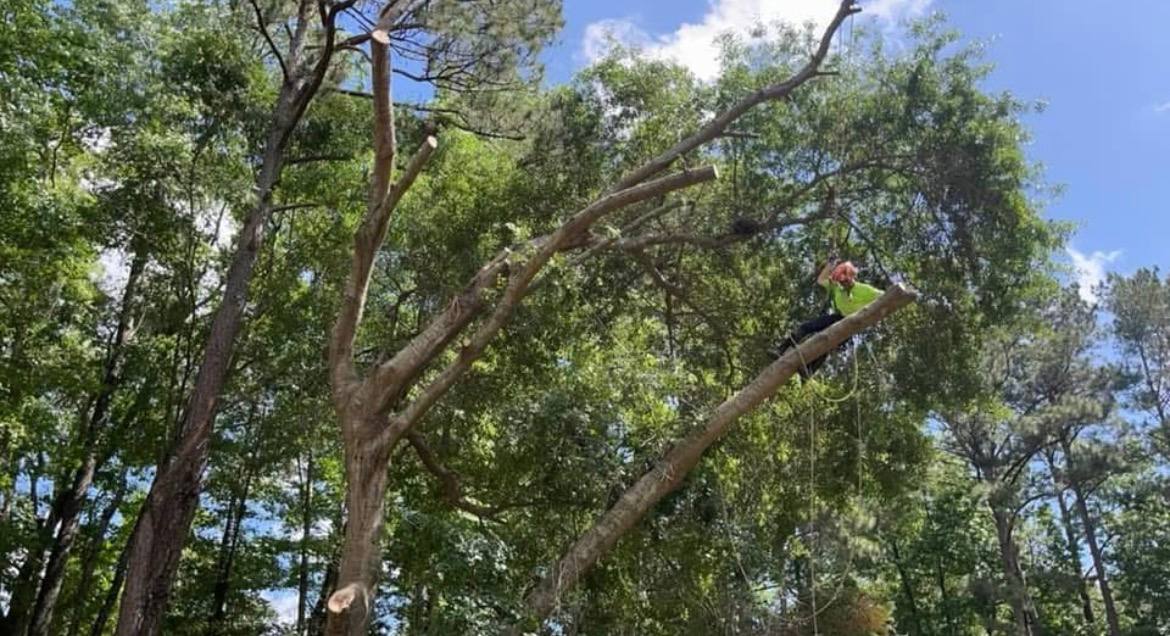
Need a live oak pruned or assessed? Reed Tree Service handles live oak pruning, permit applications, and removal throughout Tallahassee and Leon County. Get a free estimate → or call (850) 570-4074.
Live Oak Pruning: What's Right and What's Not
Live oaks are forgiving trees, but they're also commonly mistreated. Here's what to know.
Best time to prune: In North Florida, summer (June through August) is generally recommended for live oaks. Pruning during summer reduces the risk of oak wilt spread (the fungal pathogen that kills oaks spreads on the spores carried by beetles attracted to fresh cuts; those beetles are less active in summer heat). Late winter pruning is second-best. Avoid early spring when the tree is leafing out.
What good pruning looks like:
- Removes dead, diseased, and crossing branches
- Clears limbs away from rooflines, power lines, and structures
- Maintains the tree's natural shape and structure
- Never removes more than 25% of the live crown at once
- Cuts are made just outside the branch collar (the swollen area where the branch meets the larger limb)
What bad pruning looks like (and what to avoid):
- Topping: cutting off the top of the tree to reduce height. Topping live oaks is both bad arboricultural practice and can be illegal under local ordinance. It causes explosive regrowth of weakly attached water sprouts, accelerates decay, and shortens the tree's life significantly. If a company recommends topping, find a different company.
- Flush cuts: removing branches flush with the trunk, cutting into the branch collar. This leaves a large wound that the tree can't compartmentalize properly.
- Lion's tailing: stripping interior branches while leaving a dense tuft at the ends. Creates sail-like resistance to wind and unbalanced weight distribution.
Common Live Oak Problems
Galls and insects. Wool sower galls, leaf gall wasps, and various caterpillars are common on Tallahassee live oaks but rarely threaten a healthy tree's life. Most are cosmetic concerns.
Spanish moss. The classic Tallahassee companion. Spanish moss (Tillandsia usneoides) is an epiphyte, it grows on the tree but takes nothing from it. Heavy moss loads can shade out leaves and add weight to branches, but it doesn't kill live oaks. If the moss is very heavy on a declining tree, removal may help, but it's rarely a priority.
Bacterial leaf scorch. Shows as browning leaf edges in midsummer. Caused by a bacteria spread by leafhoppers. No cure, but a properly maintained tree can live with it for many years.
Sudden oak death (SOD). Not yet established in North Florida, but a pathogen worth knowing. Phytophthora ramorum has devastated oaks in coastal California. Keep an eye on state agricultural advisories.
Structural failure. Live oaks develop wide horizontal limbs that are subject to "sudden branch drop", a poorly understood phenomenon where apparently healthy limbs fall on calm days. Heavy limb loading, codominant stems with included bark, and root damage are all risk factors. We assess these during any evaluation.
When a Live Oak Needs to Come Down
Sometimes, even a heritage live oak needs to come down. The common scenarios:
- Advanced decay: internal rot (confirmed by resistograph testing or visible fungal fruiting) that has compromised structural integrity to the point where the tree cannot be preserved safely
- Root system failure: subsidence, construction damage, or prolonged drought can fatally compromise the root plate
- Storm damage: catastrophic splits or uprooting that cannot be corrected
- Structure damage: roots that are actively destroying foundations or infrastructure where remediation has failed
When we pull a permit for live oak removal, we document everything properly and work with the county or city inspector as required. We'll also advise on replacement species to help you replant in compliance with local ordinances.
How Much Does Live Oak Pruning Cost in Tallahassee?
Live oak pruning in Tallahassee typically runs $300–$1,200 for a single tree, depending on size, height, and how much work is needed. A small live oak needing deadwood removal and clearance cuts is a quick job. A large specimen with extensive canopy work requiring a bucket truck and multiple climbers is a full-day job.
We don't publish flat rates because the right price is based on seeing the tree. Call (850) 570-4074 for a free on-site estimate — we'll walk the tree with you and give you an exact number.
Have a live oak you're concerned about? Call (850) 570-4074 for a free assessment. We serve Tallahassee, Leon County, and the surrounding North Florida region. Request an estimate online.