
South Georgia's Pecan Trees Are a Special Challenge
If you own property in Thomas County, Grady County, Mitchell County, Brooks County, or anywhere else in South Georgia, you probably have pecan trees. They're part of the landscape here, backyard pecans that have been growing since the 1940s, orchard rows that stretch across flatlands, and single-specimen trees that anchor the corner of a yard and have been producing nuts for longer than anyone can remember.
Pecan trees are also one of the more common reasons we get called out across our South Georgia service area. Beautiful and valuable as they are, pecans develop specific problems that can make them dangerous, and those problems aren't always obvious until it's too late.
What Makes Pecan Trees Different
Pecan trees are large. Really large. A mature pecan in good South Georgia soil can reach 100 feet tall with a canopy spread of 60 to 80 feet. The root system extends even farther. When something goes wrong with a tree that size, the consequences are significant.
They also live a long time and age in a specific way that can be misleading. Pecans develop internal decay that's hard to see from the outside. A tree can have full green leaves and a healthy-looking canopy while the interior of the trunk is soft and rotting. We've taken down trees that looked fine from 50 feet away and found hollow cores 3 feet in diameter when the saw got to work.
The combination of massive size and invisible internal rot is what makes pecans one of the more dangerous trees on a residential property.
Signs Your Pecan Tree Needs Attention
Fungal brackets or mushrooms on the trunk. This is the most reliable external indicator of internal decay. If you see shelf-shaped fungi growing from the bark, the wood inside is being consumed. The higher they are on the trunk, the more extensive the decay. This tree needs to be evaluated and likely removed.
Bark that's falling off in large sections. Healthy bark peels in small flakes or strips as the tree grows. Large slabs of bark falling off in sheets (especially if the wood underneath looks gray or soft) is a sign of serious health problems.
Dead limbs that aren't coming down. Pecans can hold dead limbs in their canopy for years before they fall. Dead branches that are 4 inches or larger in diameter are hazards. They fall without warning and the weight is enough to cause serious damage to whatever is below them.
Major forks with included bark. The crotch between two major limbs is a weak point in any tree. If you look up at the fork and see that bark has grown into the joint rather than around it (this shows as a dark line or groove running into the fork), that joint is significantly weaker than it looks and can split under load.
Leaning after a storm. Pecans have deep root systems, but prolonged drought, construction near the roots, or a saturated storm event can compromise those roots. A pecan that leans more after a major storm may be pulling out of the ground. Don't wait to get this looked at.
When Pruning Is the Answer
Not every pecan problem means removal. Proper structural pruning can extend the life of a pecan significantly and reduce its risk profile:
- Crown cleaning removes dead, dying, and crossing branches. Doing this every 3-5 years keeps hazardous dead wood from accumulating.
- Structural pruning on younger trees establishes strong branch angles and reduces the likelihood of major failures later. The best time to prune pecans is during dormancy in late winter (January-February in South Georgia).
- Crown raising removes lower limbs to give clearance for vehicles, structures, or pedestrians below the tree.
What pruning can't fix is significant internal decay, major structural cracks, or a compromised root system. These are removal situations.
When Removal Is the Right Call
The tree is over a structure with internal decay. A hollow trunk can hold a tree upright under normal conditions. It cannot hold it upright in a 60 mph wind event, which South Georgia gets regularly during thunderstorm season. If a large pecan is over or near your house, garage, or fence and shows signs of internal decay, it needs to come down.
The tree has split. A pecan that has split at a major fork (especially one with included bark) has already failed structurally. It's not a question of whether the rest comes down; it's a question of when.
The tree is dead. A dead pecan doesn't fall immediately. It can stand for 2-5 years after death, becoming progressively more brittle. The wood loses flexibility and becomes unpredictable in wind. Dead pecans near structures should be removed promptly.
The root system is compromised. Root damage from construction, trenching, or soil compaction weakens the tree's anchorage. If you've had significant construction near a large pecan in the last few years, have it evaluated.
Pecan Tree Removal Is a Big Job
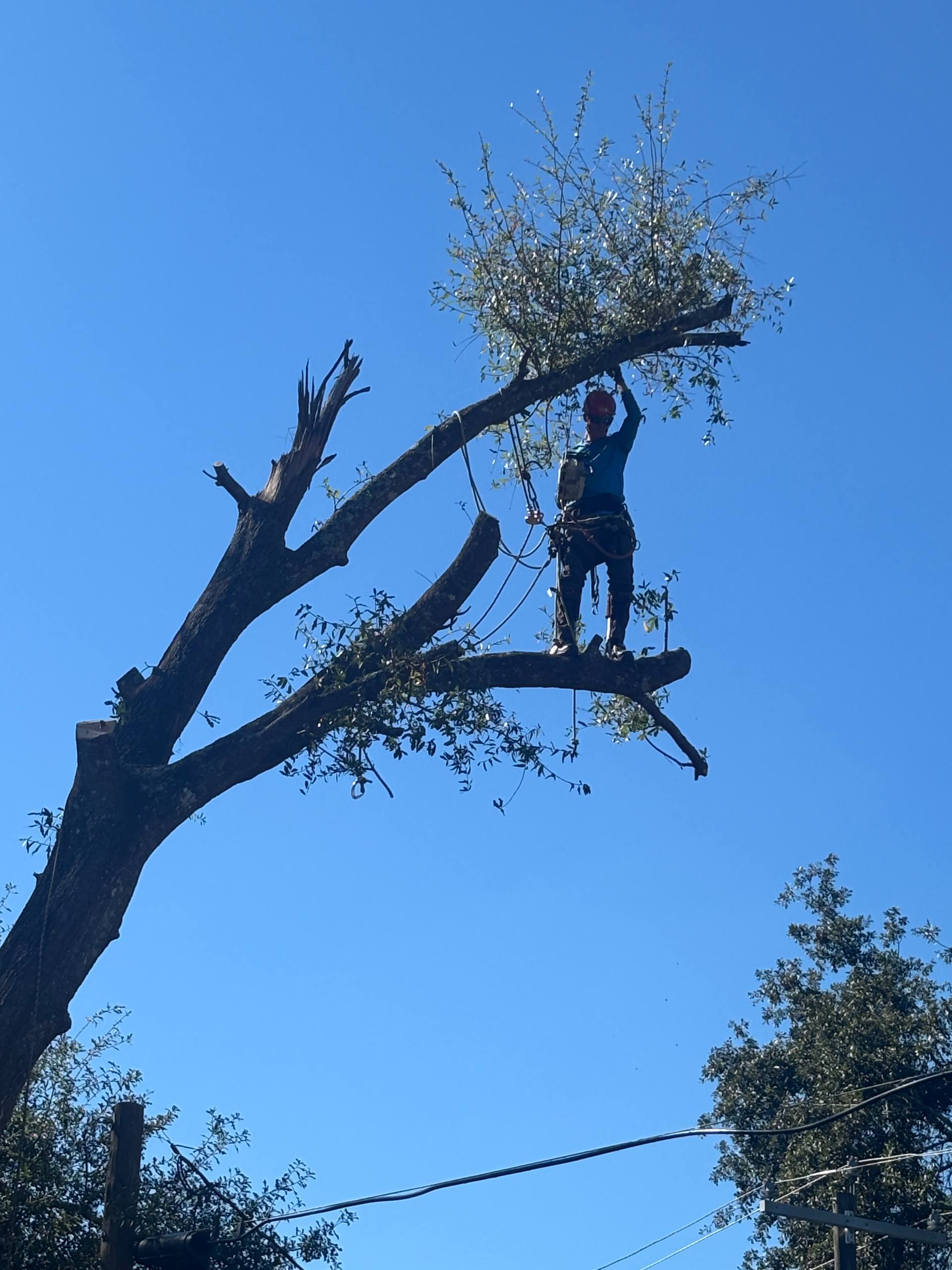
This is worth being direct about: taking down a large, mature pecan is not a small tree job. A 90-foot pecan with a 70-foot crown spread positioned near a house or fence requires planning, the right equipment, and a crew that knows what they're doing.
We regularly take down large pecans throughout South Georgia. We use a crane for the situations that require precise piece-by-piece control. We clean up completely and grind stumps to below grade. If you have a pecan that's concerning you, call us for a free evaluation, we'll give you an honest assessment of what it needs.
We serve all of South Georgia, including Thomas, Grady, Mitchell, Brooks, Colquitt, Lowndes, and Tift counties. Call (850) 570-4074 or request a free estimate online.