Why Pine Beetles Are a Serious Problem in This Region
If you have pine trees on your property in North Florida or South Georgia, you need to know about southern pine beetles. They're one of the most destructive forest insects in the southeastern United States, and when they hit a stand of pines (whether in a forest or a residential neighborhood) they can kill multiple trees in a matter of weeks.
The frustrating part is that once you notice the signs, the infestation has usually been underway for weeks or months already. By the time a pine looks visibly dead, the beetles inside have likely already moved to the next tree.
How to Tell If Your Pine Has Beetles
The signs appear in a predictable order:
1. Fading foliage that turns yellow, then red. A healthy pine's needles are deep green. When southern pine beetles attack, the needles turn yellow, then orange-brown, then a distinctive rusty red, all within 2-4 months of initial attack. If you notice a pine with leaves that look "off" compared to surrounding trees, look closer.
2. Pitch tubes on the bark. When a pine defends itself against beetle attack, it pushes resin through the bark entry points. These look like small, white or yellow-brown globules of hardened sap stuck to the bark, sometimes called "pitch tubes." They typically appear 2-10 feet up from the ground where beetles prefer to enter. Presence of pitch tubes with reddish sawdust (frass) at the base means the attack is actively underway.
3. S-shaped galleries under the bark. If you can get close enough to pull back loose bark on a tree that's been attacked, you'll see the characteristic S-shaped tunnels the beetles carve through the cambium layer just under the bark. This is definitive identification.
4. Small, round holes in the bark. Exit holes left by adults emerging from a dead tree look like they were made by an ice pick, circular, about 1/8 inch diameter. If you see many of these on a recently dead pine, beetles are the likely cause.
The Spread Pattern: Why Time Matters
Southern pine beetles don't attack trees randomly. They attack in a characteristic pattern: starting in a few weakened trees (usually those stressed by drought, lightning, root damage, or construction), then building population and spreading outward in a roughly circular or oval pattern that can expand several feet per week.
An infestation that starts with two dead pines can consume a dozen trees in a season if not addressed. The beetles complete multiple generations per year in Florida and Georgia's warm climate, which accelerates this process.
The trees you can't save: Any pine that already has fully red or brown needles is beyond saving. The beetles have already exited and the tree is dead.
The trees that may be savable: Pines that show early signs (yellowing foliage, pitch tubes, but still somewhat green) may benefit from professional intervention, but the window is short.
What to Do If You Find Beetle Damage
Call a professional immediately. This is not the situation for "let's wait and see." Every week that passes during an active infestation means more trees at risk.
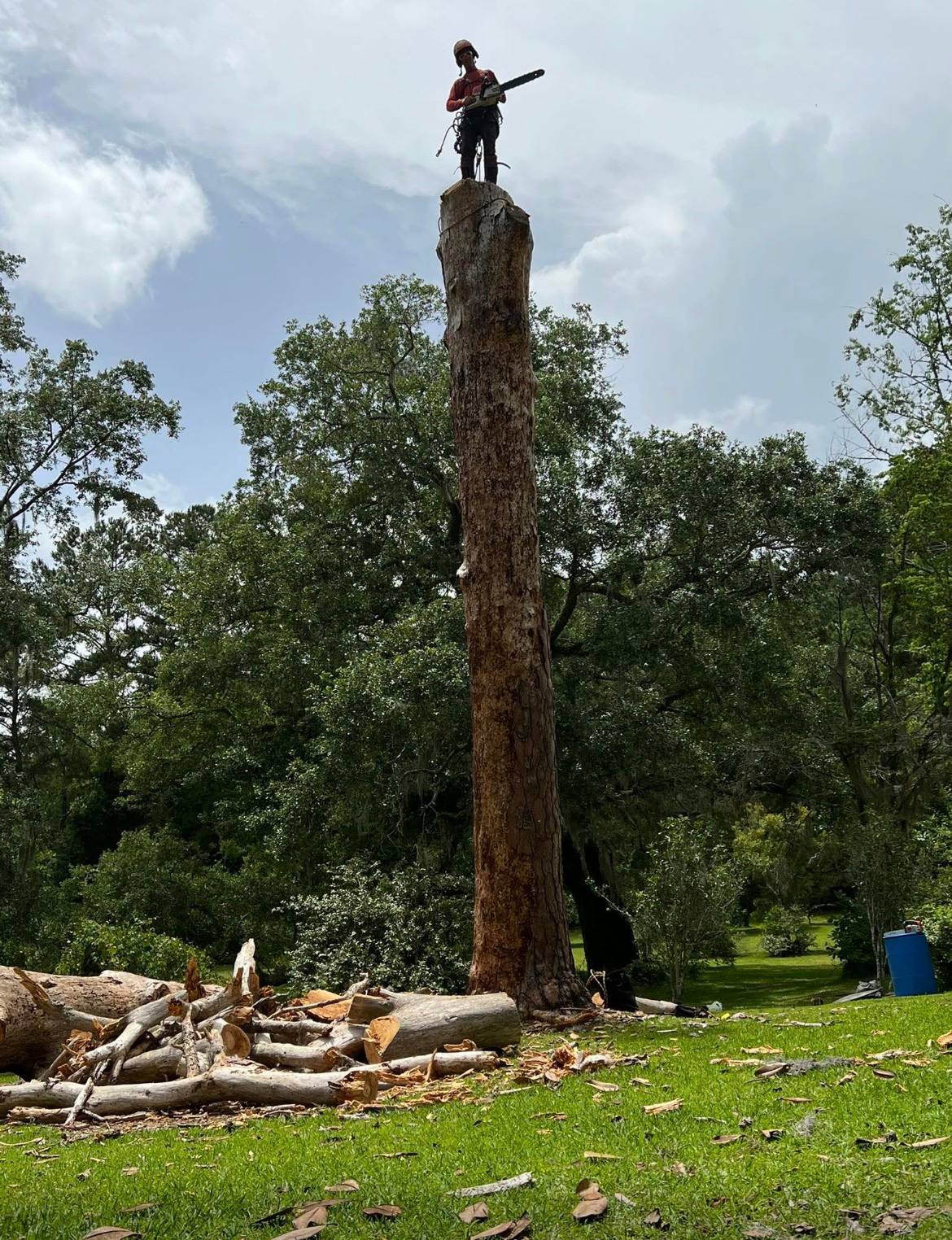
Remove infested trees promptly. Dead and dying beetle-infested pines should be removed quickly for two reasons. First, they present a falling hazard, a recently dead pine loses structural integrity within 6-18 months, depending on size. Second, removing them eliminates the beetle population inside before adults emerge and attack new trees.
Don't bring infested wood indoors. Cut logs from beetle-killed trees can harbor live beetles that will emerge and seek new hosts. If you're burning or chipping the wood, do it quickly.
Consider buffer trees. If your neighbor's pines are affected and yours are healthy, proximity is a risk factor. Keeping your trees healthy (proper irrigation, avoid root compaction, no construction near root zones) is the best defense.
Common Pine Species Affected in Our Area
Loblolly pine: The most common species in North Florida residential areas and one of the primary beetle hosts. Many neighborhoods in Leon, Wakulla, and Jefferson counties have dense loblolly stands.
Slash pine: Also common in residential and forest settings throughout the region. Frequently attacked.
Longleaf pine: Less susceptible than loblolly or slash, but not immune, especially when stressed.
Sand pine: Common in sandy upland areas. Can be attacked but is less frequently the primary target.
When to Remove vs. When to Watch
Remove now:
- Pines with fully red/brown needles (dead)
- Pines with confirmed active beetle attack and significant pitch tube presence
- Dead pines near structures, powerlines, or areas with foot traffic
Monitor closely:
- Adjacent healthy pines when a neighboring tree has been attacked
- Pines that show early yellowing but are still mostly green
You can't wait on this one. We see it every year, homeowners wait through the summer hoping the red-needled pine will somehow recover, and by fall they've lost 5 trees instead of 1. The math is simple: a healthy pine is worth keeping; a beetle-infested pine is a ticking clock.
If you see the signs, call us at (850) 570-4074. We serve Tallahassee, North Florida, and South Georgia and can assess your trees and help you understand the scope of any infestation. Free estimates, request one online.