Pine Species in North Florida
Three pine species dominate the North Florida landscape:
Longleaf pine (Pinus palustris), the historic native of the region, once covering millions of acres of the Southeast. Recognized by its long needles (10-15 inches), large cones, and distinctive grass-stage juvenile form. Slower growing, longer lived, fire-adapted, and highly valued. Relatively rare as a yard tree; more common in undeveloped areas and restored natural communities.
Loblolly pine (Pinus taeda), the most common commercial and residential pine in North Florida. Fast growing, adaptable, widely planted. Typical yard specimens in Tallahassee and surrounding areas. Lifespan in residential settings often 60-80 years.
Slash pine (Pinus elliottii), common throughout North Florida's coastal plain, often planted for timber. Similar in appearance to loblolly; identified by needle characteristics and cone shape. Also widely used in residential plantings.
Pine Tree Health: What to Watch For
Bark Beetle Infestation
Southern pine bark beetles are the primary health threat to pines in North Florida. These small beetles bore under the bark of stressed or weakened trees, introducing blue-stain fungi that disrupt water transport. A healthy tree can pitch out (push back) a few beetles with resin; a stressed tree cannot.
Signs of bark beetle infestation:
- Pitch tubes on the bark: small resin masses where beetles entered or were pushed back
- Sawdust-like frass at the base of the trunk or on the bark surface
- Reddish-brown needles beginning at the top of the crown and progressing downward (needles die top-first in most pine beetle situations)
- Small, round exit holes in the bark (about the size of a pencil tip)
- Presence of woodpecker activity: woodpeckers target beetle-infested wood
Important: By the time needles are turning brown, the beetles have usually completed their life cycle and moved on. The tree is already dead or dying. There is no effective treatment once bark beetles have successfully attacked a tree. The management response is removal to prevent the dead tree from becoming a hazard and to prevent the beetles from spreading to adjacent healthy pines.
Preventing bark beetle attacks:
- Maintain tree health: watering during drought, avoiding injury, mulching root zones
- Avoid pruning wounds during high-risk periods
- Remove dead or severely stressed pines promptly, they attract beetles and serve as breeding grounds
Turpentine Beetles
A related species (turpentine beetles (Dendroctonus terebrans)) attacks the base of pines rather than the mid-trunk. Damage appears as resin flow and frass at the base, usually within the first few feet of the trunk. Typically attacks stressed trees and can be distinguished from bark beetles by location.
Pitch Canker
Pitch canker (Fusarium circinatum) is a fungal disease causing resin-soaked cankers at branch unions and on the trunk. Affected branches die, beginning with needle browning at tips. Slash pine is particularly susceptible. There's no effective cure; management focuses on maintaining tree vigor and removing severely affected trees that present hazards.
Needle Diseases
Various needle diseases cause browning and needle drop, brown spot needle blight (affecting longleaf), Dothistroma needle blight, and others. Needle diseases are generally less serious than bark beetle attacks; affected trees can recover with improved vigor and, in severe cases, fungicide applications.
Pine Tree Hazard Assessment
Pines become significant hazards as they die. Key hazard indicators:
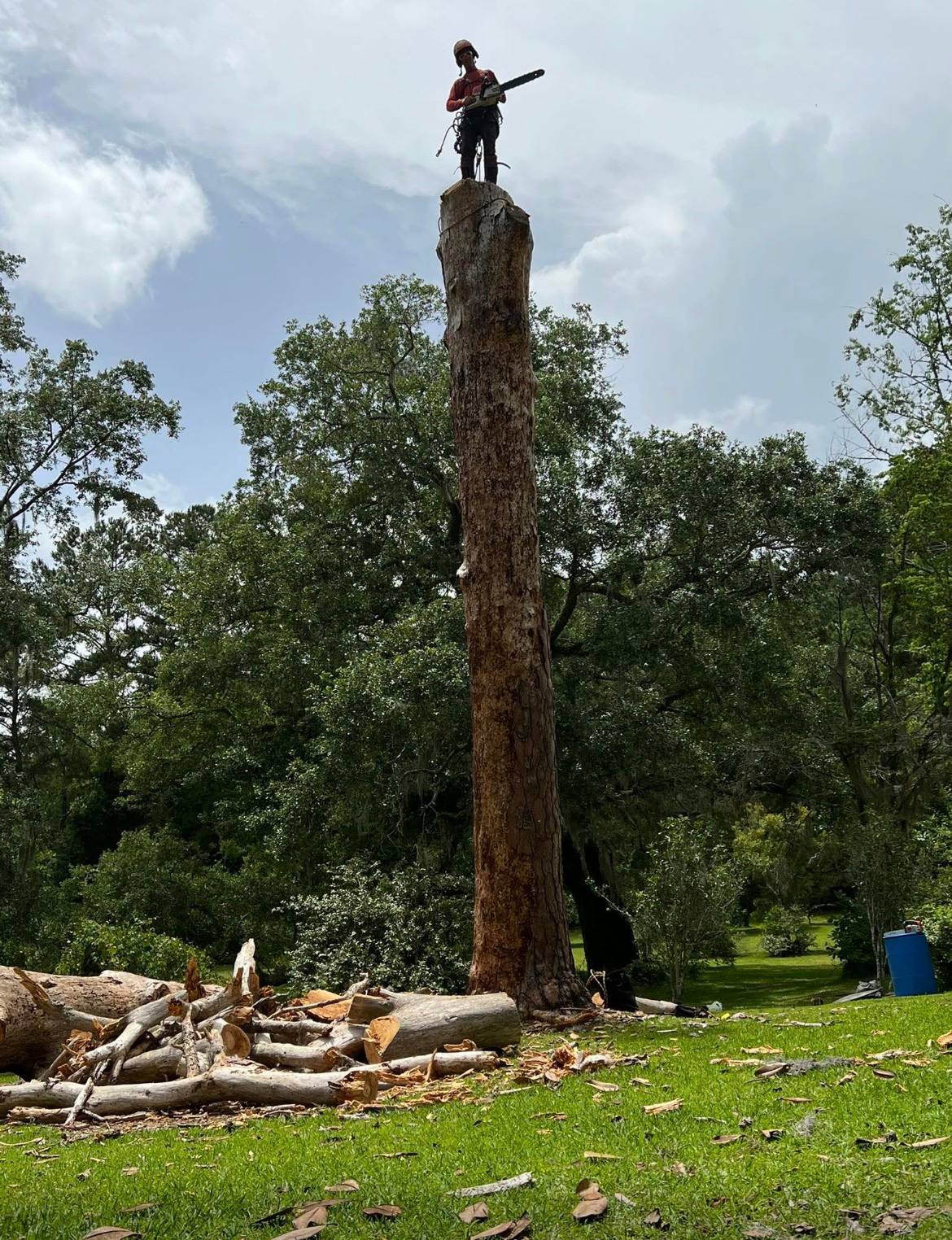
Dead or dying trees: A pine with completely brown needles and no remaining green foliage is dead. Dead pines retain structural integrity for 1-3 years, then begin to degrade rapidly. The top (the lightest, smallest diameter part) falls first, followed over time by increasingly large sections.
Lean: A pine that has developed a progressive lean (particularly if not historically leaning) should be evaluated. Pines in sandy soil can develop root zone problems that lead to sudden failures.
Root plate heave: Soil disturbance or mounding at the base of the root plate on the opposite side of a leaning tree indicates root failure on the tension side.
Top death (flagging): Dead branches at the very top of the crown while lower portions remain green can indicate lightning strike damage, early bark beetle attack, or other vascular issues.
Pine Removal: What's Involved
Pines are among the more technically demanding residential tree removals:
Height: Residential pines in North Florida commonly reach 60-80+ feet. Tall trees require either climbing, crane, or aerial lift equipment, depending on access.
Root plate and stump: Pine roots tend to be shallower than hardwoods, which facilitates stump grinding but means tall pines can have significant surface root presence around the base.
Wood volume: A large pine produces significant wood volume. Whether it's chipped, left as logs for other uses, or hauled away affects both logistics and pricing.
Fire hazard near structure: Dead pine needles are highly flammable. Dead pines adjacent to structures carry fire risk during dry periods, an additional reason to address them promptly.
Questions about pine trees in Tallahassee? Call (850) 570-4074 or request an assessment online.