What Crown Raising Is
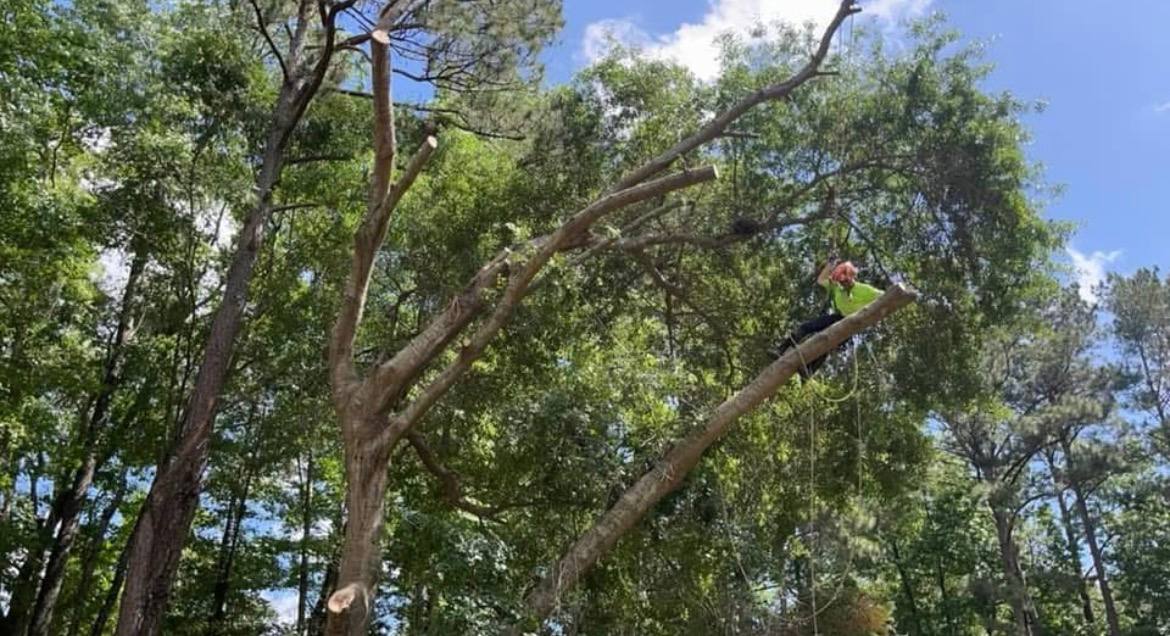
Crown raising (also called crown lifting) is the removal of lower branches to increase the clearance between the ground and the lowest living branches of a tree. The goal is to create usable space under the tree, for vehicles, pedestrians, lawnmowers, sight lines, or simply to reduce the enclosure effect of a low-hanging canopy.
This is one of the most common requests we get, particularly from homeowners with live oaks, water oaks, or other large canopy trees that have grown to where the lowest limbs are at head height or lower.
When Crown Raising Makes Sense
Vehicle clearance: Limbs hanging over a driveway at windshield height or lower. Raising the crown creates clearance for vehicles without removing the tree.
Pedestrian clearance: Low limbs over walkways, sidewalks, or paths. Standard clearance for pedestrian areas is 7-8 feet minimum.
Mowing: Limbs that make mowing under the tree difficult or dangerous. Raising the crown allows mower access.
Light and visibility: Dense low canopy can block views and reduce light to windows and adjacent planting. Selective lower limb removal opens views while preserving the tree's overall form.
ANSI standard: Professional crown raising follows ANSI A300 standards, which specify that no more than 1/4 of the live crown should be removed in a single pruning session to avoid excessive stress on the tree.
What Crown Raising Doesn't Do
Crown raising changes where the canopy starts, it doesn't reduce the size or wind resistance of the upper canopy. If your concern is canopy weight or wind load reduction, that requires crown thinning or crown reduction, not crown raising.
It also doesn't change the spread of the canopy, if a tree's branches are extending over your neighbor's property, crown raising won't address that horizontal spread.
Limits: The 1/3 Rule and Bark Ridge Principle
Don't remove more than 1/3 of the live crown in one pruning. Removing too many live branches at once stresses the tree. If significant crown raising is needed, stage the work over 2-3 years.
Make cuts at branch unions, not mid-limb. Proper crown raising removes limbs at the connection point with the trunk or parent branch, not at an arbitrary height. Stub cuts leave dead wood that invites decay and is visually unappealing.
Avoid lion's tailing: Some improper pruning involves stripping foliage from the interior of limbs to create clearance, leaving foliage only at the tips. This creates mechanical leverage problems and isn't proper crown raising.
North Florida Live Oak Considerations
Live oaks in North Florida often develop large, sweeping lower limbs that extend outward and downward before curving back up. Removing these limbs is often straightforward on smaller branches, but on mature specimens, large lower limbs can be significant structural elements. Professional assessment and proper technique matter particularly on large, old live oaks.
Questions about crown raising or clearance pruning? Call (850) 570-4074 or request a consultation online.