The Most Overlooked Tree Planting Problem
Walk around any residential neighborhood in Tallahassee and look at the base of the trees. A large proportion of them (planted by well-intentioned homeowners, landscapers, and even some tree services) have their root flares buried under soil and mulch.
This is one of the most common causes of premature tree decline. It happens during the original planting, and the symptoms show up years later when the damage is already advanced.
What the Root Flare Is
The root flare (also called the root collar) is the area at the base of the trunk where the trunk transitions into the root system. On a healthy, properly planted tree, this area flares outward visibly, the trunk gets wider as it meets the ground.
This transition zone is critical. The bark above and below the root flare has different properties:
- Trunk bark above: designed to handle air and light, moderately resistant to moisture
- Root bark below: designed to function underground, adapted to soil contact
- The root flare itself: the transition zone, must not be chronically buried
When soil covers the root flare:
- The root flare bark doesn't tolerate prolonged moisture and burial
- Decay organisms colonize the buried tissue
- Girdling roots often develop in the buried zone, circling the trunk
- The tree's gas exchange at the root zone is disrupted
What Deep Planting Looks Like Over Time
A tree planted too deep usually looks fine for 5-10 years. The tree is growing on stored energy and surviving on the roots it established before the decay processes advanced.
Then: gradual decline. Smaller leaves than expected. Thinning canopy. Dead branches appearing without obvious cause. The tree looks stressed, but disease testing shows nothing specific. Fertilization doesn't help. Irrigation doesn't help.
Eventually the tree fails entirely, sometimes from Phytophthora root rot, sometimes from structural failure at the buried and weakened root collar, sometimes from secondary infections.
The diagnosis: too deep planting that started a decade earlier.
How It Happens
Planting hole too deep: The most common cause. Planting hole dug deeper than the root ball height, with loose soil underneath that settles over time.
Soil added over time: Mulch applied heavily year after year eventually buries the root flare. The "mulch volcano" (a pile of mulch mounded against the trunk) is a landscape epidemic that slowly suffocates root flares across North Florida.
Nursery issues: Some nursery stock has soil added to containers during production that already buries the root flare before you buy it. The visible top of the root ball in the container may not be the correct planting depth, the actual root flare may be 2-4 inches below the container soil surface.
Grade changes: Construction or landscape grading that raises the soil level around an existing tree buries the root flare of a previously well-planted tree.
How to Check Your Trees
Stand back and look at the base of your trees. On a properly planted tree:
- The base of the trunk should flare visibly where it meets the ground
- You should see the top of the first major roots at or near the soil surface
- The trunk should not go straight into the ground like a telephone pole
If the trunk goes straight into the ground with no visible flare, the root flare is likely buried.
Confirm by digging: Carefully dig around the base of the trunk, just a few inches deep and out about 12 inches in all directions. If you find buried root flare, girdling roots, or fungal growth at the root collar, the tree needs intervention.
What Can Be Done
If the problem is caught early enough:
Root collar excavation: Carefully remove the soil covering the root flare, exposing it to air. This is delicate work, done incorrectly, excavation causes more damage than it prevents. The buried trunk tissue needs to dry out and the root collar area should stay exposed.
Remove mulch from the trunk base: At minimum, pull mulch away from the trunk base to leave 3-6 inches of bare soil around the trunk. This doesn't undo buried planting, but it stops making it worse.
Address girdling roots: If girdling roots are found during excavation, selective removal (done carefully so as not to destabilize the tree) can relieve the strangling effect.
If the decay is advanced, options are limited. A tree with significant root collar rot and well-established girdling roots may be past the point of meaningful intervention.
The Fix for New Plantings
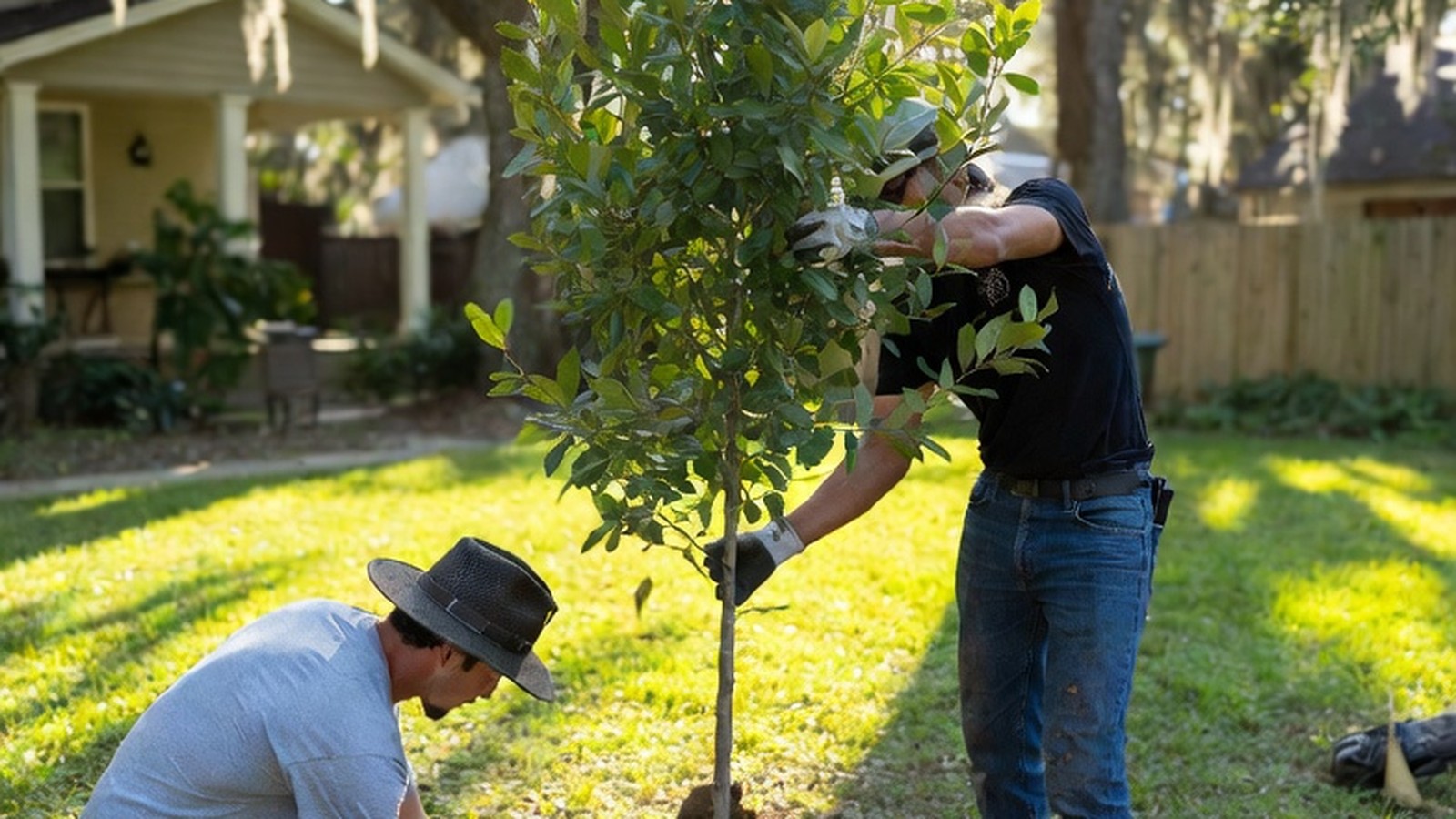
Plant at the right depth from the start:
- Identify the actual root flare, the topmost root on the tree, which may be below the container soil surface
- The root flare should be at or just above grade after planting
- The planting hole should not be deeper than the root ball height (to prevent settling below grade)
- Mulch 3-4 inches deep in a ring, keeping 3-6 inches clear around the trunk base
Getting this right takes 10 extra minutes on a planting job. Getting it wrong costs the tree 20 years.
Concerned about a tree that may be planted too deep in Tallahassee? Call (850) 570-4074 or request an assessment online.