Before You Cut It Down, Read This
A large live oak develops a split crotch and suddenly you're getting quotes for removal. A heavy lateral limb hangs over the roof and everyone says it has to go. Before you commit to taking down a mature tree (especially a protected live oak or a century-old shade tree) there's a question worth asking:
Can it be saved with structural support?
The answer is often yes. Tree cabling and bracing is a legitimate, widely-used arboricultural technique that stabilizes structurally compromised trees, often adding 20 or 30 years of safe life. It's not a last resort or a band-aid, it's standard practice for managing valuable trees with structural risk.
What Is Tree Cabling?
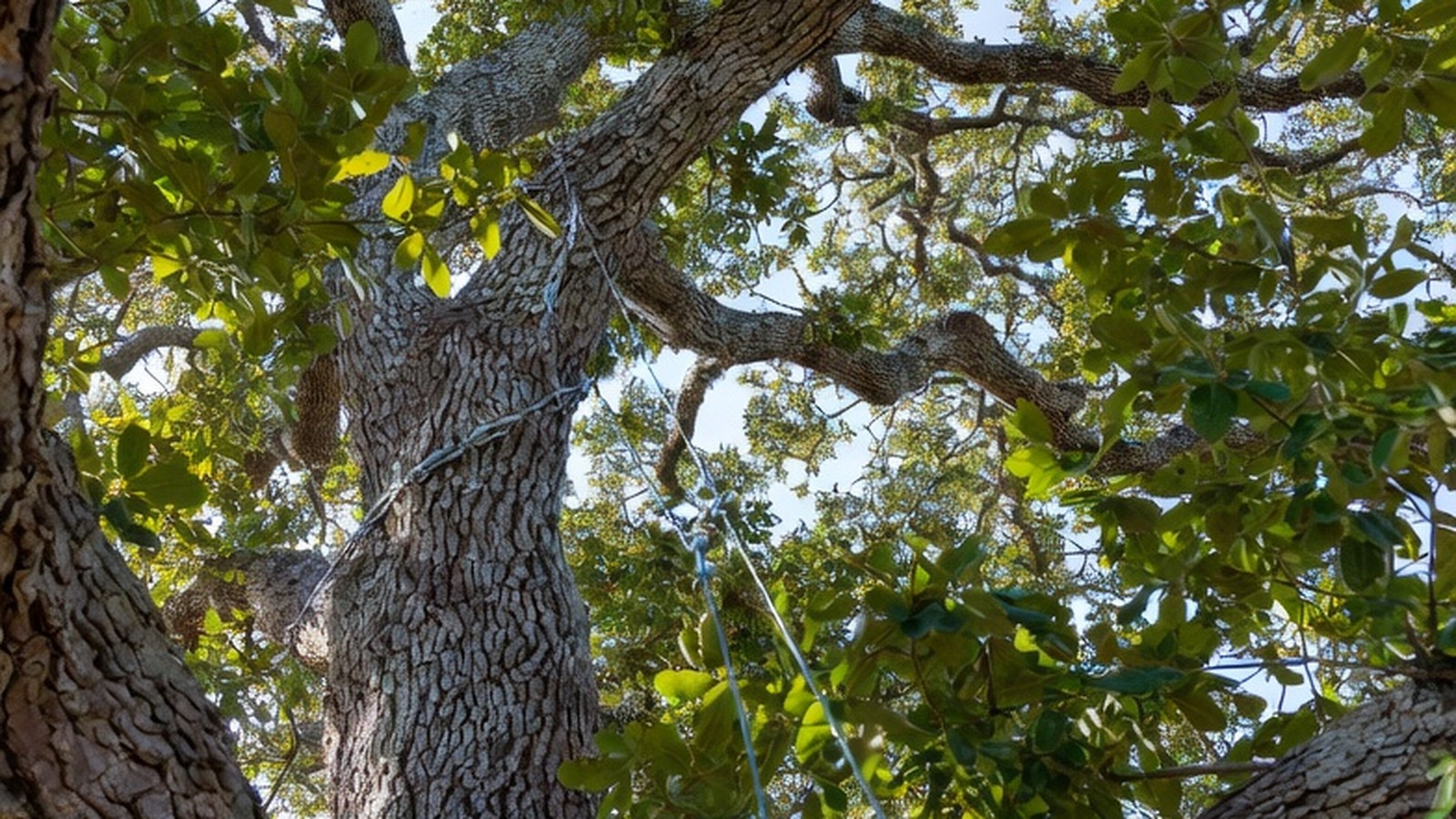
Cabling installs high-strength steel cables (or synthetic rope systems, depending on the application) between major limbs or stems to limit movement and distribute load. The goal isn't to hold a tree together like a splint, it's to reduce the amplitude of movement so that structural weak points aren't subjected to the forces that cause failure.
A properly installed cable system:
- Limits how far a codominant stem can split outward under wind load
- Transfers some of the weight of a heavy horizontal limb back toward the trunk
- Reduces stress on included bark unions (the most common failure point in mature trees)
- Allows the tree to continue growing and functioning normally
The hardware (typically threaded eye bolts installed through sound wood above the weak point) is sized to the tree and positioned to be effective without causing unnecessary damage.
What Is Bracing?
Bracing uses threaded steel rods installed through a split or crack in wood to physically hold cracked sections together and prevent further separation. Where cabling limits dynamic movement, bracing addresses static structural failure that has already started.
Bracing is used when:
- A crotch has already begun to split and cannot be left unsupported
- A significant crack has opened in a trunk or major limb
- A previously narrow-angle union is showing signs of failure at the included bark
Cabling and bracing are often used together, bracing to stabilize a split, cabling to reduce the loads that would worsen it.
When Is Cabling Appropriate in North Florida?
In Tallahassee and the surrounding area, the most common candidates for cabling are:
Live oaks with codominant stems. This is the big one. Live oaks (Quercus virginiana) frequently develop two or more trunks of roughly equal diameter growing from a single base. When both stems grow together, they often form an included bark union, a weak point where bark is compressed between the stems rather than proper wood-to-wood attachment. These unions are prone to sudden failure, especially after years of growth have widened the angle.
If you have a mature live oak with a V-shaped crotch, get it evaluated. Codominant stems with included bark are one of the leading causes of large-limb failure in Tallahassee neighborhoods.
Water oaks with heavy horizontal limbs. Water oaks (Quercus nigra) grow fast and develop wide-spreading crowns. The long horizontal limbs that make them beautiful also create significant lever arm forces at the attachment points. Cabling a problematic limb is almost always preferable to removing it, losing a major limb can destabilize the entire crown.
Pecans in South Georgia. Pecan trees are prone to branch failures as they age, especially on the large, heavy-laden limbs that develop in mature specimens. Cabling is common orchard management practice in commercial operations and applies equally to yard trees.
Storm-damaged trees. After a significant split (from wind, ice, or lightning) a tree may still be structurally viable if the damage is addressed quickly. We've successfully stabilized trees that looked like losses after storms with a combination of bracing at the split and cabling above.
When Cabling Won't Work
Cabling is not a cure-all. There are situations where it genuinely can't make a tree safe:
- Advanced internal decay: if the wood where hardware would be installed has rotted, there's nothing solid to anchor into
- Root failure: a tree that's already leaning due to root plate movement is a falling tree that cabling can't stop
- The tree is already beyond the tipping point: some splits have progressed too far to stabilize. We assess this before recommending any approach
- The target zone: if the tree falls in any direction and there's nothing of value to protect, the cost-benefit of cabling changes considerably
We will always tell you honestly whether cabling makes sense for your situation. Sometimes the right answer is still removal.
What the Installation Looks Like
A cabling job on a residential live oak typically takes one to three hours. Our crew climbs the tree, installs hardware at the appropriate height (generally two-thirds of the distance from the weak point to the tree top), and tensions the system.
After installation:
- The hardware is mostly invisible from the ground
- The tree continues to grow normally: hardware is checked and adjusted on a schedule, typically every 3-5 years
- You'll want to let us know if you observe any changes (new cracking sounds, visible movement in the hardware, storm events) so the system can be re-evaluated
The Economics of Cabling vs. Removal
This calculation is almost always in favor of cabling for a mature, healthy tree with localized structural issues.
A protected live oak removal in Tallahassee (including permits, crew time, crane if needed, debris hauling, and stump grinding) runs several thousand dollars. Cabling the same tree is almost always significantly less expensive and preserves a tree that took 60 or 80 years to grow.
There's also the landscape value. Mature shade trees add measurable property value. Replacing a 70-year-old live oak with anything that looks remotely similar takes 30+ years.
Have a tree with a split trunk, heavy overhanging limb, or codominant stems? Give us a call at (850) 570-4074: we'll assess it and tell you honestly whether cabling is an option. We serve Tallahassee, Leon County, and all of North Florida and South Georgia. Request a free estimate online.