Why Tree Removal Pricing Is Never One Number
"How much does it cost to remove a tree?" is one of the most common questions we get, and it's also one of the hardest to answer without seeing the tree.
Tree removal pricing in Tallahassee isn't like buying a product with a set price. Two trees of the same species can have dramatically different removal costs depending on where they're located, what's around them, how they're oriented, and what needs to happen to the debris. Understanding what drives the price helps you evaluate quotes accurately and know whether a bid is fair.
The Primary Factors
1. Tree Size
The single biggest factor. A 20-foot water oak is a fundamentally different job from a 60-foot water oak, different equipment requirements, different crew time, different debris volume.
We generally think about trees in rough size categories:
- Small (under 25 feet): shrubs, small ornamental trees, young trees. These jobs are typically the most straightforward.
- Medium (25–50 feet): Most residential understory trees fall here. The bulk of tree removal calls in Tallahassee are in this range.
- Large (50–75 feet): Mature oaks, large pines, mature pecans. These require more equipment and crew.
- Very large (75+ feet): Old-growth live oaks, very large pines, any tree that has grown to exceptional size. These are specialized jobs.
We don't publish pricing by size category because the other factors below affect the final number too significantly.
2. Location and Access
A tree in the middle of an open lawn is the easiest possible removal, equipment can park close, there's room to lay sections on the ground, and nothing is in the way.
A tree of the exact same size located between a house and a fence, over a roof, or in a backyard accessible only through a narrow gate is a completely different job. These scenarios require:
- Section-by-section removal (pieces lowered by rope or crane rather than felled)
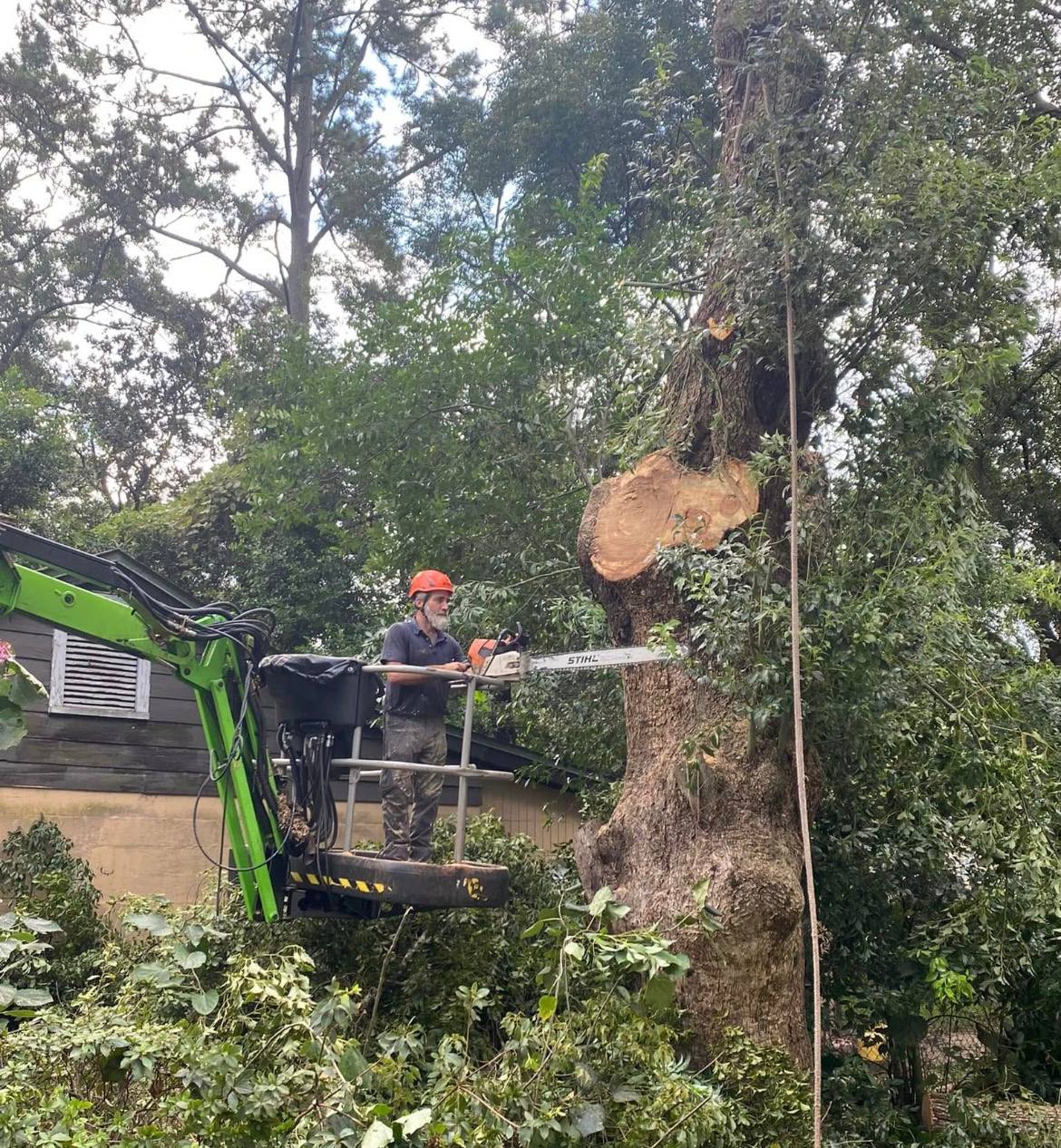
- Crane use when overhead or tight-access conditions make sectional removal necessary
- Extra crew time for the precision work required
- More complex logistics
Crane work specifically (when required) adds significant cost because of the equipment day rate and the specialized expertise needed to direct crane operations safely. We have a full post on when crane removal is necessary and what it looks like.
3. What's Below and Around the Tree
A tree over an open yard leaves the debris handling options open. A tree over a pool, over a power line service drop, or pressed against a structure has zero margin for error. That complexity is priced accordingly.
The most expensive removals we do are trees that are partially failed, partially over a structure, and can't be safely worked from the ground. These require bucket truck or crane work regardless of tree size.
4. Debris Handling
How do you want the wood and debris handled?
- Chip and haul: We chip the brush on-site and haul away the chips. This is the most common option and is included in standard removal pricing for most jobs.
- Leave chips on-site: We chip and leave the material in a pile or spread it. This reduces cost slightly and gives you mulch material if you want it.
- Log lengths left: If you want firewood, we can leave trunk sections cut to length. This doesn't typically reduce cost much (the cutting work is the same) but you keep the wood.
- Full haul: All material including trunk sections leaves the property. Standard for most residential jobs.
Large volumes of trunk wood from very large trees may require dump truck hauls, this adds cost compared to chipper-only jobs.
5. Stump Grinding
Stump grinding is usually priced separately from tree removal. It's not included in removal pricing unless specifically stated.
Stump grinding cost depends on stump diameter (measured at ground level). Surface roots extending outward from the stump add to the grinding time.
Not every stump needs to be ground immediately, but if the area will be replanted, developed, or used for lawn, grinding before doing that work is significantly easier and cheaper than trying to work around stumps later.
6. Emergency and Storm Conditions
Emergency removal (tree on a structure, imminent fall hazard, post-storm work) is priced at a premium over standard scheduled removal. Crews are dispatched out of normal routing, work may be required at night or in poor conditions, and equipment may need to respond quickly.
If you're not in an emergency situation, scheduling the work in advance almost always saves money.
What Doesn't Affect Pricing (That People Assume Does)
How long you've been a customer. We price based on the job, not on loyalty. A fair price for the work is a fair price.
The reason for removal. Whether you're removing a tree because it's dead, diseased, or you just don't want it anymore doesn't affect what the work costs.
The species alone. Species matters because it affects size potential and wood density, but we're not going to quote a live oak removal differently from a pine removal of identical size and complexity just because it's a live oak.
Getting an Accurate Quote
Photos help significantly for initial estimates. For a standard residential tree that isn't over a structure, photos from multiple angles (base, full tree height, what's around it) often let us give you a number over the phone or via text.
For complex removals (crane work, trees over structures, large-acreage clearing) a site visit is better. You get an accurate number and we know exactly what we're committing to.
We don't charge for estimates. Call (850) 570-4074 or request an estimate online with photos.
A Note on Lowball Quotes
In any market with multiple tree service providers, you'll occasionally see quotes that seem remarkably low. A few things to check:
- Is the company insured? Ask for proof of liability insurance and workers' comp.
- Is the quote written? Get it in writing with a scope of work.
- What's actually included? Stump? Debris haul? Make sure you're comparing the same scope.
Uninsured or underinsured tree work leaves you liable if something goes wrong on your property. It's not worth the savings.
Call (850) 570-4074 for tree removal estimates throughout Tallahassee, Leon County, North Florida, and South Georgia. Request an estimate online, photos help us turn quotes around quickly.