Commercial Tree Maintenance: Different Requirements
Commercial properties (office parks, retail centers, medical campuses, industrial facilities, HOA common areas, apartment complexes) have tree maintenance needs that differ from residential work in several important ways.
Liability exposure: A dead limb falling on a customer's car, or a hazard tree failing onto a building, creates liability exposure for commercial property owners. Documented, regular tree maintenance is both good practice and risk management. Written records of assessments, work performed, and hazard identification are valuable in the event of a claim.
Regularity and planning: Commercial properties benefit from scheduled, systematic maintenance rather than reactive service after problems develop. Annual or bi-annual inspections, seasonal pruning programs, and planned removal of declining trees fit a property management schedule better than emergency calls.
Documentation: Insurance requirements, lease agreements, or property management contracts sometimes specify tree maintenance and documentation. ISA arborist assessments with written reports satisfy these requirements.
Access and hours: Commercial properties often have traffic, customers, or business operations that affect when and how tree work can be performed. Early morning starts, lane restrictions, or phased work may be needed.
Typical Commercial Tree Services
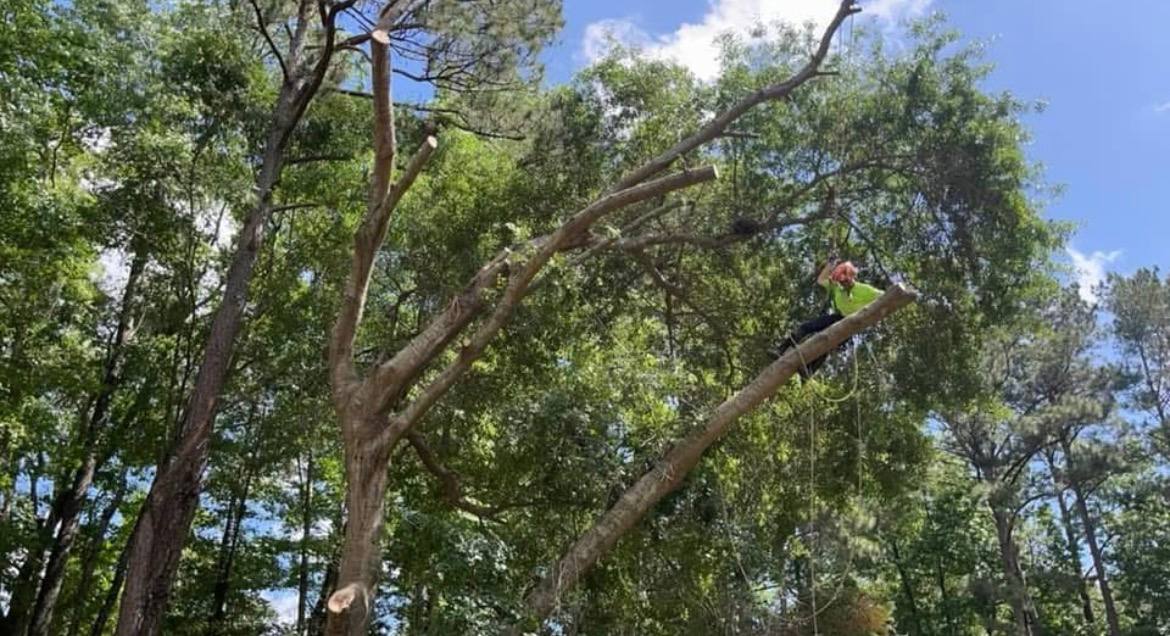
Crown maintenance pruning: Removing deadwood, crossing branches, and structural problems from the tree canopy on a scheduled basis. For most commercial properties, this is the core of a tree maintenance program, keeping existing trees healthy and hazard-free rather than letting issues develop.
Clearance pruning: Maintaining clearance over parking areas, walkways, building entries, and signage. Branches that impede parking lot lighting, hang over pedestrian areas, or obscure signage are common commercial pruning priorities.
Hazard tree removal and replacement: Declining trees should be removed proactively before they fail. Commercial properties are better served by planned removal with replanting than by emergency removal after a failure causes damage.
Storm preparation and response: Before storm season, a proactive assessment identifies trees with structural issues that increase failure risk. After storms, we provide prioritized commercial property cleanup.
Stump grinding: Following removals, stump grinding maintains the property's appearance and eliminates hazards (tripping, equipment damage) in parking areas and turf.
Parking Lot Trees: Common Issues
Parking lot trees (crape myrtles, live oaks, and other species planted in islands or perimeter strips) face challenging conditions:
Soil volume limitations: Planting strips and islands have limited soil volume. Restricted root zones limit tree growth and health.
Compaction: Vehicle overhang, adjacent pavement, and foot traffic from all sides compresses the soil.
Heat island effect: Pavement radiates and absorbs heat. Surface temperatures in parking lots significantly exceed ambient temperature, increasing water demand.
Root-pavement conflict: Tree roots and pavement are inherently in tension over time. Proactive root management, flexible pavement designs, and eventually replacement when root-pavement conflict becomes severe are all options.
For existing parking lot trees, maintaining soil health (mulching where possible, avoiding compaction), adequate irrigation during establishment, and appropriate species selection for future plantings are the practical management tools.
HOA and Multifamily Properties
HOA common areas and multifamily properties have specific dynamics:
Multiple decision-makers: Tree decisions in HOA common areas may require board approval, vendor contracts, or budgeting cycles.
Shared liability for common areas: Hazard trees in common areas create shared liability concerns. Documented maintenance and hazard assessment records protect the HOA.
Resident trees vs. common area trees: The line between individual homeowner trees and common area trees can be a source of conflict. Clear policies (in HOA documents and in maintenance contracts) about who maintains what help manage this.
Budget planning: Significant tree work (major hazard removals, replanting programs) can be planned into annual or multi-year HOA budgets.
Working With Property Managers
We work with property managers directly. For commercial accounts:
- Written scope of work before each job
- Insurance certificates available upon request (general liability + workers' comp)
- Scheduled maintenance programs with defined intervals
- ISA-certified arborist involvement for assessments, hazard documentation, and complex work
- Post-work documentation suitable for your records
Commercial tree service in Tallahassee? Call (850) 888-5603 or request a commercial consultation online.