What Topping Is and Why It Gets Recommended
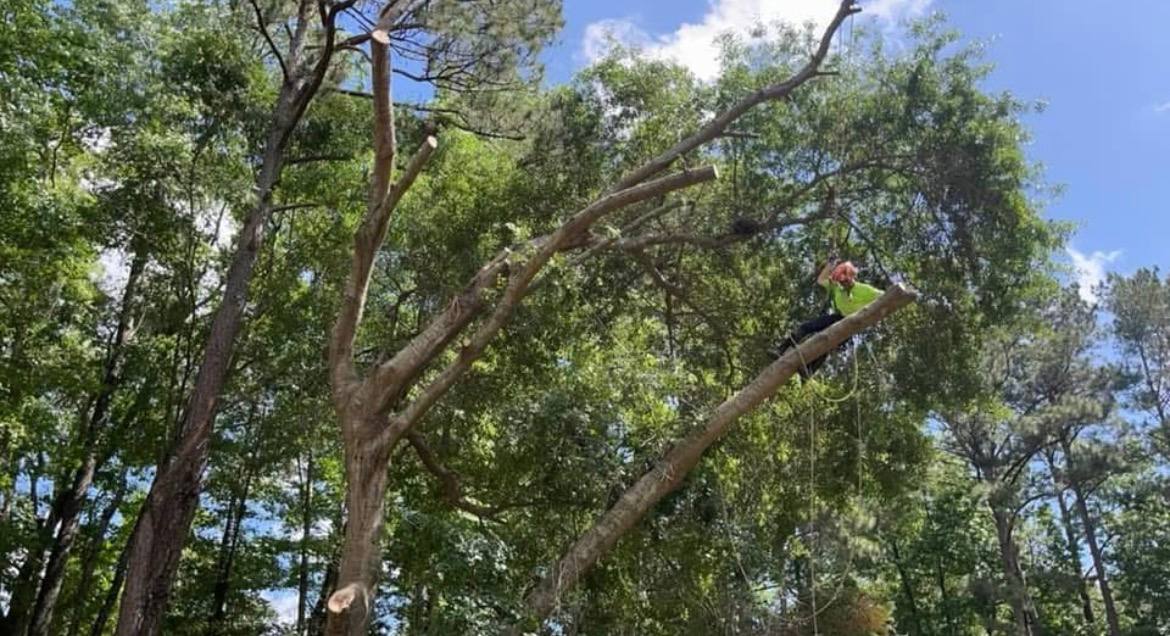
Tree topping is the practice of cutting back major branches to stubs, removing large sections of the canopy without regard for branch structure or the tree's natural growth pattern. The remaining stubs are often 4–8 inches in diameter with no attached leaf growth.
It gets recommended for two reasons: it makes trees look smaller immediately, and it's fast work. Neither reason reflects what's actually good for the tree or the property owner.
The ISA (International Society of Arboriculture) considers topping harmful tree care practice. No credentialed arborist recommends topping a healthy tree.
Why Topping Damages Trees
Large wounds that can't be sealed. Trees compartmentalize wounds through a process called CODIT (Compartmentalization of Decay in Trees). A small pruning cut on a lateral branch can be sealed over time, limiting decay spread. A large-diameter stub cut (the kind left by topping) cannot be sealed effectively. Decay enters the wound, spreads through the limb, and can advance into the trunk.
Weakly attached regrowth. Trees respond to topping by pushing vigorous new growth (epicormic sprouts or water sprouts) from just below the cut. This regrowth grows fast, is poorly attached to the underlying wood (attached only at the surface, not embedded in the structure), and creates exactly the kind of structurally weak limbs that pose a storm hazard. Within a few years, a topped tree often has more structurally dangerous wood than before it was topped.
Accelerated decline. Removing 50–80% of a tree's leaf surface in one operation puts enormous stress on the tree. The leaves are where photosynthesis happens, the energy source for root maintenance and continued growth. Removing this much photosynthetic capacity at once forces the tree to draw on its carbohydrate reserves, weakens it, and makes it more susceptible to insects and disease.
Increased long-term cost. Trees that have been topped require more frequent pruning to manage the weakly attached regrowth. They're often removed sooner than they would have been without topping. The "savings" of cheap topping work compound into higher costs over time.
What Topping Is Often Sold As
Topping gets proposed under various names and justifications:
- "Making it safer": in reality, topping creates the weakly attached, vigorous regrowth that's most likely to fail in a storm. Proper structural pruning reduces risk; topping increases it.
- "Reducing size": yes, temporarily. Within 2–3 growing seasons the water sprout growth often exceeds the original canopy density. Nothing has been permanently reduced.
- "Reducing storm risk": see above. Precisely backwards.
- "Vista pruning" or "raising" done excessively: sometimes topping is presented as normal pruning. If large-diameter cuts are made at stubs rather than at lateral branches, it's topping regardless of what it's called.
What Proper Pruning Actually Looks Like
Cuts are made at branch unions. A properly placed pruning cut removes a branch at its attachment point to a larger branch or the trunk. The cut follows the branch collar (the slight swelling at the base of the branch) which contains the tissue the tree uses to seal the wound.
No large stubs. Properly pruned trees have no large-diameter stubs. If there are stubs, cuts were made in the wrong place.
Removed material is lateral branches, not main stems. The crown can be reduced by selectively removing lateral branches that extend beyond the target size. This is called reduction pruning or crown reduction, it's done properly when the removed branches are replaced by retained laterals, maintaining the tree's natural form at a smaller size.
ISA standard compliance. The ISA's ANSI A300 pruning standards govern what appropriate tree pruning looks like. A Certified Arborist works within these standards.
What to Do With a Tree That's Already Been Topped
If a tree on your property was topped by a previous owner, landscaper, or uninformed tree service, you're working with a compromised tree. Options:
Wait and assess. In some cases, topped trees can recover with proper care. They'll never be the structurally sound tree they would have been, but with correct maintenance pruning of the regrowth (training the epicormic sprouts into somewhat better structure over time), some trees can be extended.
Plan for eventual removal. A badly topped tree with significant decay at the stub wounds is on a trajectory toward failure. It's worth monitoring and having a timeline for removal before it becomes a structural emergency.
Don't compound the damage. Topping it again is not the answer. If the regrowth is getting too dense or large, proper crown reduction can address it.
We assess previously topped trees as part of any property evaluation. If you've inherited a topped tree, let us tell you honestly what you're working with.
What We Practice
We perform structural pruning following ISA standards. We don't recommend topping. If someone quotes you a job that involves cutting back to stubs, get a second opinion from an ISA Certified Arborist before agreeing to the work.
Questions about a tree's pruning history or condition? Call (850) 570-4074 or request an assessment online. We serve Tallahassee, North Florida, and South Georgia.