Tree trimming is one of those services where "what does it cost?" doesn't have a useful single answer without more information. The honest range in Tallahassee runs from around $150 for a small, accessible ornamental to well over $2,000 for a mature live oak with a sprawling canopy. The difference is real, and it comes down to a handful of predictable factors.
Here's what drives pricing in this area, what you can expect for different tree sizes, and how to make sense of quotes you receive.
Tree Trimming Cost by Size in Tallahassee
Size is the biggest single factor in price. Taller trees require more equipment, more time in the air, and more crew on the ground managing falling wood.
| Tree Height | Typical Price Range |
|---|---|
| Small (under 20 ft) | $150 – $300 |
| Medium (20 – 40 ft) | $300 – $700 |
| Large (40 – 60 ft) | $700 – $1,200 |
| Very Large (60 ft+) | $1,200 – $2,500+ |
These are ballpark ranges for a single tree in a reasonably accessible location. A grove of five medium trees will cost less per tree than five individual mobilizations. A very large tree in a tight backyard with no equipment access will push toward the top of the range or beyond.
What Affects the Price Beyond Size
Height and canopy spread. A 50-foot loblolly pine that grows straight up is a different job from a 50-foot live oak with lateral branches extending 40 feet in every direction. Live oaks in particular have complex, wide-spreading canopies that require more time to work through safely.
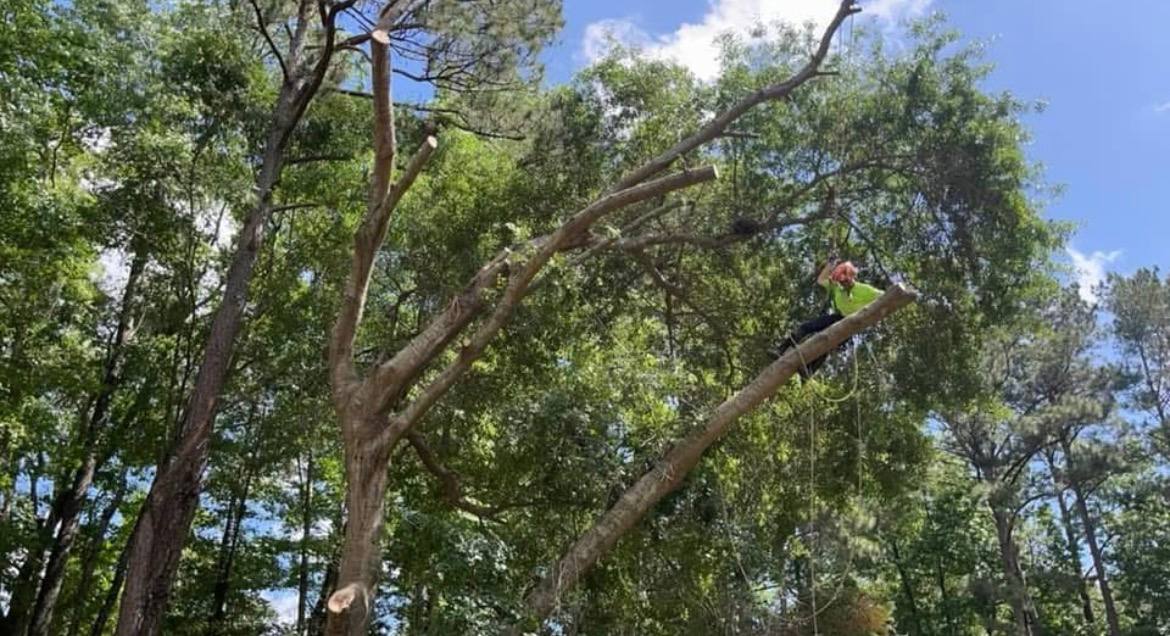
Access. Can a bucket truck or aerial lift get to the tree? If yes, the work goes faster and costs less. If the tree is in a fenced backyard with a 3-foot gate, or on a slope that equipment can't safely navigate, everything is done by climbing. Climbing work is skilled, slower, and priced accordingly.
How long since the last trim. A tree that gets trimmed every two to three years is a maintenance trim: remove the deadwood, clean up the crown, make the corrective cuts. A tree that hasn't been touched in fifteen years is a different project entirely. Overgrown canopies have more wood to remove, more structural issues to address, and more debris to haul. Expect to pay more for catch-up work than for ongoing maintenance.
Number of limbs and their size. More limbs means more cuts, more rigging points, and more ground crew time. Larger-diameter limbs require more precise rigging to control where they land.
Species. Different trees have different canopy structures and different pruning needs. Live oaks have dense wood and complex branching. Pines are tall but often faster to work because the branching is more predictable. Crape myrtles need selective thinning, not heavy removal. Species affects both the time required and the technique.
Debris removal. Some estimates include hauling all the cut material away. Others leave it on-site as chips or logs for the homeowner. Clarify this before you agree to a price. If you want the debris gone, make sure that's explicit in the quote.
Pruning vs. Trimming vs. Topping
These three terms get used interchangeably in casual conversation, but they describe different things.
Pruning is selective removal of specific branches for structural, health, or clearance reasons. Good pruning follows natural branch attachment points, removes dead or crossing wood, and improves the tree's form without compromising its long-term structure. This is the work arborists are trained to do.
Trimming typically refers to light shaping and clearance: cutting back branches that overhang a roof, lifting the canopy above foot traffic height, or cleaning up the edges of an ornamental. The goal is practical clearance, not structural correction. Trimming at the right times and in the right places is perfectly fine.
Topping is the practice of cutting a tree's main stems or scaffold branches back to stubs at an arbitrary height. You'll see topped trees all over Tallahassee, especially crape myrtles. Topping isn't pruning. It leaves large wounds that the tree can't compartmentalize properly, forces out clusters of weakly attached water sprouts, and shortens the tree's useful life. A properly topped tree will be a structurally compromised tree within a few years.
What responsible arborists do instead is crown reduction: selectively reducing the height or spread of the canopy by cutting back to lateral branches large enough to take over as the new leader. The result is a smaller tree that retains its natural form and branch architecture. It costs more than topping because it takes more skill and more time, but the tree survives it and recovers well.
If a company quotes you "topping" as routine maintenance, that's a signal to get a second opinion.
Live Oaks and Crape Myrtles: The Tallahassee Specifics
Two species deserve special mention here because they're so common in Leon County and because they're so frequently trimmed incorrectly.
Live oaks are Tallahassee's defining tree. They grow old and massive, with lateral spread that can exceed their height. A mature live oak is a complex trimming job: the canopy structure requires careful reading, large limbs require proper rigging, and permits are required by the City of Tallahassee and Leon County for removal of oaks above a certain diameter. Trimming (not removal) generally doesn't require a permit, but significant structural pruning of a large live oak should be done by someone who knows what they're looking at. Live oak trimming at the large end of the size range ($700–$1,200+) is almost always worth hiring a qualified crew rather than cutting corners.
Crape myrtles are the most over-trimmed tree in North Florida. Drive through any Tallahassee neighborhood in February and you'll see them: heavy trunks chopped back to knuckled stubs every year, a practice so common it has its own name. Crape murder. The result is permanent structural damage and a tree that looks progressively worse over time. Proper crape myrtle pruning removes suckers, crossing branches, and interior clutter while preserving the natural form. It's a lighter touch than most people expect, and it costs less than aggressive topping because there's less wood coming out.
When to Trim Trees in North Florida
Best time: late winter through early spring before new growth pushes. In Tallahassee, that means January through early March for most species. The tree is dormant or nearly so, the canopy is lighter and easier to work in, and cuts made before spring flush heal quickly once growth begins.
Second-best: after the growing season in fall, once active growth has slowed. Not ideal for every species, but acceptable for general maintenance.
Avoid timing trims within six to eight weeks of a named storm threat. Freshly trimmed trees haven't had time to develop wound response tissue, and they're more vulnerable to wind stress immediately after major cuts. In a normal Tallahassee summer this is hard to predict, but if there's an active tropical system in the Gulf, it's not the right week to schedule major crown work.
The exception: dead, storm-damaged, or hazardous branches should come out whenever they're identified. Don't wait for the "right" season to remove a limb that poses an active risk.
On DIY Tree Trimming
Small trees, good access, no power lines nearby: homeowners handle these all the time with a pole pruner or a basic handsaw. If the branches you're removing are under three inches in diameter, the tree is well under 15 feet tall, and there's nothing important beneath it, that's reasonable DIY territory.
The situation changes fast once any of these factors enter the picture:
A ladder and a chainsaw together. This is the single most common setup for serious homeowner tree injuries. Operating a chainsaw while perched on a ladder is inherently unstable. The saw can kick back, the branch can shift unexpectedly, or you can simply lose balance. Emergency rooms across the Southeast see these injuries every season.
Power lines. Any branch within 10 feet of an overhead line is utility company territory, full stop. Never attempt to trim near active power lines. Call your utility company or a tree service with utility line clearance training.
Height. Once you need more than a 6-foot ladder to reach what you're cutting, the risk profile changes significantly. A fall from 12 feet can be catastrophic.
Large branches. A limb that's 6 inches in diameter falling from 20 feet carries a lot of energy. Rigging that fall correctly requires experience and equipment most homeowners don't have.
The cost of hiring out a job that's beyond your safe DIY range is real, but it's small compared to an ER bill or property damage from a branch that went the wrong direction.
Get an Accurate Quote
The price ranges above are starting points. An accurate quote for your trees requires seeing the actual job: the tree's size and condition, what access equipment can get to it, what needs to come out, and what the debris situation looks like.
We serve Tallahassee, Leon County, and the surrounding North Florida area. Call or text (850) 570-4074 for a free estimate, or request one online. If you're not sure whether your trees need trimming or a more substantial structural assessment, our tree pruning service page covers what we look at and what we typically recommend.
Frequently Asked Questions
How often should I trim my trees?
Most mature landscape trees benefit from a trim every two to four years for general maintenance. Fast-growing species like water oaks may need more frequent attention. Ornamentals like crape myrtles often need only annual sucker and crossing-branch removal. The honest answer is: have a qualified arborist look at your trees and tell you what they see. "Trim every X years" without context is too blunt a rule for the range of trees and conditions in a typical Tallahassee yard.
Do I need a permit to trim a tree in Tallahassee?
Pruning and trimming (not removal) generally don't require a permit in the City of Tallahassee or Leon County. Removal of protected trees, particularly live oaks and other hardwoods above a certain diameter, does require a permit. If there's any question about whether your work crosses the line from trimming into removal, or if the tree is on a protected species list, check with the City's Urban Forestry office or ask your tree service. We pull permits as part of our process when the work requires one.
Is winter or summer better for trimming?
Late winter is better for most species in Tallahassee: dormancy, visible structure, and fast wound closure when spring growth begins. Summer trimming isn't prohibited, but the trees are in active growth, the canopy is full and hot to work in, and large cuts made in summer can be slower to close. Emergency work and deadwood removal can happen any time.
Will trimming hurt my tree?
Done correctly, no. Proper pruning removes dead, crossing, or hazardous wood; improves air circulation; and sets the tree up for healthier long-term growth. Done incorrectly, particularly when large cuts are made at the wrong points or the tree is topped, trimming causes real structural damage. The technique matters. If a company can't explain why they're making a specific cut, that's worth asking about before they proceed.