What Tree Cabling Is
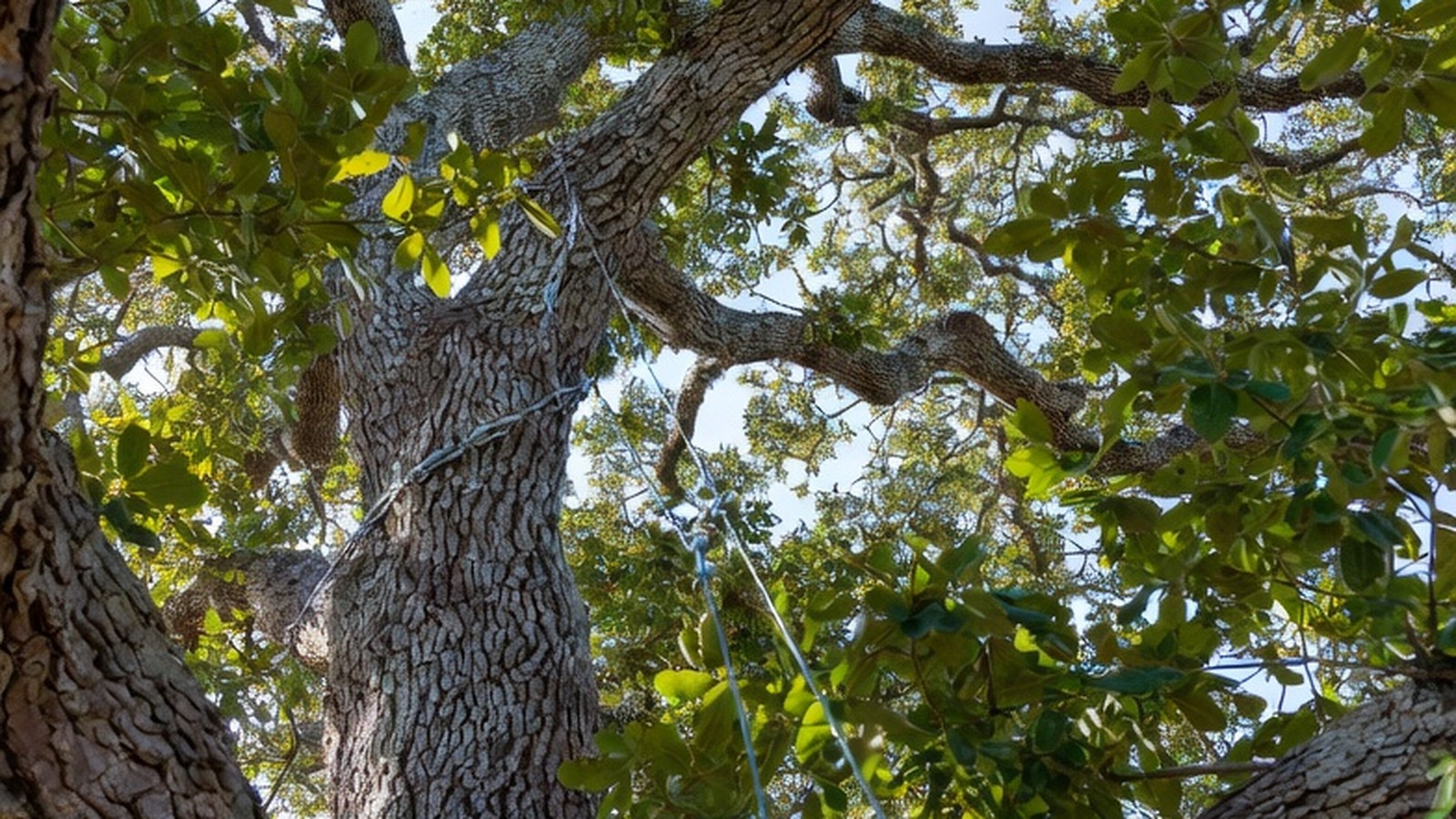
Tree cabling is the installation of high-strength steel cable between major stems or branches of a tree to limit how far apart they can spread under wind or ice loading. The cable is attached to eyebolts threaded into the wood of each stem and tensioned to provide support without being rigid.
Cabling is not a repair, it doesn't fix a weak union or restore damaged wood. It's a management tool that reduces the risk of failure at a known weak point by limiting the mechanical forces that weak point has to resist.
When Cabling Makes Sense
Co-dominant stems with included bark: Two stems of roughly equal size meeting at a tight V-shaped crotch are the most common cabling application. The weak union can't be repaired, but cable prevents the stems from spreading apart in wind. See our co-dominant stem guide for more on this structural issue.
Heavy horizontal limbs over targets: A long, heavy horizontal limb extending over a structure benefits from a cable from above (attached to the trunk or a higher limb) that supports the limb's weight and limits downward movement in a failure scenario.
Trees with historic or significant value: Old live oaks with sentimental, heritage, or aesthetic significance that have structural issues worth managing rather than removing. Cabling extends the viable life of these trees.
What Cabling Doesn't Do
It doesn't fix root problems. A tree with advanced root rot, girdling roots, or compromised anchorage is a fall risk that cabling can't address. Cabling works on above-ground structural issues.
It doesn't prevent all failure. Cable can break, eyebolts can pull through decayed wood, and extreme wind events can exceed what any cable system is designed to handle. Cabling reduces risk, it doesn't eliminate it.
It's not permanent without maintenance. Cable systems need periodic inspection (every 2-3 years for most installations) to check for eyebolt pull-through, cable wear, and whether the tree's growth has changed the geometry of the installation.
Hardware: What Should Be Used
Proper cabling uses high-strength steel cable (not rope, not chain) attached via threaded eyebolts installed at specific heights in the tree. The cable is sized based on the weight and spread of the stems being supported.
Some installations use dynamic cabling systems (slightly elastic hardware) rather than static steel cable, these allow some movement while still limiting extreme spread. Ask your arborist about the appropriate system for your specific tree.
North Florida Application
Live oaks in North Florida frequently develop multi-stem forms. Some of the most beautiful old live oaks in Tallahassee have significant co-dominant structure that can be safely managed for decades with proper cabling. The decision is always tree-specific, position, target value, decay extent, and the homeowner's goals all factor into whether cabling is the right choice.
Questions about cabling for your trees? Call (850) 570-4074 or request a consultation online.