Updated October 15, 2026. This is general guidance, not an inspection. A tree you are worried about should be looked at in person.
After Hurricane Isaias, the fallen trees are easy to spot. The harder ones are still standing: a pine that now leans, an oak with a crack in the trunk, a limb hanging in the crown. Two questions sort most of them. What is under the tree, and did it change in the storm?
Call now if you see any of these
The tree is leaning over something that matters and the lean is new. That means a house, a car or a driveway you use daily. If you can say the lean was not there before the storm, treat it as an emergency.
The soil is cracked or heaved. The International Society of Arboriculture (ISA) says cracks or separations in the soil can point to soil heaving from excessive root movement, and call it a warning sign for failure, especially if the tree is leaning. Walk around the base and look for cracks in the soil, a gap opening around the trunk or a raised mound of dirt.
The tree is resting on another tree, a roof or a fence. In its storm damage brochure, ISA warns that uprooted trees resting in other trees or on built structures may keep moving during and after the storm, and that trees and limbs under tension can react unexpectedly when cut or moved.
A limb has broken and is hanging. A detached branch hanging over a door, a play area or a parking spot can drop with no warning. ISA's tree risk checklist asks, "Are there detached, hanging branches?"
There is a long crack in the trunk, or where a big limb meets it. The ISA risk brochure tells owners to watch for longitudinal cracks or splits in the trunk, major branches or branch unions, and says a tree showing those defects should be examined by an arborist.
Anything touches a wire. Stay back and call your electric utility. ISA's advice is never to try removing tree parts from or near power lines.
If one of these applies and the tree is near your house, call Josh at (850) 888-5603. Say what it is leaning toward and whether it has moved since the storm.
What can usually wait a few days
If you cannot tell which list your tree belongs on, call and ask.
A lean that was there before the storm and has not changed. A long-standing lean with undisturbed soil and nothing under it is a different case from a fresh one. If you are not sure it was there before, assume it is new.
A leaning or damaged tree far from any building, driveway or path. ISA ties the risk from a dead branch to its size and its distance from potential targets. The same logic applies to a tree standing in a back corner with nothing under its fall zone. It is still worth a visit, but it is not a 2 a.m. call.
A tree that lost most of its leaves. The University of Florida's Wind and Trees publication says leaf loss does not mean a tree is dead. Most trees leaf out again in a few months or the following spring, and if there is no new growth by spring or early summer, the tree is unlikely to recover. Wait and watch.
A pine that looks fine. UF says pines can show no visible damage after high winds and still die anywhere from 6 months to 2 years later, likely from hidden damage caused by bending, twisting and ruptured roots. Keep an eye on it. A standing pine with no lean and no cracks is not a middle-of-the-night call.
What the signs look like up close
UF's publication lists cracks, seams, a swollen base, dead branch stubs and old wounds as signs of internal decay, and mushrooms at the base can point to root problems. Unhealthy trees are predisposed to storm damage, so a storm tends to finish off a tree that was already weak. Wet ground adds to it: ISA notes that wind can uproot trees, particularly when heavy rain has softened the soil, and WJHG reported that Isaias brought heavy rains as well as damaging winds to Walton County.
What not to do
Do not push, pull, prop or cut a leaning tree yourself, and do not park or stand where it would fall. Skip the ladder for a hanging limb too. ISA's guidance lists working at height, retrieving tree parts from buildings or utility lines, and running cutting equipment as inherently dangerous work. Take photos from a safe distance to describe the tree on the phone.
How a crew handles a tree like this
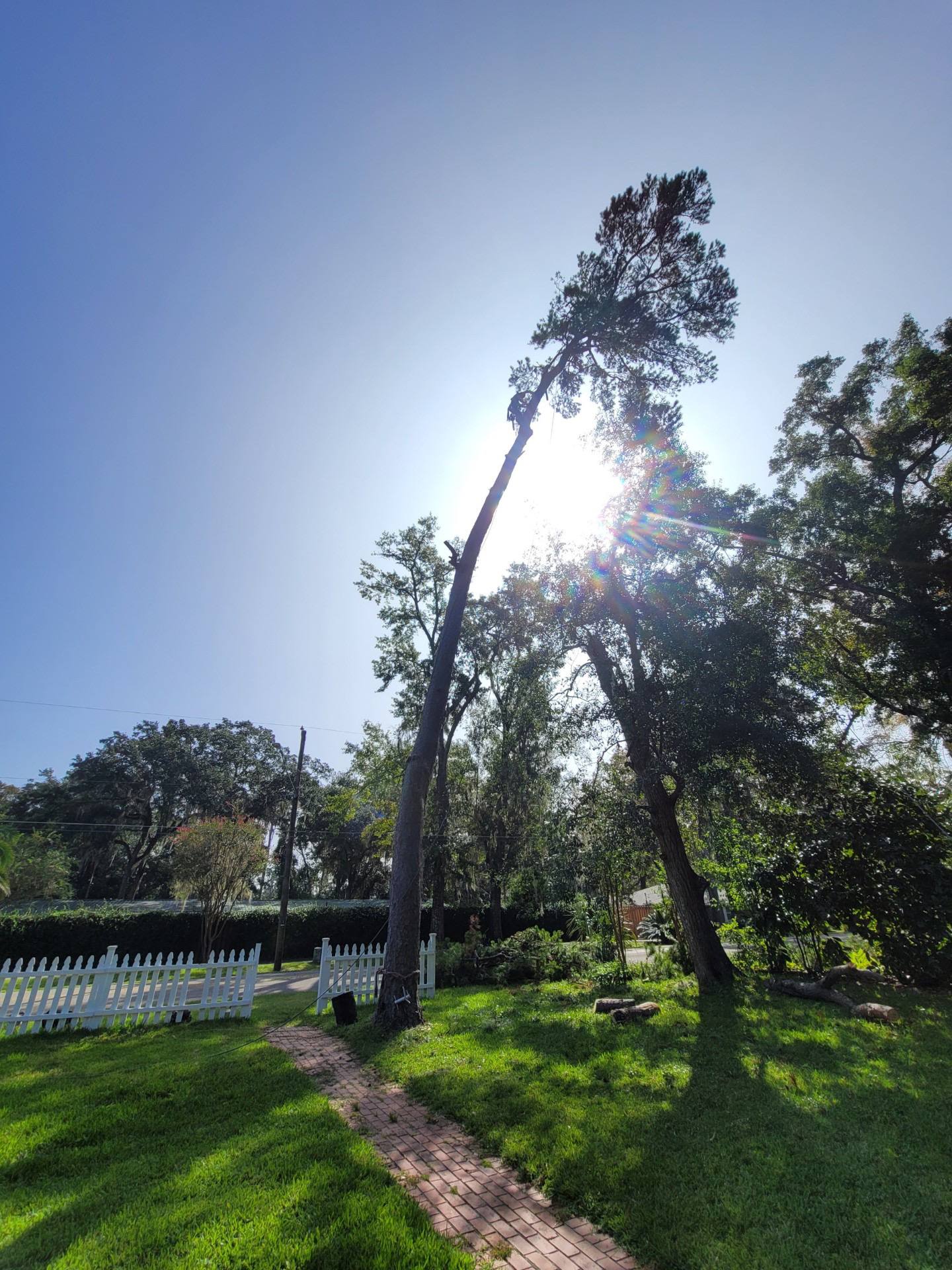
Josh looks at what the tree is leaning on and what could move when a piece comes off. A climber goes up and takes the tree down in sections, lowering each piece on rigging lines.
Josh cuts the tree and moves the debris to the road. In Destin the city's first debris pass was expected to take about 17 days. In Fort Walton Beach the city's standing rule is that it does not pick up yard waste from private contractors. On big jobs Josh can arrange haul-off through a sub, quoted per job. Our debris pickup guide has the source for each rule.
More on triage is in our guide to assessing trees after a hurricane. The Destin storm cleanup page and the area pages for Destin and Fort Walton Beach cover where the crew is working.
FAQ
Is a leaning tree after a hurricane an emergency?
It is when the lean is new and the tree is over a house, a car or a path, when the soil is cracked or heaved near the base, or when the tree is resting on something. A long-standing lean with nothing under it can usually wait for a scheduled visit.
Can a leaning tree be straightened?
We do not recommend trying it yourself. Pulling or propping a tree puts tension on wood and roots you cannot see. Call and describe what you are looking at.
Should I remove a tree that lost all its leaves?
Not right away. UF says leaf loss does not mean the tree is dead, and most trees leaf out again within months or by the following spring.
Leaning, cracked or hanging over your house in Destin or Fort Walton Beach? Call Josh at (850) 888-5603.