In fall, plenty of Tallahassee homeowners look out at a pine and see brown. Is the tree shedding the way pines do, or is something killing it? The needles alone can't answer that. The bark, the weather, and the pines around it can. Everything below comes from UF/IFAS and the Florida Forest Service.
For the full picture of pine care in this area, see our guide to maintaining a pine tree in North Florida.
Seasonal Needle Drop Is Normal
Pines drop needles with the seasons. UF/IFAS notes that on longleaf pine, needle drop occurs seasonally, enough that some landscapers keep it away from paved surfaces. A pine that sheds some needles and otherwise looks like itself is doing what pines do.
A problem shows up in what else you see: marks on the bark, a crown changing color, or other pines nearby doing the same.
Signs of Southern Pine Beetle
The southern pine beetle is a native insect that ordinarily attacks stressed and dying pines, according to the Florida Forest Service. Now and then it breaks out and kills healthy pines too, in forests and in residential yards. These are the signs the Florida Forest Service and UF/IFAS describe, in roughly the order you would notice them:
- Boring dust. UF/IFAS lists reddish-brown dust from tunneling through the outer bark as the earliest sign of a possible attack, often with white pitch specks.
- Pitch tubes. Clumps of resin on the outer bark, whitish or reddish, usually 2 cm across or less, at the spots where beetles bored in. UF/IFAS describes a heavy attack as hundreds of them, like popcorn stuck to the trunk. Southern pine beetles tend to enter at the crevices between bark plates. Pitch tubes can be crumbly or missing if the tree was already severely stressed or dead when attacked, so no pitch tubes does not mean no beetles.
- Small exit holes. Round holes about 1 mm across, where a new generation of beetles has left the tree.
- A changing crown. The needles of an infested tree gradually go from green to yellow to reddish-brown.
- A group of trees. Southern pine beetle infestations tend to kill trees in clusters. In the woods they spread outward from the edges of a patch, and the trees at the edge may still have green needles.
The most reliable test is not something a homeowner can do from the lawn. Under the bark, southern pine beetles leave winding, crisscrossing S-shaped tunnels packed with boring dust, and that pattern is how they are told apart from other bark beetles. Pitch tube color won't settle it, because UF/IFAS says the color of the resin depends on other factors.
Why Brown Needles Come Late
Browning is the last signal, not the first. The Florida Forest Service says that by the time the needles of an infested tree have turned brown, the next generation of beetles has often completed its life cycle and left. UF/IFAS says the same about red crowns in Florida. In the other direction, a pine that has been successfully colonized can be functionally dead within a day while the crown stays green for several days or weeks.
That is why a green pine with pitch tubes deserves a look even though it seems fine. A brown crown is not proof of beetles either way. The bark and the neighboring pines tell you more.
One Dead Pine Is Not Always an Outbreak
Be careful with the first diagnosis you hear. UF/IFAS points out that every dead pine in the Southeast gets colonized by bark beetles and wood borers, and most of them are secondary species that do not attack nearby healthy trees. Unless your area is in a major outbreak, pines killed by southern pine beetle are rare. If someone tells you it is beetles and the pine has to come down, ask to see the evidence.
Other pine bark beetles in Florida behave differently, according to the Florida Forest Service. Ips engraver beetles normally stay in pines that are already stressed, damaged, or dead, and they do not spread aggressively from tree to tree, so removing an infested tree does not necessarily protect its neighbors. The black turpentine beetle attacks near the base of the tree, does not usually kill healthy trees, and a tree can sometimes recover from a limited number of attacks.
Drought and Stress
Drought can leave a pine weak. The Florida Forest Service says southern pine beetles usually attack trees stressed by overcrowding, competition, injury, drought, disease, or old age. UF/IFAS adds a wrinkle: it says chronically stressed or shaded-out pines are rarely colonized by this beetle. So a pine that looks rough after a dry summer is not automatically a beetle tree. It may just be a stressed one, and a stressed pine is the one to watch.
Timing in Fall
Fall is not a quiet season for the beetle. The Florida Forest Service notes a second dispersal period in the fall, when adults fly out to start small, scattered infestations that can carry through the winter. Development slows in the cold but can continue when temperatures climb above 60 degrees F. A fall pine that looks wrong is worth checking now rather than in spring.
What Happens If It Is Beetles
The Florida Forest Service says there is no insecticide that will reliably save an infested tree or kill beetles already inside it. UF/IFAS agrees that once a tree is colonized it cannot survive, whatever the treatment. In residential settings the Florida Forest Service says infested trees should be cut and removed as quickly as possible, and it may be worth protecting nearby uninfested, high-value pines with an approved insecticide. If a pine can't be saved, that is a tree removal job, and for southern pine beetle the Florida Forest Service's advice is to move quickly.
When to Call
Call if you see any of these on a pine:
- Pitch tubes or reddish-brown dust on the trunk
- A crown turning yellow or reddish-brown
- Brown pines in a group, or green pines right beside one that just died
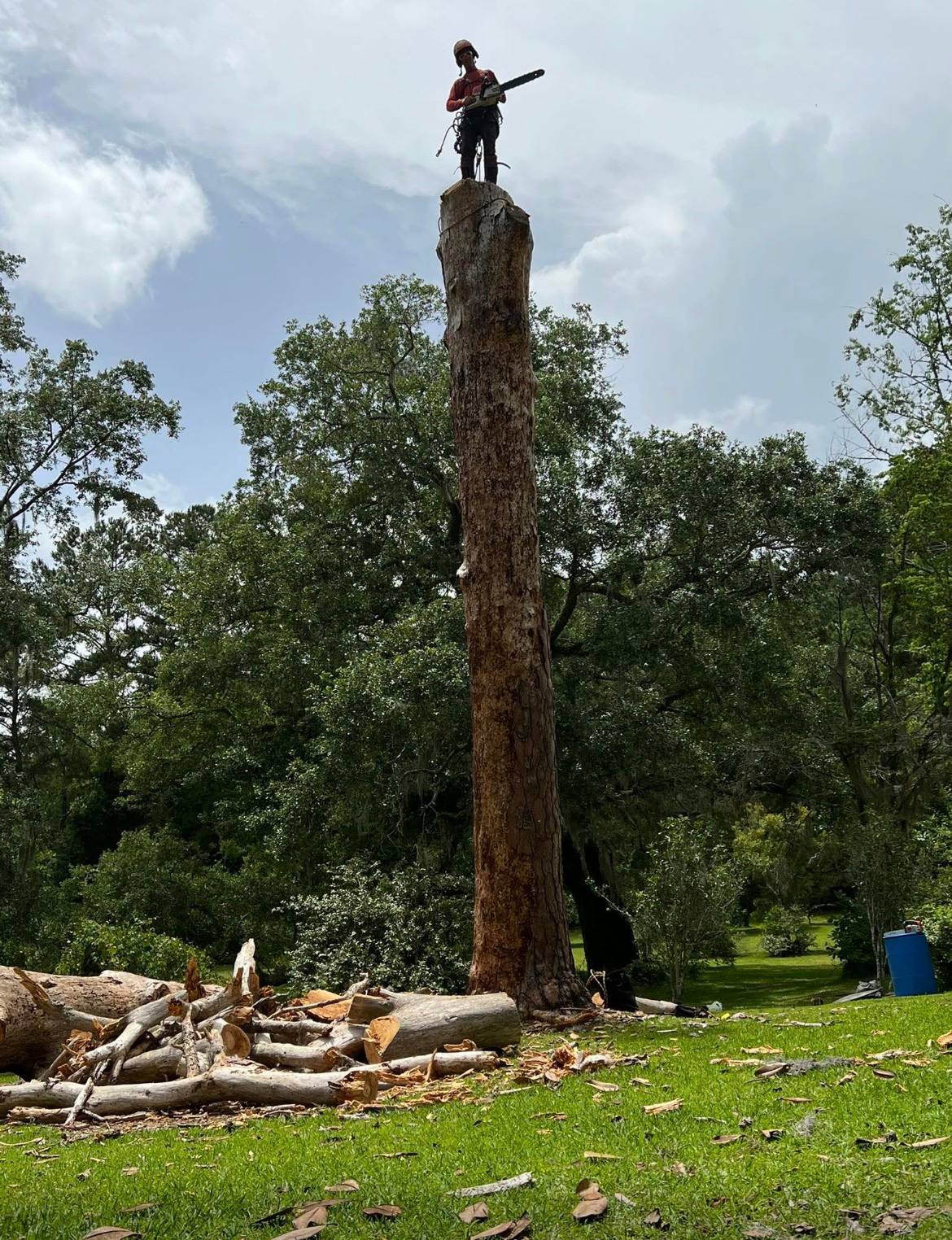
- A dead pine standing within reach of a house, a driveway, or a power line
If you can't tell what you're looking at, call Josh at (850) 888-5603.