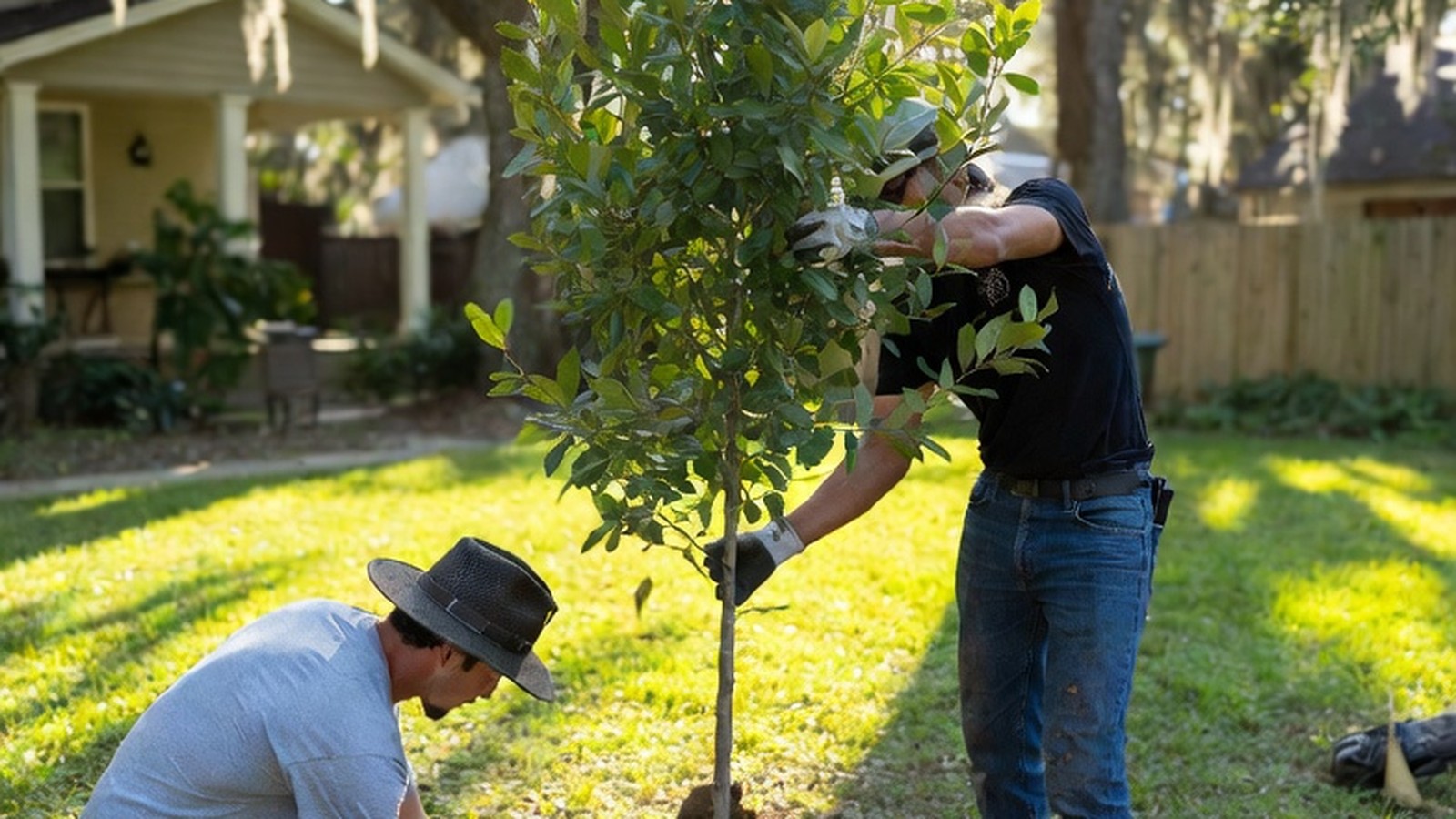
Why Planting Technique Matters
The most common reason young trees fail in North Florida isn't the wrong species or drought or pests, it's incorrect planting. Specifically:
- Planting too deep
- Holes that are too narrow
- Pot-bound roots not addressed
- No follow-through on post-planting watering
Most of these problems aren't obvious at planting. The tree looks fine, gets established, and then declines or dies 2-5 years later, long enough that the connection to planting practice isn't obvious.
Here's how to plant trees so they actually establish and thrive.
Before You Dig: Site Preparation
Call 811. Dial 811 (Call Before You Dig) before digging to locate underground utilities. Required by law and important.
Check overhead clearance. Look up. What's the mature size of the tree you're planting, and is there adequate clearance from overhead utility lines? Choosing the right tree for the space is as important as planting it correctly.
Assess soil drainage. Dig a test hole 12 inches deep, fill with water, and time how long it takes to drain. If water remains in the hole after 12 hours, drainage is poor and many species will fail. Either choose a species adapted to wet conditions, improve drainage, or choose a different location.
The Hole: Critical Dimensions
Width: Two to three times the diameter of the root ball. Wide and shallow, not deep and narrow. This matters because roots grow laterally, not straight down. A wide hole loosens the soil in the zone where roots will actually grow.
Depth: The hole should be no deeper than the root ball height, often slightly shallower. The root flare (the point where the trunk begins to widen into the root system) should end up at or slightly above grade, not buried.
This is the most common error: planting trees too deep. If you dig to the full depth of the root ball plus a few extra inches "for good measure," the tree ends up planted too deep, which leads to bark burial, reduced oxygen at the root crown, girdling roots, and eventually tree failure.
Test the depth before placing the tree: Set the tree in the hole and use a straight edge or stick across the hole to verify that the root flare will be at or slightly above existing soil grade.
Inspecting and Preparing the Root Ball
Container trees: Slide the pot off and examine the roots. Look for:
- Circling roots: Roots growing in circles around the inside of the pot. These must be corrected, cut circling roots or straighten and spread them. If left in place, circling roots girdle the tree as they grow, eventually strangling the trunk.
- J-hooks: Roots bent back at the bottom of the pot. Straighten these before planting.
- White fibrous roots throughout: good sign of health
- Dark, mushy roots: sign of root rot, problematic
B&B (balled and burlapped) trees: Remove all twine, wire baskets, and burlap before or after placing in the hole. Synthetic burlap especially doesn't decompose and can girdle roots. Wire baskets should be fully removed (not just bent down).
Placing and Backfilling
Remove soil amendments. In most situations, backfill with the original soil from the hole, not with improved soil, peat, compost, or other amendments. The idea that you should amend the backfill to help the tree is outdated; amended backfill creates a soil boundary that roots don't cross readily, keeping roots in the amended zone rather than expanding into surrounding soil.
The exception: severely compacted clay sites where standard organic matter incorporation across a broader planting zone (not just the planting hole) can help.
Backfill in layers: Return the native soil in stages, firming it with your hands (not feet, don't compact) to eliminate air pockets.
No volcano mulch. After backfilling, the root flare should be visible at or slightly above grade. Mulch goes around the tree in a flat ring (3-4 inches deep, extending outward), NOT piled against the trunk.
Staking
Most trees do not need staking. Stake only if:
- The tree cannot stand on its own in light wind
- The site has significant sustained wind exposure
- The root ball is small relative to the crown
When staking: use wide, flexible straps (not wire), attach loosely enough to allow some movement (movement stimulates trunk caliper development), and remove stakes after 1 year. Staking that remains beyond one year can damage the tree.
Post-Planting Watering
The most critical factor in establishment success is water management for the first 1-2 years.
Frequency: In Tallahassee's climate, established trees need no supplemental watering. Newly planted trees need regular watering throughout the establishment period. See our summer heat watering guide for specifics.
Application: Water the root ball, not just the surrounding soil. The root ball is where the roots are; that's where the water needs to go.
Deep vs. shallow: Slow, deep watering encourages roots to grow downward. Frequent light watering encourages shallow roots.
Tree planting service in Tallahassee? We plant correctly from the start. Call (850) 570-4074 or request a quote online.