What View Clearing Can and Can't Do
Tree trimming for views and visibility is a legitimate service, but there are real limits to what it can achieve:
What it can do:
- Raise the crown by removing lower limbs to improve sight lines and light at ground level
- Selectively remove specific branches that block a defined view
- Thin the interior of a crown to increase light transmission
- Create clearance to signage, lighting, or entry features
What it can't do:
- Permanently reduce the overall size of a tree without ongoing intervention
- Remove major structural portions of a tree without damaging it
- Make a large, full-canopy tree into something that lets light through consistently
If your goal is substantially more light or a fundamentally open view, and the limiting factor is a tree that's structurally important to the property, removal and replacement with an appropriate lower-growing species is often the more honest answer than repeated pruning.
Crown Raising: The Most Common Approach
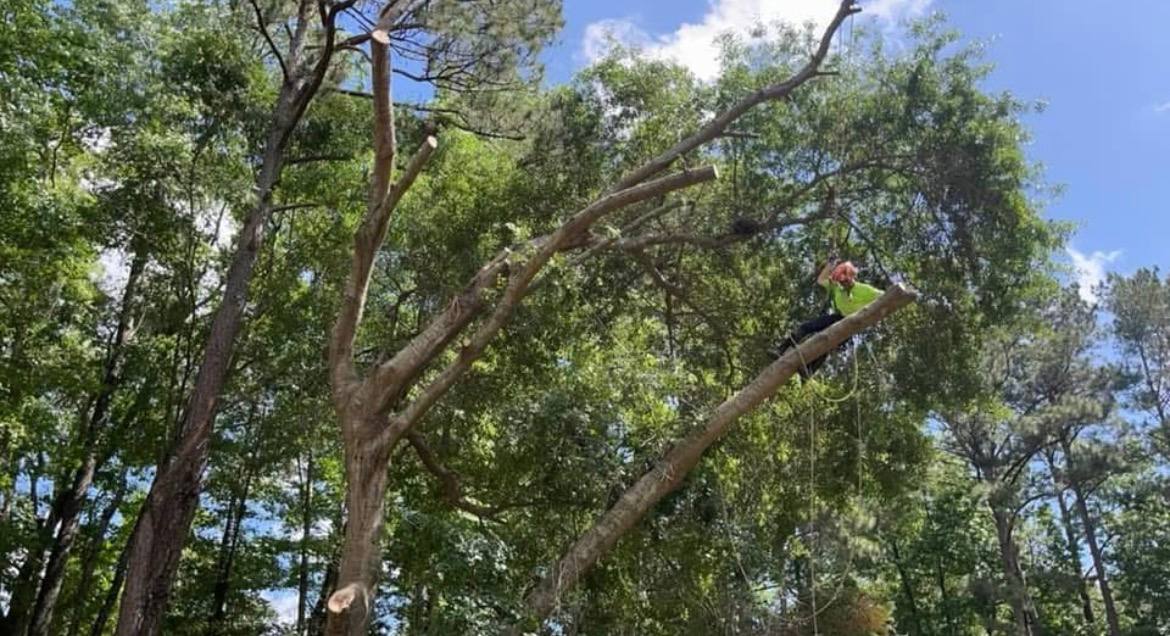
Crown raising: removing lower limbs to elevate the bottom of the canopy, is the technique that most commonly achieves view and clearance goals. It:
- Is arboriculturally appropriate when done properly (cuts at branch unions, not stubs)
- Improves sight lines at vehicle and pedestrian level
- Lets in more lateral light
- Maintains the tree's canopy and health
The result: a tree with higher visible trunk height, more openness underneath, but the same canopy spread above.
Limits: Crown raising doesn't change what happens above the raised level. If the issue is a canopy that blocks views from a window or second floor, crown raising may not help.
Selective Branch Removal
For specific view-blocking situations (a branch that blocks a particular window view, a limb growing toward a sign or entry feature) selective removal of the specific branch at the appropriate union is often possible.
The success of this approach depends on:
- Whether the blocking branch is a minor limb or a major structural branch
- What the view/clearance goal specifically is
- Whether removing the branch leaves the tree structurally balanced
A minor side branch blocking a window view is easy to address. A major structural limb that happens to be in the way of a desired sight line is a different situation, removing it may require significant crown intervention.
Sight Line Clearing in Tallahassee
Common view and sight line clearing requests in the area:
Security visibility: Trees and shrubs that create areas of low visibility around properties, entries, and driveways. Crown raising often addresses ground-level blind spots effectively.
Address numbers and mailboxes: Overgrown shrubs or low branches that obscure address numbers or mail access.
Traffic and intersection visibility: Trees or vegetation that reduces visibility at driveway exits, creating safety concerns.
Light for solar panels: Shade from trees affecting solar panel production. This is a cost-benefit analysis, see our solar panel shading guide for the specifics.
Interior views from the home: Windows that are progressively more blocked by tree growth over time.
Live Oak Considerations
For significant live oak pruning in Tallahassee, permit requirements may apply. Any work that removes more than 25% of a live oak canopy, or that significantly alters the structure, may require city review. We advise on permit requirements based on the specific tree and scope of work planned.
Tree trimming for views or visibility in Tallahassee? Call (850) 570-4074 or request an estimate online.