Once the leaves are down, Tallahassee homeowners start asking whether it's time to trim. For most hardwoods the answer is yes. For a handful of trees it's the wrong season, and a cut made now costs you next spring's flowers. This guide covers which is which, how to tell good work from bad, and what drives the price. Josh does this work through our tree pruning service.
Why Winter Suits Most North Florida Hardwoods
A dormant tree is a tree you can read. With the canopy bare, the branch structure is visible, so it's easy to spot the crossing limbs, the weak attachments, and the dead wood that a full summer canopy hides. The canopy is also lighter to work in, and cuts made before spring growth starts close quickly once the tree wakes up.
That is why we treat late winter as the best window for most species in Tallahassee, and fall as a fair second choice once active growth has slowed. Our tree trimming cost guide lays out the same timing.
Dead, storm-damaged, or hazardous limbs are the exception. If a branch is a danger to your roof or your family, it comes out whenever you find it, in any month.
Trees to Wait On
A few trees follow a different calendar.
Azaleas. Azaleas flower from late February to early April, and UF/IFAS says to prune them in late spring or early summer, shortly after flowering, because they set next year's flower buds during the summer (UF/IFAS Gardening Solutions: Azaleas). A winter haircut takes the spring show with it.
Dogwoods. Dogwoods also set their flower buds in summer, so shaping cuts belong in the weeks after bloom, May through early June. Winter is fine for structural work a dogwood actually needs. Our dogwood care guide covers the details.
Crape myrtles. These are a late-winter job, not a November one. In Tallahassee the window is late February through mid-March, while the trees are still dormant and before buds push. Cutting in fall can trigger tender new growth that the next cold snap burns.
The bigger myth is that crape myrtles need to be cut back hard to bloom. They bloom on new growth, so a hacked tree does flower, and that is why people think the chopping worked. Untouched crape myrtles bloom just as well. What the cutting leaves behind is knuckled stubs and weak sprouts. Our crape myrtle pruning guide shows what a light, correct trim looks like.
Oaks and Fresh Wounds
Oaks are good winter candidates, with one habit worth keeping: make fewer, cleaner cuts. Every cut is a wound, and big oaks have a lot of wood to protect. The Florida Forest Service says oak wilt has not been detected in Florida, and UF/IFAS has said the same, but we still suggest doing non-urgent oak pruning in the cooler months as a cheap precaution. The details are in our oak wilt guide.
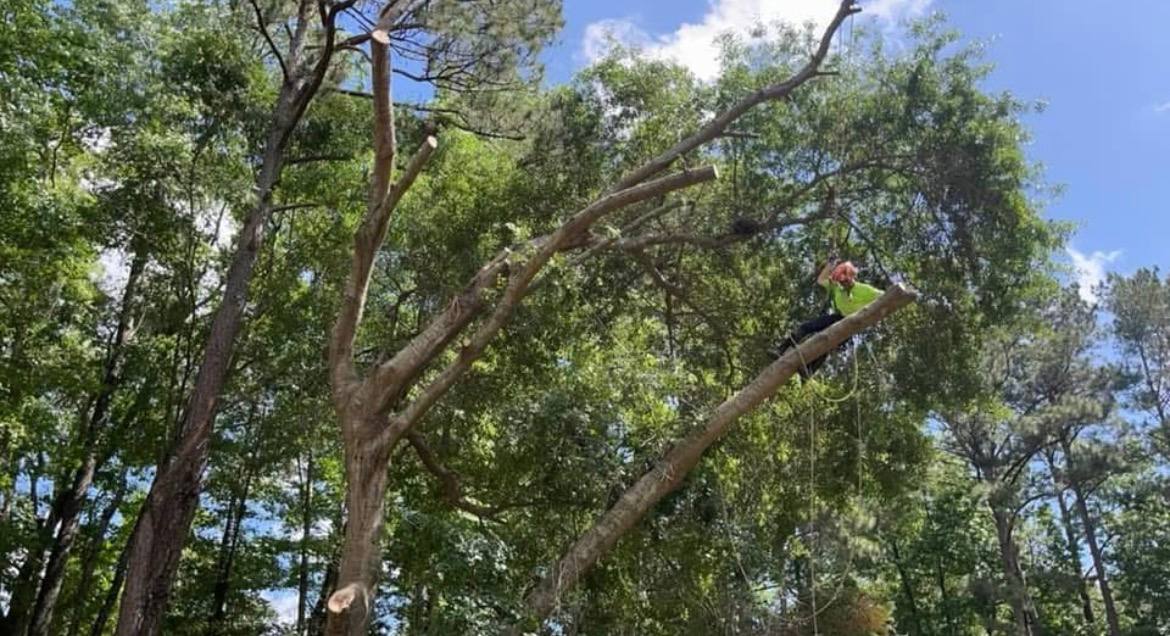
Large live oaks are skilled work. Their canopies spread wide and the limbs are heavy, so the rigging matters as much as the cutting.
What a Good Trim Looks Like
After a proper trim you should still recognize your tree. Look for these things:
- Cuts made just outside the branch collar, the swollen ring where a branch meets its parent stem, with no stubs left sticking out.
- Large limbs shortened back to a side branch big enough to take over, rather than chopped off mid-limb.
- The tree's natural shape intact, only lighter and more open.
- No paint or sealant slathered on the cuts. Research has found wound dressings do not help trees, and a good cut closes on its own.
What Topping Looks Like Instead
Topping cuts main stems or big branches back to stubs at an arbitrary height. You see it all over town. The tree is left with large wounds it can't seal, and it responds by throwing up a thick flush of sprouts just below each cut. Those sprouts attach weakly to the wood underneath, so they are the first things to fail in a storm. Within a few growing seasons the canopy is often as dense as before, only weaker.
The ISA considers topping a harmful practice. If a crew proposes it, or calls it something softer like "heading" or "tipping," read our guide to topping and proper pruning before you agree to anything.
What Affects the Price
The ranges by tree height are in the cost guide. What moves a quote:
- Size. Taller trees take more equipment, more time in the air, and more people on the ground.
- Canopy spread. A 50-foot pine that grows straight up is a different job from a 50-foot live oak with limbs reaching out 40 feet.
- Access. If a bucket truck can reach the tree, the work goes faster. A fenced backyard with a narrow gate means climbing, which is slower.
- Time since the last trim. A tree trimmed every few years is a maintenance job. One that hasn't been touched in fifteen years has more wood to remove and more problems to correct.
- Number and size of limbs. More cuts and heavier limbs mean more rigging.
- Species. Live oaks, pines, and crape myrtles all take different time and technique.
- Scope. Deadwood removal is the lightest job. Crown lifting, thinning, reduction, and structural pruning each take more.
Ask any crew which of those jobs the quote covers. A bid that doesn't say can't be compared with one that does, and a quote far below the others usually means a smaller scope.
If you have trees to trim this winter, call Josh at (850) 888-5603.