When a Tree Outgrows Its Space
It happens regularly in Tallahassee. A water oak planted 20 years ago is now 60 feet tall with branches over the roof. A crape myrtle that looked right in a 6-foot planting strip is now 30 feet and rubbing the gutters. A live oak that was a sapling at the back of the yard is now dominating the entire property.
The instinct is to cut it back. The question is: how far, and in what way?
What "Crown Reduction" Actually Means
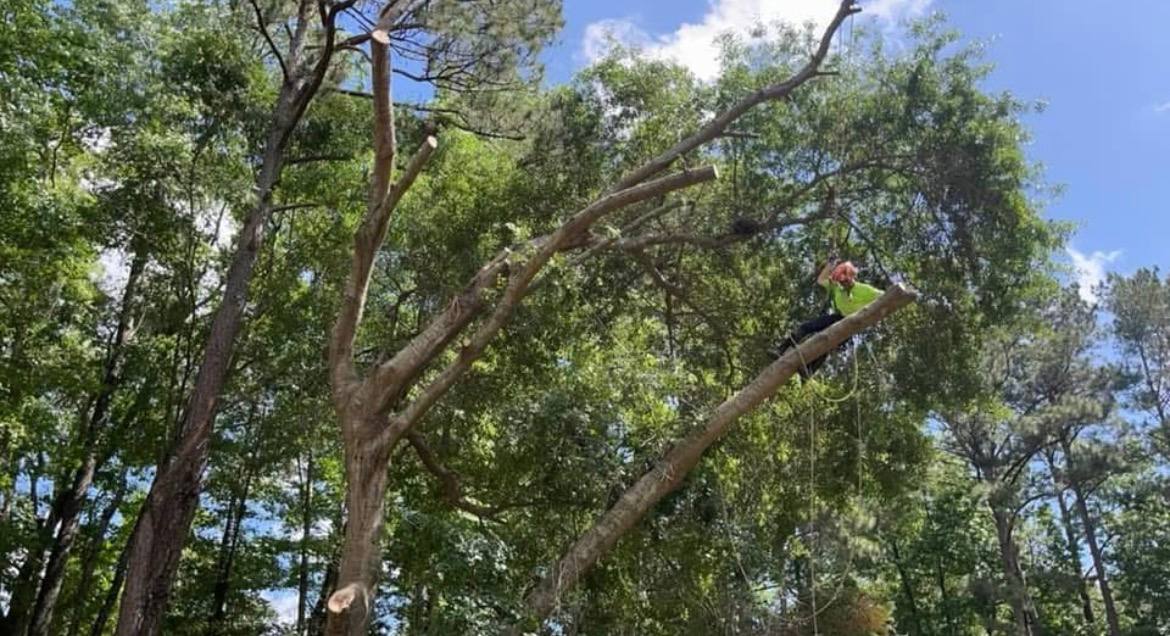
Crown reduction (reducing the overall size of the canopy) is legitimate tree care when done correctly. The ISA defines it as reducing the height and/or spread of a tree's crown while maintaining the natural form and structural integrity.
Done correctly:
- Cuts are made at branch unions (where a branch meets another branch), not at random points along the branch
- The retained branch is large enough to be a "leader" for that section, at least 1/3 the diameter of the removed portion
- The natural layered form of the tree is preserved
- No single cut removes more than 25% of the crown in a given year
Done this way, crown reduction is a useful tool for trees that are:
- Too close to a structure and growing toward it
- Encroaching on a neighboring property
- Creating clearance or visibility problems
- Too large for their location relative to what was planted
What It Cannot Do
Crown reduction cannot permanently make a large tree small. Trees grow. A water oak reduced by 15 feet will be 15 feet taller again in 10-15 years if growing conditions support it. Managing size through periodic pruning is a long-term commitment, not a one-time fix.
For a tree that is fundamentally too large for its location (an 80-foot oak in a 20-foot planting strip, a large pine 10 feet from the house) repeated reduction is expensive maintenance that never resolves the underlying problem. At some point, removal and replacement with a more appropriately sized species is the honest answer.
What Topping Is and Why It Doesn't Work
"Topping" (cutting a tree's trunk or major branches back to stubs) is the most common wrong answer to an overgrown tree. It's often sold as a cheaper, faster way to reduce a tree's height.
The results:
- Large wounds that don't heal properly, inviting decay fungi into the trunk
- Rapid growth of weakly attached "epicormic shoots" from below each cut, these grow faster than normal branches and are structurally weaker
- The tree often ends up larger and more structurally dangerous within a few years than it was before
- A topped tree frequently dies within 5-10 years
There is no version of topping that is acceptable arboricultural practice. If a company offers topping as a management solution, find a different company.
Specific Situations and Solutions
Branches over the roof: Crown lift (raising) to clear the roof line, combined with targeted removal of branches that are directly over or contact the structure. This is the right approach, not wholesale crown reduction.
Tree competing with a power line: This is utility territory for overhead lines, the utility company handles transmission line clearance. For secondary service drops to your house, we coordinate appropriate clearance pruning.
Tree too close to the foundation: Depending on species and distance, this may be best addressed by removal. Root systems from species like water oak extend as far as the crown, a tree 15 feet from a foundation already has extensive roots under the house regardless of crown pruning.
Tree blocking light to solar panels: See our post on trees and solar panels for this specific situation.
Live oak in a residential space: Tallahassee's live oaks require permits for removal and significant work. We handle the permit process. See our post on live oak permits in Tallahassee for details.
When Removal Is the Right Answer
An honest tree service will tell you when removal is more appropriate than repeated expensive pruning. The signs:
- The tree species is too large for the site and no realistic pruning schedule keeps it manageable
- The tree has structural defects (co-dominant trunks, significant decay) that make it a risk, and crown reduction increases that risk
- The roots are causing property damage that won't stop while the tree remains
- The tree is otherwise declining and management only prolongs the inevitable
We don't recommend removal when management is the better path. But we also don't recommend management when removal is the honest answer.
Call us to assess your overgrown tree in Tallahassee: (850) 570-4074 or request an estimate online.