Updated October 17, 2026. This is general guidance, not an inspection. A tree you are worried about should be looked at in person.
Tallahassee got off easier than the Panhandle, and that is exactly why some yards are still carrying damage nobody has looked at. The power came back, the roads cleared, and the tree in the corner of the yard that tipped a few degrees toward the house stayed exactly where it was. The weeks after the storm are the right time to walk the property and look up.
What Isaias did in Tallahassee
Isaias came ashore around 9:30 p.m. Eastern on Friday, October 9, near Destin as a Category 2 hurricane. The Tallahassee Democrat reported that the city sat on the eastern side of the storm and avoided the worst of it, with a modest 2.77 inches of rain at the airport. The National Weather Service in Tallahassee described tropical-storm-force conditions with gusty winds that caused some outages and some trees down. Nearly 25,000 City of Tallahassee utility customers lost power, and by Saturday morning the city said crews had restored more than 98 percent.
Fox 49 reported that Leon County crews did more than 40 tree cut-and-toss operations overnight to clear roads, that the airport saw a peak gust of 52 mph, and that about 4 inches of rain fell in six hours in Killearn and about 3 inches elsewhere in the county. The county also said the forecast for Saturday still included gusts of 25 to 30 mph that could bring down trees and limbs weakened overnight.
South of us, WALB reported that the outages in south Georgia were concentrated in Quitman, Clay, Decatur, Randolph and Calhoun counties.
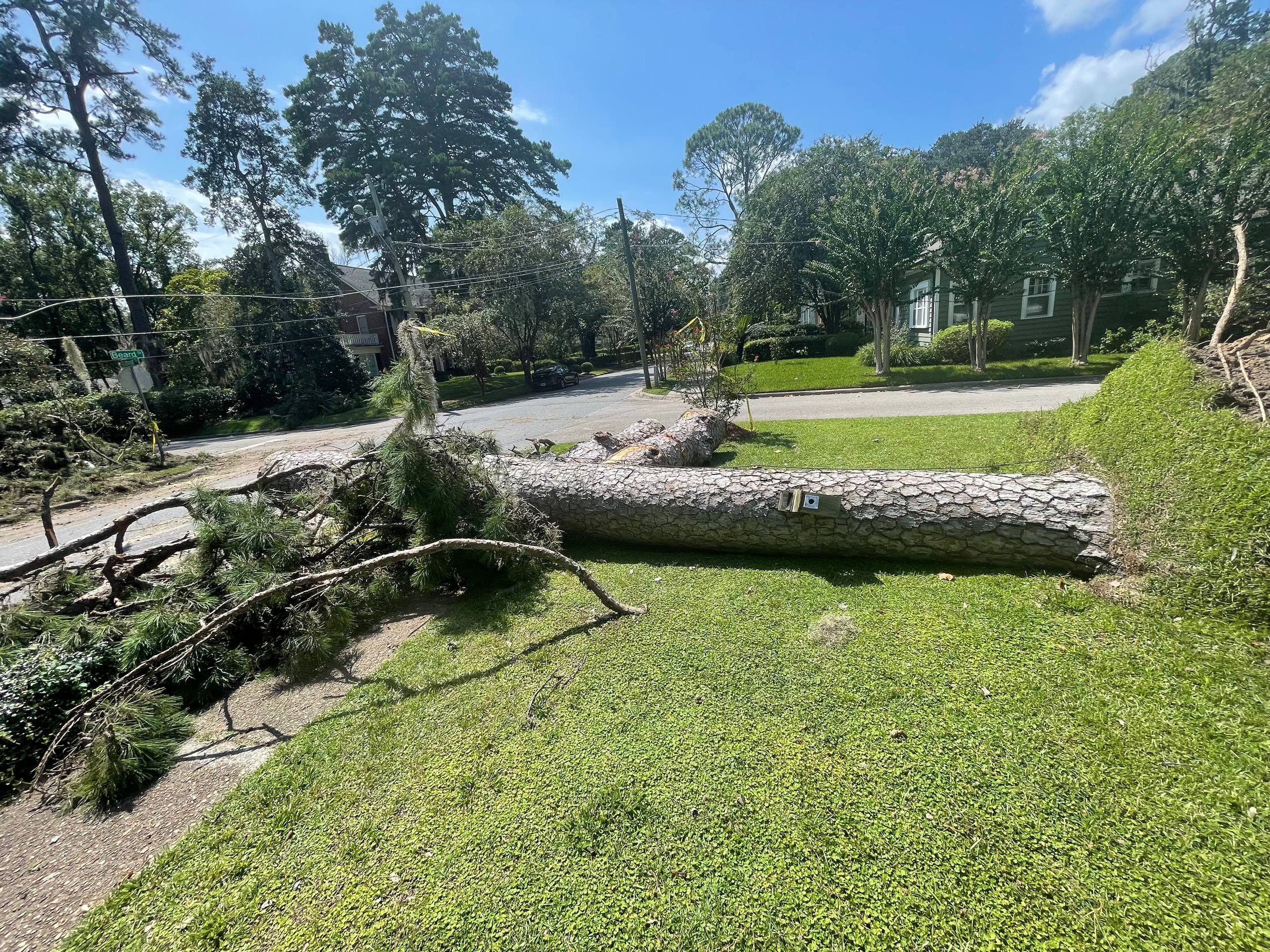
"Spared" still left damage behind. It is scattered: a tree here, a limb there, a trunk that is not quite where it used to be. Those are the cases that get missed.
Start with the lines
Before you look at anything else, look for wires. If a tree or limb is touching or tangled in a power line, a service line running to your house, or anything that looks like a cable, stay back and call the utility first. Do not touch the tree, do not cut it and do not let anyone else cut it.
- Inside the city: City of Tallahassee Utilities takes outage reports online or at 850-891-4968.
- Outside the city, if Talquin is your electric provider: Talquin Electric's outage map.
If the tree has pulled the weather head, mast or meter box loose from the house, that equipment belongs to the homeowner, not the utility. The City's page on how power is restored explains who is responsible for what and says the repair has to be done by an electrician, with inspection before power is reconnected. Josh can deal with the tree. He cannot fix the electrical side of it.
What to check in your yard
Walk the whole property in daylight, and look up before you look down. Stand outside the drop zone of anything that looks questionable.
- Leaning trees. Compare the tree to a fixed line, like the corner of the house or a fence post. If it leans more than it did before the storm, or you cannot remember, treat it as new.
- Cracked or split trunks. Look for a vertical split, a crack where a major limb joins the trunk, or bark that has torn away in a long strip.
- Hanging limbs. A broken limb caught in the branches above can drop days later when the wind moves it or the wet wood gets heavier. Tree crews call these hangers.
- Lifted root plates. Look at the ground around the base. Soil that has heaved up on one side, fresh cracks in the lawn, or a trunk that rocks when the wind pushes it all say the roots let go, at least partly. Heavy rain softens the soil, and soft soil is where roots let go.
- Trees on or against something. A trunk resting on a fence, shed, roof edge or another tree is under load. Leave it alone.
- Damage you can only see from a distance. Walk to the edge of the yard and look back at the crown. A big missing section, or a limb stub that was not there before, tells you something changed.
Take photos of anything you find, from a safe spot, with the date. More on that below.
What should not wait
Call Josh at (850) 888-5603 soon if:
- a tree or large limb is leaning over the house, a car, a driveway, a play area or a walkway you use daily;
- the trunk is split or cracked, or the root plate has lifted;
- a hanging limb is large, or it moves in the wind;
- a tree is resting on a roof, a fence or another tree and you are not sure what is holding it up;
- you cannot keep people and pets out from under it.
If a tree is touching a line, the utility comes first, then Josh. If anyone is in danger right now, call 911 and get clear.
What can wait
- A small broken limb on the ground in the open, away from the house and from where people walk.
- A leaning tree that is far from anything it could hit, with no cracks and no lifted soil.
- A fence or shed that has a limb on it but no sign that a bigger tree is still moving.
- Leaves and twigs. Rake and bag them when you get to them.
Rope off the area, keep people away and take photos so the problem is documented. If you are not sure which pile your tree belongs in, describe it to Josh on the phone.
Photos before anyone cuts
If the tree touched your house, car or fence, or you plan to file a claim, photograph it before anything moves. Get the whole tree, the break point or the lifted roots, where it landed and every point of contact. Add a wider shot of the yard so the tree's position is clear. Back the photos up right away.
Call your insurer and ask whether they want to see the tree before it is cut. Our guide to what to do when a tree falls on your house in Tallahassee goes through the full order of steps. If you also want to report damage to the county, Leon County has a Property Damage Assessment Form on its emergency information portal.
Debris: what happens after the cut
Josh cuts the tree and moves the debris to the road. Haul-off happens only on big jobs, through a sub he hires, and it is quoted per job. What happens at the road depends on your pickup service.
Leon County's Waste Disposal Guide covers regular yard debris pickup. It says plastic bags are not accepted, each piece or container must weigh under 50 pounds, no limb may exceed six inches in diameter and up to 8 cubic yards is collected weekly. Anything over those limits is outside regular pickup, so a whole trunk is a different problem from a pile of branches. That guide is the county's. If you are inside the city, check with the City of Tallahassee on its yard debris rules rather than assuming they match.
If you are thinking about burning a pile, the Florida Forest Service asked residents to use caution. It said piles must be under 8 feet in diameter, must be out an hour before sunset and must keep required distances from houses, forests and roads. Smoke travels, and the agency noted that many people in storm-hit areas were still without power and had their windows open.
Getting Josh out to your tree
In October 2026 Josh's climbing crew worked storm jobs in Destin. Call him, tell him what you have, and he will tell you straight when he can look at it. If something is dangerous right now, do not wait on any tree service: stay clear, call the utility if there is a line involved, and call 911 if someone is at risk.
The forecast issued October 17 by the National Weather Service in Tallahassee called for several dry days with light winds, which made it recovery time rather than emergency time for most yards. Light wind is still not zero wind, though, and a cracked tree does not heal.
Related reading and services
- Storm cleanup for limbs, damaged trees and debris after a storm.
- Tree removal when a leaning, cracked or lifted tree has to come down.
- Emergency tree service for trees on structures. Our post on what to do in a tree emergency in Tallahassee covers what to tell him on the call.
- Our Leon County service area page for where we work around Tallahassee.
Not sure which pile your tree is in?
Describe it to Josh: what it is leaning toward, whether you see a crack or lifted soil, and whether a wire is involved. Call Josh at (850) 888-5603.