
The FEMA pages we read do not list cutting up a fallen tree among the things its household aid pays for. They do list money to repair a primary home damaged by Hurricane Isaias, and help with a place to stay when fallen trees keep you out of the house, and FEMA asks about your insurance first.
Does FEMA Pay for Fallen Trees After Isaias?
Questions about a tree? Call Josh at (850) 888-5603.
We read every FEMA page linked below on November 10, 2026, and each fact says "read 2026-11-10" beside its link. FEMA updates these pages, so open the link before you act on anything here.
Which counties can apply
FEMA's page for DR-4955-FL (read 2026-11-10) shows Florida Hurricane Isaias with an incident period of October 6 to October 12, 2026 and a declaration date of October 27, 2026. Its designated areas page (read 2026-11-10) says "Individuals and households in these designated counties are eligible to apply for financial and direct services." The Individual Assistance counties are Bay, Escambia, Gulf, Holmes, Okaloosa, Santa Rosa, Walton and Washington.
FEMA's October 29 release (read 2026-11-10) says "Additional designations may be made later if requested and warranted by the results of further damage assessments." If your county is missing, check the designated areas page again.
What household aid does pay for
FEMA's housing and other needs page (read 2026-11-10) lists these, among others:
- Home repair: "Money to help you repair or replace your home damaged by the disaster." The housing options page (read 2026-11-10) says the money is to make a home "safe, sanitary and functional" and that the amount "is based on damage verified by a FEMA inspection."
- Private roads, bridges and docks: "Money for survivors whose only access to their home has been damaged by the disaster."
- A place to stay: rent, or hotel and motel costs, "if you are displaced from your home because of the disaster."
- Cleaning: money to "clean and sanitize your home after a disaster to prevent additional loss and potential health or safety concerns."
That page also says FEMA does "not offer housing assistance for secondary or vacation homes, only for your primary residence," and that small businesses go to the Small Business Administration for loans. The Individuals and Households Program page (read 2026-11-10) adds that the aid "is not a substitute for insurance and cannot compensate for all losses caused by a disaster."
Look through those lists for tree work and it is not there. A tree that falls on your roof is damage to your home, and the repair side of that is what FEMA lists. Paying a crew to cut the tree off it is not on the list.
Where fallen trees do matter to FEMA
An inspector who visits a home asks "Is there a safe access to and from the home?" (FEMA home inspection page, read 2026-11-10). The same page says that when a home cannot be reached, the inspector may meet you "at the obstruction or a neutral location."
FEMA's Individual Assistance Program and Policy Guide (read 2026-11-10) goes a step further. Among the conditions for reimbursing lodging costs, it counts a home as inaccessible when it "cannot be entered due to access impediments (e.g., fallen trees, downed power lines, damaged access ramps)." So a tree across your door or drive can support a request for somewhere else to stay. Nothing on the pages we read says FEMA pays to move the tree.
Insurance gets asked first
FEMA's Isaias page (read 2026-11-10) puts it at the top: "If you have insurance, you should file a claim with your insurance company immediately. FEMA assistance cannot help with losses already covered by insurance."
FEMA's Road to Recovery page (read 2026-11-10) says you do not have to file your claim before you apply, "but you will be required to provide FEMA your insurance settlement or denial before being considered for certain types of assistance."
Whether your own policy pays to remove a tree is a question for your insurance company, not for us. We do not know your policy. Our post on a tree that fell in the yard and hit nothing reads what the state's insurance page says about that case.
Debris is a separate FEMA program
FEMA's debris removal page (read 2026-11-10) says debris removal is eligible under Public Assistance "if the removal is in the public interest, among other factors," and lists vegetative debris. That program makes grants to governments and certain nonprofits, not to households.
FEMA's recovery FAQ (read 2026-11-10) says removing debris from private property is eligible only "in limited circumstances," in areas FEMA works out with state and local governments. The Isaias page we read names no such area. What county and city crews pick up at the curb is covered in our Isaias debris pickup post.
How to apply
FEMA's Isaias page (read 2026-11-10) says "The fastest way to apply is through DisasterAssistance.gov." You can also use the FEMA mobile app or call the FEMA Helpline at 800-621-3362. The DisasterAssistance.gov home page (read 2026-11-10) says the Helpline runs 7 a.m. to 10 p.m. in your time zone, seven days a week.
The Isaias page also lists Disaster Recovery Centers, including the Destin-Fort Walton Beach Rigdon Center and the DeFuniak Springs Community Center, with hours posted for each.
Deadline: FEMA's Isaias page gave no date. The DisasterAssistance.gov home page lists "Dec 26" for "Florida Hurricane Isaias 4955-DR-FL" under Application Deadlines, and says "Disasters with past dates may be open for late applications."
Photograph before anything is cut
FEMA tells applicants to "Take photos of any damage," "Make a list of your losses," and "Keep all receipts to verify expenses caused by the disaster." It also says not to wait for the inspection to start cleaning up, "if it is safe to do so" (home inspection page, read 2026-11-10).
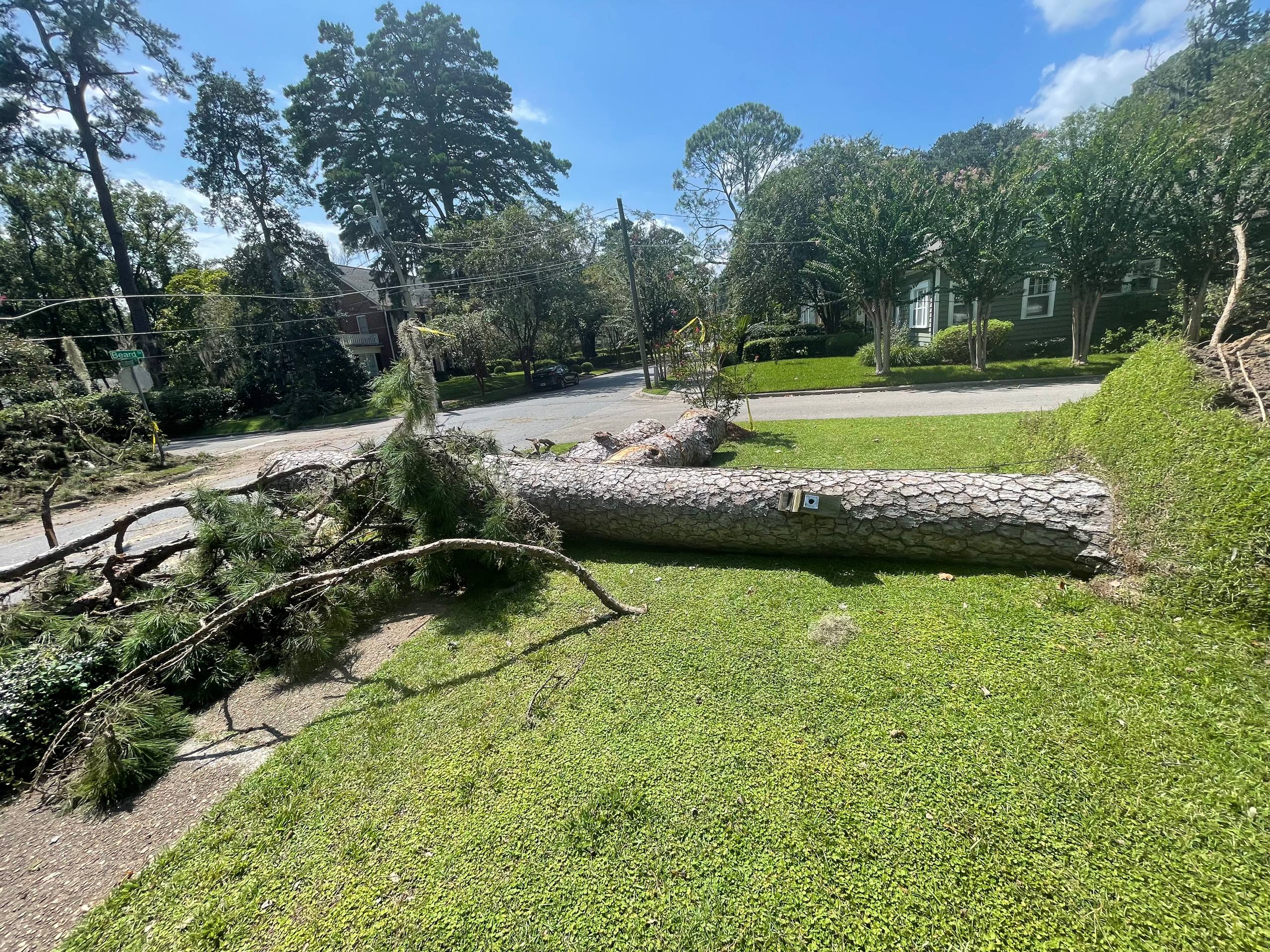
Cleanup is exactly when a tree stops looking like it did. Once the trunk is in pieces at the curb, your photos are what is left. This part is our advice, not FEMA's. Take these before a saw starts:
- The whole tree where it lies, with the house in frame.
- Each spot where the trunk or limbs touch the roof, wall, fence, car or driveway.
- The damage underneath, close up.
- The roots, if the tree came up.
- Any door, gate or drive the tree blocks.
If a limb or trunk touches a power line, stay back and call the utility first. Our who to call for what post has the numbers. Keep your receipts for storm costs, including tree work.
Where a tree service fits
Because FEMA's lists leave tree cutting out, that job is between you, your insurance company and the crew you hire. Reed Tree Service is owner-operated and insured, based in Tallahassee. In the weeks after Isaias, Josh's crew worked storm jobs in Okaloosa and Walton counties. He cuts hanging, leaning and fallen trees, and the rig includes a National crane, a Nifty-Lift boom lift, a skid-steer and an F-250. Our tree on your house guide and storm cleanup service page show how a job goes.
Josh quotes each job once he has seen the tree. Cleanup, debris removal, haul-off and stump grinding are each quoted separately, so ask what is in the number. He does not write formal reports or file claims, so your own photos are the record.