
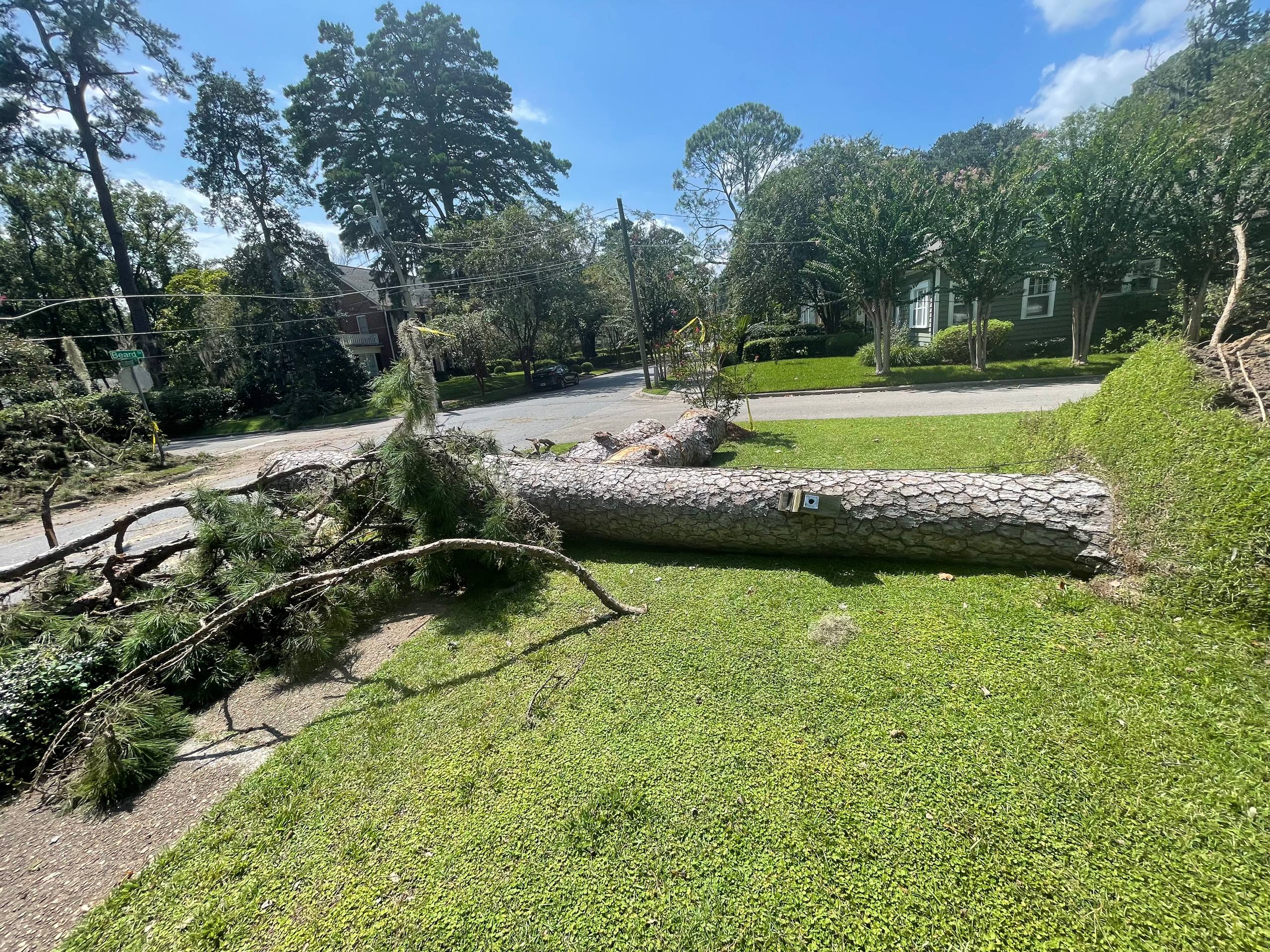
The Florida Department of Financial Services says there is usually no debris removal coverage when a tree falls on the ground and does not damage covered property. So if an Isaias tree came down in your yard and touched nothing, your homeowners policy may not pay to cut it up, and the bill may land on you. Your own contract decides, and your insurer or agent can tell you what it says.
Tree Fell but Hit Nothing After Isaias: Who Pays?
Questions about a tree? Call Josh at (850) 888-5603.
We read every page linked below on November 10, 2026, and each fact says "read 2026-11-10" beside its link. These pages change, so open the link before you act on anything here. This is not insurance advice, and we have not seen your policy.
What the state's page says
The Florida DFS homeowners insurance overview (read 2026-11-10) has a paragraph headed "Debris and Tree Removal":
Most insurance policies cover debris & tree removal if the downed tree damaged insured property regardless of who owns the tree. However, there are usually limits that the company will pay. There is usually no debris removal coverage if the trees fell on the ground and did not damage covered property. Some policies provide debris & tree removal if the downed tree blocks the main entrance to the property. Since insurance policies vary between insurers, you should always refer to your own personal contract.
Read plainly, that is two cases. A tree that lands on something your policy covers, like the house, is usually covered for removal, up to a limit. A tree that lands on the grass and damages nothing usually is not. The page hedges both with "most" and "usually," then sends you back to your own contract.
Our post on tree storm damage insurance claims in Florida covers how the rest of these claims work. This one stays with the tree that hit nothing.
Look twice before you decide it hit nothing
The state's wording turns on damage to covered property. Walk the whole fall line before you settle on "nothing": the fence, the shed, the gutter, the corner of the roof, the meter, the pool screen. A tree that clipped a fence did hit something, and that moves you into the first case above. The walk is our suggestion, not DFS's.
The main entrance exception
The same paragraph says "Some policies provide debris & tree removal if the downed tree blocks the main entrance to the property." Some, not most. If a trunk lies across the way into your property, ask your insurer whether your policy has this and what it counts as the main entrance. The state's page does not say.
The deductible point
Insurance Journal's November 9 story on Isaias claims (read 2026-11-10) says "Trees were down everywhere across the Panhandle after the tempest." It then relays what Keith Goolsby, a Pensacola insurance agent, saw: a number of policyholders with trees down "quickly filed claims after the storm, but then realized the tree had not actually damaged the home or that the HO policy does not cover tree removal or that the claim would fall below the deductible." The story also lists "damage that was below the deductible" among the reasons Isaias claims were closed without payment.
The DFS Isaias page (read 2026-11-10) says "You are responsible for the hurricane deductible before insurance payments will be made" and "You can locate the hurricane deductible on your insurance policy's declaration page." A removal bill that comes in under your deductible leaves the insurer nothing to pay. That is our reading of those lines, not a DFS statement, so check your own number before you assume either way.
What to check in your own policy
Ask your insurer or agent four things:
- Does my policy pay to remove a tree that damaged nothing? (The state's page says that usually it does not.)
- Does it pay when a tree blocks the main entrance, and what does it count as the entrance?
- What is the limit on debris and tree removal?
- Which deductible applies to this storm, and what is it?
The DFS Isaias page (read 2026-11-10) says "Report damage to your insurance agent or company immediately." It also says "For assistance understanding your insurance coverage or filing a claim, please call the Department of Financial Services' toll-free Insurance Consumer Helpline," and prints that number as 1-877-693-5236.
If it was a neighbor's tree
The state's paragraph says coverage for a tree that damaged insured property applies "regardless of who owns the tree." If the tree came from next door and hit your house or fence, our post on a neighbor's tree that fell on your house in Florida covers who pays for removal.
What city and county crews pick up
County and city debris pickup after Isaias runs on each place's own schedule, and public pickup takes what residents put out. It does not cut the tree for you. Our Isaias debris pickup post lists where each county and city stood when we read their pages, and the rules differ by town.
FEMA
FEMA is a separate question, and the pages we read do not list cutting up a fallen tree among what its household aid pays for; our FEMA post goes through them.
Photograph before anything is cut
The DFS Isaias page (read 2026-11-10) says "Take photos and/or video to document damage and share with the company adjuster." Once the trunk is in pieces, those photos are all that is left of how it lay. This part is our advice, not DFS's. Take these before a saw starts:
- The whole tree where it lies, with the yard and the nearest buildings or fences in frame.
- Anything it touched or came close to, up close.
- The roots and the hole they left, if it came up.
- Any gate, drive or walkway it blocks.
If a limb or trunk touches a power line, stay back and call the utility first. Our who to call for what post has the numbers.
Where a tree service fits
If your insurer tells you the removal is not covered, that job is between you and the crew you hire. Reed Tree Service is owner-operated and insured, based in Tallahassee. In the weeks after Isaias, Josh's crew worked storm jobs in Okaloosa and Walton counties. He cuts hanging, leaning and fallen trees, and the rig includes a National crane, a Nifty-Lift boom lift, a skid-steer and an F-250.
Josh quotes each job once he has seen the tree. Cleanup, debris removal, haul-off and stump grinding are each quoted separately, so ask what is in the number. He does not write formal reports or file claims, so your own photos are the record.
If you do pay a crew yourself, check who you hire. The DFS Isaias page (read 2026-11-10) says "Scammers oftentimes frequent neighborhoods in the aftermath of a storm to solicit unsuspecting homeowners. They offer services such as putting on tarps or removing tree debris for a fee." It adds "There is a risk that, after receiving payment, they leave the area and never complete the work." Our post on storm chasers versus a legitimate tree service has the checks.