

NOAA's Storm Events Database holds 1,758 storm reports from 2015 through 2025 that mention trees, limbs or branches in nine counties around Tallahassee and across the Georgia line. Thunderstorm wind accounts for 1,481 of them, and June through August holds more than half of the separate storm dates.
Storm Tree Damage in North Florida and South Georgia: NOAA Data, 2015 to 2025
Questions about a tree? Call Josh at (850) 888-5603.
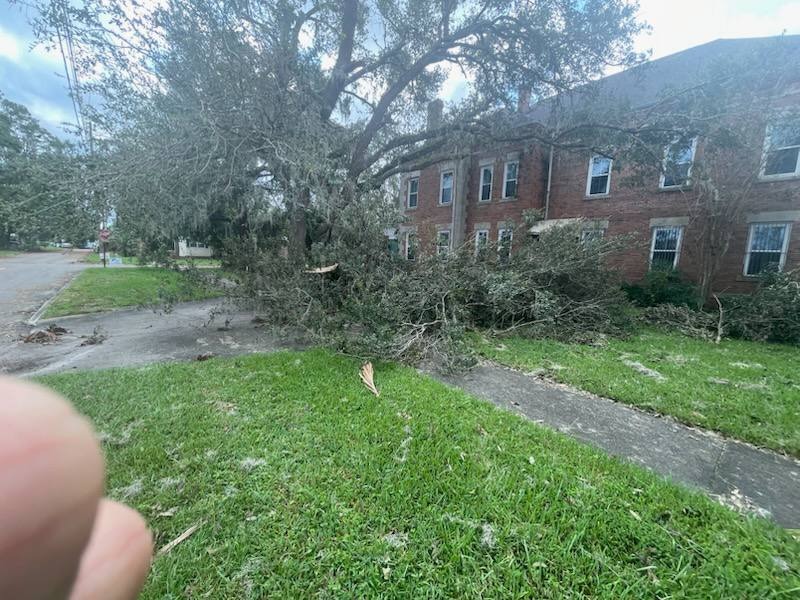
We pulled the public NOAA files, filtered them to this area, and put the result in a table anyone can download and reuse. This page has the numbers, how we got them, and what the data cannot tell you.
Download the data and cite it
- Download the CSV (1,758 rows, one per NOAA storm record).
- Source: the NOAA National Centers for Environmental Information (NCEI) Storm Events Database. The raw yearly files are in the bulk download folder. We downloaded them on October 31, 2026.
To cite this page or the file:
Reed Tree Service, compiled from NOAA NCEI Storm Events Database, 2015 to 2025 (Leon, Wakulla, Gadsden and Jefferson counties, Florida; Thomas, Grady, Lowndes, Decatur and Brooks counties, Georgia). https://reedtreeservice.com/blog/noaa-storm-tree-damage-data-north-florida-south-georgia
The CSV has one row per NOAA record with these columns: date, county, state, area_type, event_type, magnitude, magnitude_note, tornado_rating, narrative_excerpt, tree_mention_in and ncei_event_id. The last column is NOAA's own event number, so any row can be looked up in the original database.
What we counted
- Area: Leon, Wakulla, Gadsden and Jefferson counties in Florida; Thomas, Grady, Lowndes, Decatur and Brooks counties in Georgia. Tallahassee (Leon County) is our base, and the rest is the North Florida and South Georgia ground around it.
- Years: 2015 through 2025, the newest complete calendar years in the NCEI files. The 2026 file is still filling in, so it is left out.
- What counts as tree-related: the record's event narrative or its episode narrative contains the whole word tree, trees, limbs or branches. A report that says "uprooted" without one of those words is not in the table.
- Left out on purpose: NOAA's damage-cost fields. This table is about what was reported, not what it cost. House numbers and personal details are removed from the excerpts; hundred-block street references are kept.
NCEI files some events by county and others by National Weather Service forecast zone. Hurricane and tropical storm records are filed only by zone, so we included the zones that cover these counties. The area_type column says which is which.
Counts by county
| County | State | Records | Separate storm dates |
|---|---|---|---|
| Leon | Florida | 505 | 138 |
| Lowndes | Georgia | 285 | 113 |
| Wakulla | Florida | 241 | 99 |
| Jefferson | Florida | 193 | 97 |
| Thomas | Georgia | 140 | 81 |
| Gadsden | Florida | 122 | 78 |
| Brooks | Georgia | 98 | 61 |
| Decatur | Georgia | 98 | 65 |
| Grady | Georgia | 76 | 60 |
Together that is 1,061 records in the four Florida counties and 697 in the five Georgia counties, on 330 different calendar dates across the whole area. "Separate storm dates" counts each calendar day once per county, so one big storm that produced 33 reports in Leon County on June 30, 2015 counts as one date for Leon.
Do not read this table as a ranking of which county is riskiest. A county with more people and more roads tends to get more storms reported, and Leon is the largest of the nine.
Counts by event type
| Event type | Records | Records where the record's own narrative mentions trees |
|---|---|---|
| Thunderstorm Wind | 1,481 | 1,416 |
| Tropical Storm | 80 | 34 |
| Tornado | 65 | 65 |
| Hurricane | 20 | 6 |
| All other types | 112 | 4 |
The "other" group is flash flood (56), hail (14), storm surge (9), flood (8), extreme cold (8), heavy snow (7), lightning (4), winter storm (2), and one each of funnel cloud, heavy rain, high wind and ice storm.
Thunderstorm wind is 84 percent of the table, so most of the tree damage NOAA has on file for this area came from everyday storms, not named ones.
The right-hand column matters. In 233 records, the tree mention is only in the episode narrative, the write-up for the whole storm, which can describe damage in a neighboring county. That is why most of the tropical storm and hurricane records fall short in the third column. Every row carries a tree_mention_in value, so you can filter to the stricter 1,525 records whose own narrative mentions trees.
Counts by month: the summer peak
| Month | Records | Separate storm dates (all counties) |
|---|---|---|
| January | 133 | 16 |
| February | 119 | 8 |
| March | 110 | 25 |
| April | 276 | 27 |
| May | 143 | 36 |
| June | 326 | 54 |
| July | 268 | 67 |
| August | 205 | 59 |
| September | 118 | 22 |
| October | 20 | 3 |
| November | 21 | 6 |
| December | 19 | 7 |
June has the most records (326), but July has the most separate storm dates (67). June through August has 799 of the 1,758 records (45 percent) and 180 of the 330 storm dates (55 percent). Dates are the steadier measure, because a single afternoon can produce dozens of reports.
April is the second bump: 276 records, including 24 of the 65 tornado records. October through December is the quiet stretch, with 60 records in three months.
Hurricanes and tropical storms
NOAA's records for this area carry hurricane-level entries on four dates: September 1, 2016 (Hermine), October 10, 2018 (Michael), August 30, 2023 (Idalia) and September 26, 2024 (Helene). Tropical storm entries appear on 13 dates. Of the 80 tropical storm records, 52 fall in August and September.
Four hurricane dates in eleven years is a small share of the 330 storm dates, but the narratives for them describe damage across whole counties. For Helene in Brooks County, the record says power lines and trees were blown down county wide and blocked 60 to 70 percent of the roads. Our post on hurricane and storm season tree prep in Tallahassee covers what to check before a storm like that.
Tornadoes and wind speed
There are 65 tornado records on 30 dates. By NOAA's rating, 24 are EF0, 33 are EF1, 6 are EF2 and 2 are EF3. Forty-eight of the 65 fall between January and April.
For the 1,481 thunderstorm wind records, NOAA lists a wind speed for every one. Of those, 1,238 (84 percent) are an estimated 50 mph gust, 76 are 58 mph or higher, and the top entry is 75 mph. Only 13 are measured gusts; NOAA labels the other 1,468 as estimated. A tree does not need hurricane wind to come down.
What these records cannot tell you
Storm Events is a useful record with real limits, and anything built on it should say so.
- It records reported events only. A tree that came down in a yard where nobody called it in is not in the database. Counts follow reporting as well as weather.
- Narratives vary. Some entries describe one tree on a named road. Others say "numerous trees" or "at least 120 trees." The table counts records, not trees.
- Episode narratives can reach past the record's county. See the third column of the event type table and the
tree_mention_incolumn. - Zones can double up. Jefferson and Wakulla counties each have an inland and a coastal forecast zone, so one tropical system can show as two records for one county.
- Wind speeds are mostly estimates. Of the 1,481 thunderstorm wind records, 1,468 are labeled estimated gusts.
- Files get revised. NCEI updates these files, so counts pulled later can differ from ours. Use
ncei_event_idto check a row against the current database. - Excerpts are shortened. The
narrative_excerptcolumn holds the first sentence that mentions a tree, with dollar amounts and house numbers removed. The full narrative is in the NOAA database under the same event number.
If one of these storms hits your trees
Most of this record is ordinary thunderstorm wind, which means a tree can fail on a day nobody calls a storm. If a tree is on your house, a car or a line, or a big limb is hanging, call Josh at (850) 888-5603. Josh quotes each job on site, and debris cleanup is quoted extra. Our post on what to do when a tree falls covers the first steps, and what to check on your trees after a storm is the walk-around list.
Josh works from Tallahassee across North Florida and South Georgia, including Thomasville and Valdosta. For where we work around the capital, see the Leon County service area page.
Related reading and services
- Storm cleanup for limbs, damaged trees and debris after a storm.
- Emergency tree service for trees on structures.
- Assessing your trees after a storm for what is urgent and what can wait.
Reporters and researchers
You are welcome to use the table and the numbers on this page with the citation above. If your story needs someone who cuts storm-damaged trees, call Josh at (850) 888-5603.