General information, not a tree risk assessment. Wind resistance describes a species on average, not the tree in your yard. Josh looks at the tree and tells you what he sees. Reed Tree Service does not write formal risk assessments; those come from a professional urban forester or a certified arborist. Check the sources below before you act on a single tree.
Which Trees Fail in Hurricanes in North Florida and South Georgia
Questions about a tree? Call Josh at (850) 888-5603.
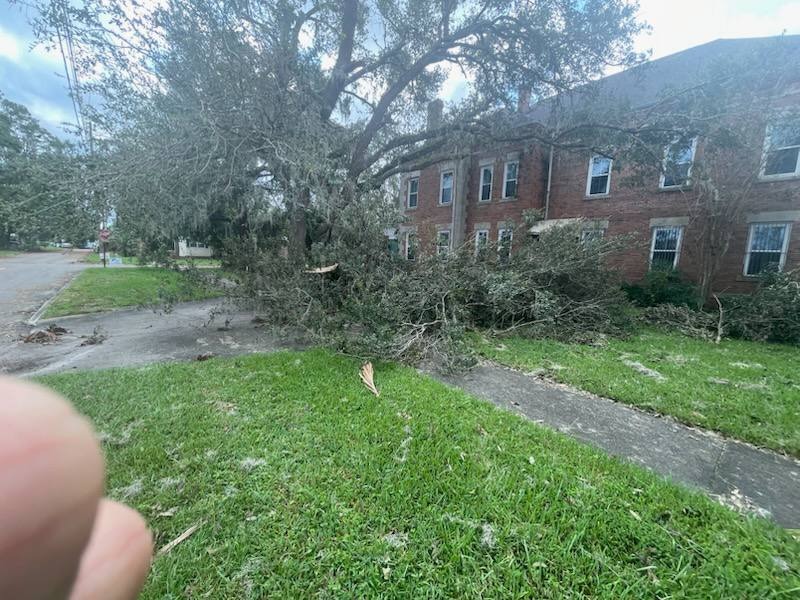
Live oak and southern magnolia sit at the top of the University of Florida's wind-resistance list for the region. Laurel oak, water oak, pecan and Bradford pear sit at the bottom. Slash, longleaf and loblolly pine land in the Medium-Low group, and sweetgum in the Medium-High group. The table below puts each tree next to the class its source gives it and what the sources say about how it fails. If a tree in your yard is on the bottom of the list and it is old, call Josh at (850) 888-5603 about removal, and cleanup and stump work are quoted extra.
Everything below comes from University of Florida (UF/IFAS) and University of Georgia (UGA) Extension pages we opened on November 2, 2026, listed at the end. The class names are the publication's own words. We did not make up a rating for any tree.
Which common trees are wind resistant and which are not?
UF/IFAS studied urban trees after ten hurricanes and published a Table 3 that sorts southeastern coastal plain species into four classes: Highest, Medium-High, Medium-Low and Lowest wind resistance. The sheet adds a warning: no species and no tree is completely windproof, and soil, age, health and tree care change the outcome.
| Tree | UF/IFAS class | What the sources say about how it fails |
|---|---|---|
| Live oak | Highest | Among the best survivors in Hurricane Ivan. Even so, it lost a lot of branches, and its raw survival was 91%, and 81% when recalculated, counting heavily damaged trees as dead. |
| Southern magnolia | Highest | An excellent survivor in Ivan while losing only 43% of its leaves, an exception to the pattern where heavier leaf loss went with better survival. |
| Sweetgum | Medium-High | Survives well but is prone to some branch breakage. |
| Red maple | Medium-Low | The sheet gives the class and no failure details. |
| Slash, longleaf and loblolly pine | Medium-Low | In Ivan, raw survival was 72% for slash, 66% for loblolly and 59% for longleaf (Table 1, FR174). Pines can look fine right after a storm and still die over the next 6 months to 2 years. |
| Laurel oak | Lowest | Poorer survival than live oak and sand live oak in four panhandle hurricanes, and an average branch loss of over 25% in Ivan. Survey respondents rated it low. |
| Water oak | Lowest | Recalculated survival of 65% in Ivan, next to a recalculated 81% for live oak. Survey respondents rated it low. |
| Pecan | Lowest | On the sheet's list of species with demonstrated poor survival. In Georgia orchards after Hurricane Michael, growers in Mitchell, Lee and Dougherty counties told UGA their areas had lost 30% to 50% of their pecan trees. |
| Cabbage palm (sabal palm) | Not in the Table 3 text; rated high in the survey | 99% of survey respondents (arborists, scientists and urban foresters) rated it high. The sheet calls it an excellent survivor. |
| Bradford pear | Lowest | The sheet gives the class and no failure details. |
A few notes on reading it. In the Ivan tables, a tree did not survive if it fell or was leaning at less than a 45-degree angle. The "recalculated" figures also count any standing tree that lost half or more of its branches. The pecan figure is about orchards, not a single yard tree. The sabal palm row comes from the survey and the text, not from the printed Table 3 list.
What do the sources say about the bottom of the list?
Laurel oak and water oak are the two to watch in an older North Florida yard. The UF/IFAS lessons sheet names sand pine, pecan, laurel oak and water oak as lowest-class species in north Florida. It says to inspect over-mature trees of species with poor hurricane survival and to remove the ones at high risk of failure. For borderline cases, it says to "consult a professional urban forester or a certified arborist." Josh will look at the tree and tell you what he sees, but Reed Tree Service does not write formal risk assessments and does not claim that credential. Our post on live oak versus water oak covers telling the two apart.
The same sheet explains why bigger and older trees fail more. In the UF/IFAS data, large trees lost the most branches, and Pensacola's older, denser canopy suffered considerably more damage than Miami's younger one. A slow, wet storm adds to it, because wet soil holds roots less firmly. Trees with more rooting space and trees growing in groups of five or more did better.
For pecan, UGA's pecan extension reported after Hurricane Michael that the worst damage northeast of Albany was in orchards 50 to 100 years old.
Do pines and palms fail the same way?
No. A broken oak shows its damage at once. The sheet says pines and palms can hide it.
- Pines. UF/IFAS says pines may show no immediate visible damage and then decline slowly, with some staying green for a year or more before the needles turn yellow and then brown. In Ivan, 2% to 3% of standing slash and longleaf pines died within three months, against 56% of standing sand pine. See our pine care and removal guide.
- Palms. The sheet says to monitor palms after storms, because bud damage may not show right away. It says to allow at least 6 months for new fronds and to check for hidden root, stem or bud damage. See our palm guide.
What should I do about a storm-damaged tree?
UGA Extension's storm-damage guidance says minor damage may be salvageable and severely damaged trees pose hazards for people and property and should be removed. Its steps before any work:
- Assess the tree, the neighboring trees and the ground for hazards first.
- Treat broken branches hung up in a tree as a falling hazard. UGA calls them widow makers.
- Clear leaves and debris from the base and look for exposed roots and disturbed soil.
- Expect instability when winds are high and the soil is saturated.
- UGA's last step: "For larger jobs, call in the professionals," which it ties to "certified arborists." Reed Tree Service does not claim that credential.
None of that replaces a power line call. If anything touches a wire, see who to call after a storm and who handles a tree on a power line. For what to look at on your own tree, see assessing trees after a hurricane, five warning signs of a hazard tree and preparing trees for hurricane season.
Where does Reed Tree Service work?
Josh takes calls across North Florida and South Georgia, including Thomasville and Valdosta. Our tree hazard inspection and tree removal service pages cover the work. Debris cleanup and stump work are an extra quote, set per job.
FAQ
Is live oak really the safest tree in a hurricane?
It is in the top class on the UF/IFAS list, and the sheet calls it a repeated survivor. It is not windproof. Live oak lost many branches in Ivan, and in south Florida in stronger storms its survival fell to 78%.
Is pecan a bad tree to keep near the house?
The UF/IFAS sheet puts pecan on its lowest wind-resistance list and names it among species to inspect when over-mature. That is a species-level finding. A given pecan can be sound, and the sources do not rate one tree.
Do these ratings hold in Georgia?
The UF/IFAS studies measured Florida and Gulf Coast neighborhoods. We did not find a Georgia yard-tree study that reports the same classes, so how the classes carry over to your Georgia yard is not verified.
Should I remove a tree that is on the lowest list?
Not just because of its species. The sheet says to inspect over-mature trees on the lowest list and remove those at high risk of failure. For borderline cases it says to "consult a professional urban forester or a certified arborist." Josh will look at the tree and tell you what he sees, but a formal assessment comes from them, and Reed Tree Service does not claim that credential.
Will Josh look at my tree, and does Reed write risk assessments?
Josh looks at the tree and tells you what he sees. Reed Tree Service does not write formal risk assessments. For one, the sheet says to "consult a professional urban forester or a certified arborist."
Sources we opened
- UF/IFAS Extension: Selecting Coastal Plain Species for Wind Resistance (EDIS FR174), for the Table 3 classes, Ivan survival and branch loss, the survey results and the pine, palm and sweetgum details.
- UF/IFAS Extension: Wind and Trees: Lessons Learned from Hurricanes (EDIS FR173), for the lowest-list species, the inspect-and-remove advice, pine decline, palm monitoring and the canopy, rooting and group findings.
- UGA Extension Forsyth County: Care for storm-damaged trees, for the hazard steps.
- UGA Pecan Extension: First look at Hurricane Michael damage to the Georgia pecan industry, for orchard losses.
What we could not verify: the UF/IFAS studies measured Florida and Gulf Coast urban trees, and we found no Georgia yard-tree study with the same classes. The two UF/IFAS sheets did not show a publication date on the pages we read. The UGA pecan report covers orchards, not yard trees. Cabbage palm is not named in the Table 3 text we read.
Worried about an old oak, pecan or pine in North Florida or South Georgia? Call Josh at (850) 888-5603.