Usually not. A small or newly planted tree that leaned over can be stood back up and staked. A mature tree whose lean is new may have lost roots, and broken roots don't grow back into a firm hold. If it leans toward your house, a road, or a power line, or the lean is new, call Josh at (850) 888-5603 before spring. A lean that has been the same for years, with nothing underneath, is often fine.
Can a Leaning Tree Be Fixed? North Florida & South Georgia
Questions about a tree? Call Josh at (850) 888-5603.
Why a Lean Is a Root Problem
A tree stays up because of its roots. UF/IFAS says leaning or fallen medium-aged and mature trees can mean a severed root or major root breakage, and that once roots are cut or broken they are unlikely to reconnect and rebuild the structure that keeps the tree upright (UF/IFAS, Assessing Hurricane-Damaged Trees).
That's why a big tree can't be pulled straight with a rope and a winch. The damage is in the roots under the soil, and you can't see them from the yard.
Old Lean or New Lean?
A lean that has been there for years usually means the tree grew that way and has stayed balanced. A lean that changed is a different story. Something shifted, and that is the one to worry about.
Signs that the lean is new or getting worse:
- Soil that has cracked or heaved on the side away from the lean
- Roots that are exposed or lifted out of the ground
- A trunk crack, or a fork where two stems join with bark pinched in between
- A canopy that's heavy on the side it leans toward
- Fresh gaps around the base after wind and rain
UF/IFAS says to look closely at leaning trees with unbalanced canopies, cracks in the trunk, and bark inclusions. Our guide to the warning signs of a hazard tree goes through them.
To tell whether the lean is changing, take a photo from the same spot every week or two. Stay out from under the tree while you do it. If the lean in the photos moves, call.
What It's Leaning Toward Matters Most
UF/IFAS puts it plainly: if a leaning tree is likely to fall on a person, building, power line, roadway, or other valuable target, it should be removed immediately after a storm. The same publication says all leaning trees should have their roots examined for breakage, exposure, or lifting out of the soil.
How far it leans matters less than what is in the way. A leaning pine in the back corner of a big lot is a very different problem from one over the bedroom.
Fix It, Watch It, or Take It Down
Small or newly planted tree. UF/IFAS says trees with a trunk under 4 inches across should be stood up as soon as possible so the roots don't dry out. Recently planted trees can be stood back up at any size, and they should be staked with the help of a professional. Call Josh if you have one down.
Mature tree, old lean, nothing underneath. It can often be left and watched. Check it after every big storm.
Mature tree, new lean, or lifted roots. Most of the time this is a removal. A tree that has already started pulling out of the ground has less holding it each time the wind rises.
Mature tree with a weak fork or heavy side. Sometimes weight can be taken off the heavy side, or the tree can be supported. That's a call someone has to make standing next to the tree. Our guides to cabling and bracing and why trees fall explain the options and the limits.
A pine. UF/IFAS says pines can snap, uproot, or lean after storms and that a pine still standing may have damage you can't see. Pines often die over a period of 6 months to 2 years after a windstorm. Brown needles throughout means the tree is dead. Our pine care guide has more.
Why Deal With It Before Spring
Hurricane season officially ends November 30 (NOAA National Hurricane Center), but the wind doesn't stop then. Cold fronts push through North Florida and South Georgia all winter, and spring brings thunderstorms. A tree this season's storms already loosened is the one to look at now, while the weather is calmer.
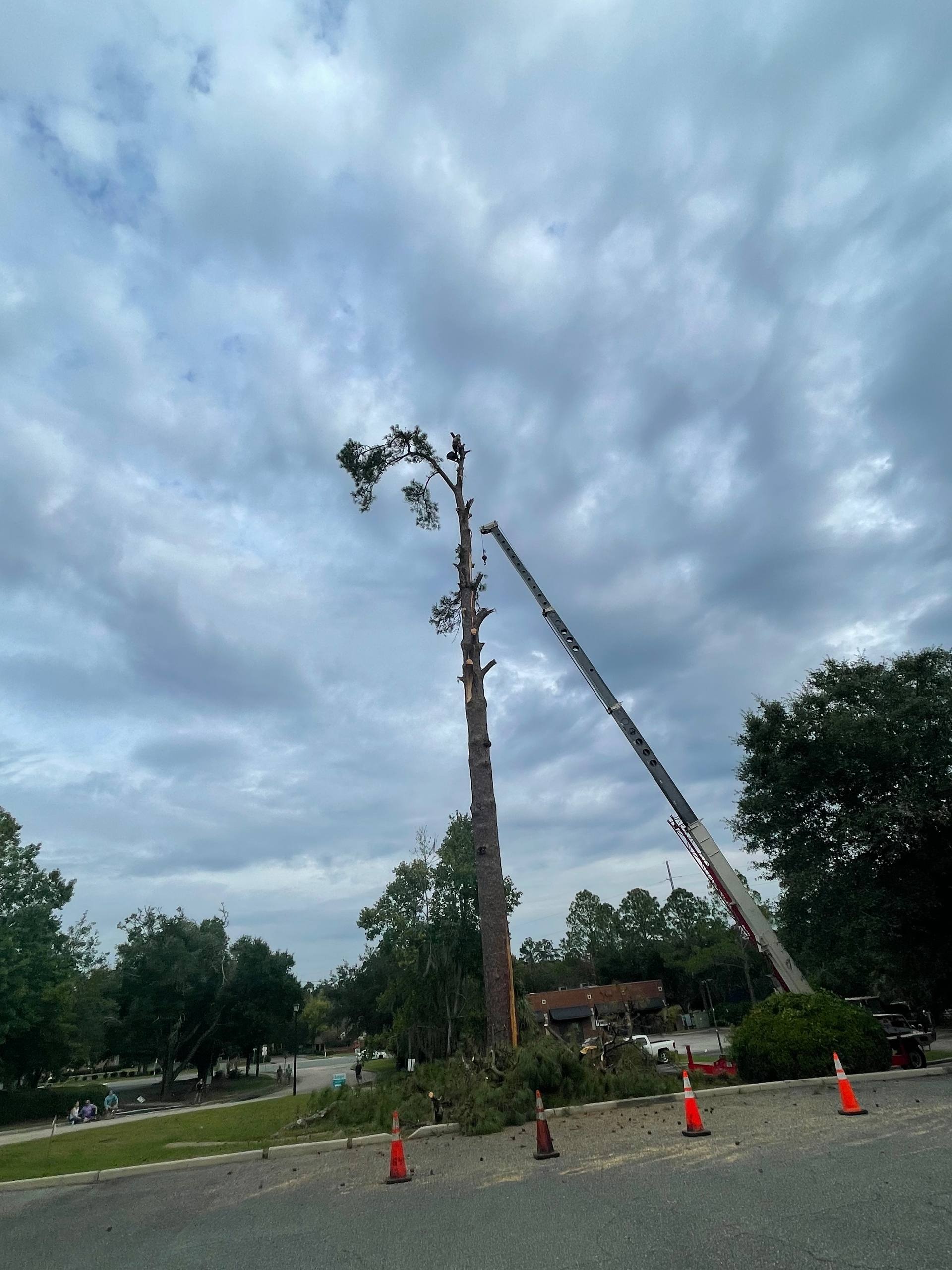
It also leaves you time to plan. A tree near the house or the lines may need climbing and careful rigging, and a big one may need a crane. A protected tree adds permit steps first. Josh can tell you on the call whether a rule applies before any cuts are made, and our live oak permit guide covers the basics.
What Not to Do
Don't push, pull, prop, or cut a leaning tree yourself. UF/IFAS says storm cleanup is extremely dangerous, even for professionals. Stay out from under it, keep kids and pets away, and take your photos from a distance. Our DIY removal guide shows how these jobs go wrong.
If the tree is already on the house, see what to do when a tree falls on your house.
What a Removal Involves
For a leaning tree, Josh looks at what it's leaning on and what could move when a piece comes off. A climber takes the tree down in sections and lowers them on rigging. Stump grinding and cleanup are always extra and quoted on the call, and haul-off is only done on bigger jobs, through a sub he hires. Our removal cost guide covers what sets the price.
Josh handles tree removal across North Florida and South Georgia from his base in Tallahassee.
FAQ
Can a leaning tree straighten itself?
Not a mature one. A tree that leans because of broken or lifted roots won't correct itself.
Is a leaning tree dangerous?
It can be, depending on how new the lean is and what's under it. A new lean toward a house, road, or line is the dangerous case.
Can you fix a leaning tree by staking or cabling it?
Staking works on small or recently planted trees. On a mature tree with a root problem, it isn't a fix. Cabling supports weak forks and heavy limbs, and it doesn't straighten a trunk.
Should I wait for spring to deal with a leaning tree?
Not if it's leaning toward your house, a road, or a power line, or the lean has changed. Those should be looked at now.
Got a tree that's leaning and you're not sure? Call Josh at (850) 888-5603.